


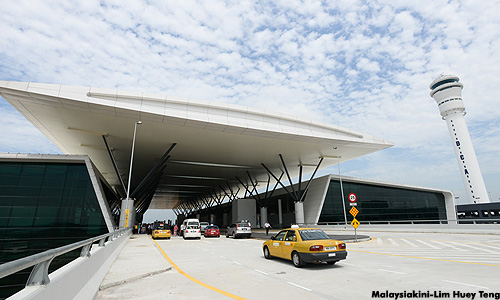

KLIA2 - what’s in a name?
QUESTION TIME When first I stepped into KLIA2, the new RM4 billion terminal, which replaced the RM300 million Low Cost Carrier Terminal (LCCT), sometime in 2014, I was astonished by its size and the numerous shops strewn all along the way to immigration, check-in and beyond.
And I, like thousands before me and millions after me, was maddened by the fact that it took me a good 45 minutes to get to the gates. Considering that the average walking speed for a human being is said to be around 5km per hour, and let’s say I was below average at 4km per hour, that’s a walk of around 3km to board the plane. And there were no walkalators then but there are some now - a lame afterthought.
I completely empathise with AirAsia group CEO Tony Fernandes’ description of KLIA2 as a Frankenstein terminal, although I did not relish the previous process at the LCCT of walking as much as 500m or more in a pouring thunderstorm with a little umbrella for shelter or under a blazing sun with the deafening roar of taxiing AirAsia aeroplanes barely metres away.
But to walk 3km in the spanking new KLIA2, even if it was in air-conditioned comfort, comes as scant improvement, especially when you consider that a massive RM4 billion was poured in as construction costs. That’s over 13 times the RM300 million cost of the previous LCCT, which was, whatever else you may say about it, far more efficient than KLIA2.
To put the cost of construction further in context, the main terminal and airport at KLIA, cost RM10 billion to build in 1998 but that included as well a satellite terminal building, two runways and infrastructure, much of which had to be put up from scratch. KLIA2 was completed in 2014, 16 years later, but with one additional runway. The RM4 billion cost still seems rather expensive...
QUESTION TIME When first I stepped into KLIA2, the new RM4 billion terminal, which replaced the RM300 million Low Cost Carrier Terminal (LCCT), sometime in 2014, I was astonished by its size and the numerous shops strewn all along the way to immigration, check-in and beyond.
And I, like thousands before me and millions after me, was maddened by the fact that it took me a good 45 minutes to get to the gates. Considering that the average walking speed for a human being is said to be around 5km per hour, and let’s say I was below average at 4km per hour, that’s a walk of around 3km to board the plane. And there were no walkalators then but there are some now - a lame afterthought.
I completely empathise with AirAsia group CEO Tony Fernandes’ description of KLIA2 as a Frankenstein terminal, although I did not relish the previous process at the LCCT of walking as much as 500m or more in a pouring thunderstorm with a little umbrella for shelter or under a blazing sun with the deafening roar of taxiing AirAsia aeroplanes barely metres away.
But to walk 3km in the spanking new KLIA2, even if it was in air-conditioned comfort, comes as scant improvement, especially when you consider that a massive RM4 billion was poured in as construction costs. That’s over 13 times the RM300 million cost of the previous LCCT, which was, whatever else you may say about it, far more efficient than KLIA2.
To put the cost of construction further in context, the main terminal and airport at KLIA, cost RM10 billion to build in 1998 but that included as well a satellite terminal building, two runways and infrastructure, much of which had to be put up from scratch. KLIA2 was completed in 2014, 16 years later, but with one additional runway. The RM4 billion cost still seems rather expensive.
We will revisit the issue of costs later, but one would have thought that if you sank RM4 billion into a new LCCT terminal, you would have got much more airport and better facilities for the public instead of that Frankenstein terminal that appears to attach an airport to a shopping mall. It does not look like an airport designed for efficient airport operations at all.
Now to rub salt in the wound, The Edge weekly in a recent report quoted Malaysia Airports Holdings Bhd (MAHB) managing director Badlisham Ghazali as saying that KLIA2 is not a low-cost terminal. He said he did not mind KLIA2 being promoted as a destination for low-cost travel, but insisted that it was not a low-cost terminal.
“If AirAsia wants to rebrand KLIA2 such that when people mention KLIA2, they think of low-cost travel and AirAsia (being the largest tenant there), that’s okay with me. As it is, our aeronautical charges are among the lowest in the region.
“The passenger service charge (PSC) at the KL International Airport (KLIA1) is lower than those at most other major airports in Asia. So, should I also call KLIA (a) low-cost travel (airport) and KLIA2 (a) lowest-cost travel (terminal)?
“But one thing is for sure - it is not a low-cost terminal,” Badlisham was quoted as saying.
Grandiose scheme
It’s difficult to say if Badlisham was trying to be sarcastic and/or cute but still one thing is clear, KLIA2 was built to replace the old LCCT, which everyone knows is a low-cost carrier terminal. And 98 percent of flights out of KLIA2 are low-cost AirAsia flights, with the remaining 2 percent by other low-cost carriers. Considering that KLIA2 handles 100 percent low-cost carriers, it cannot be considered anything other than a low-cost terminal even if it cost a lot to build.
But clearly, it was a low-cost terminal which was built at a rather high cost. There is this website which has a lot of information on KLIA2, but there is no info on who operates it - although one may have suspicions - apart from making clear that it is not by MAHB or anyone else whose services are listed on the website. But it is a great source for anyone who wants quick info on KLIA2, which seems to be accurate and which is far more comprehensive than info available on the official MAHB site.
The site quotes a news article that the final cost of KLIA2 was RM4.5 billion. And it traces the rise in costs from RM1.7 billion in 2007 to over RM4 billion eventually.
Back to the semantics war over what is low cost. According to The Edge article, passengers departing Malaysia’s international airports pay a passenger service charge, or PSC, of RM65 for international flights and RM9 for domestic flights while at KLIA2, the fee is RM32 and RM6 respectively. The average for major Asian airports, not including KLIA1, is RM78.34 per passenger.
Badlisham was also quoted saying that he wanted the gap between the PSC of KLIA2 and other airports closed. He said MAHB had invested RM4 billion in KLIA2, but there had been no corresponding increase in PSC. Fernandes, of course, does not agree.
“The worse comment was that MAHB has invested RM4 billion and so (they) need to raise charges. (MAHB adviser Bashir Ahmad Abdul Majid) promised the cabinet that there was no need to raise charges.
“And why did you build a RM4 billion airport? Our plans to build a new airport at Labu cost RM2 billion. And we projected only RM1 billion for the new LCCT at KLIA. You can't charge passengers for your grandiose schemes,” Fernandes said.
Now we begin to understand what’s in a name. For Badlisham it’s about trying to get an increase in passenger charges, while for Fernandes it’s about keeping the charges low. For the former, it pays to keep ‘low-cost’ out of KLIA2, for the latter there is everything to be gained by branding KLIA2 as a low-cost terminal.
The general public will favour Fernandes, of course, but in this case it will be justifiably so, since low-cost air travel does not need such an expensive terminal. What was MAHB thinking? Or, as in typical Malaysian fashion, were there other “considerations”?
P GUNASEGARAM would like readers to note that “consideration” means “careful thought” sometimes and “payment or reward” at other times. Contact: t.p.guna@gmail.com.


