


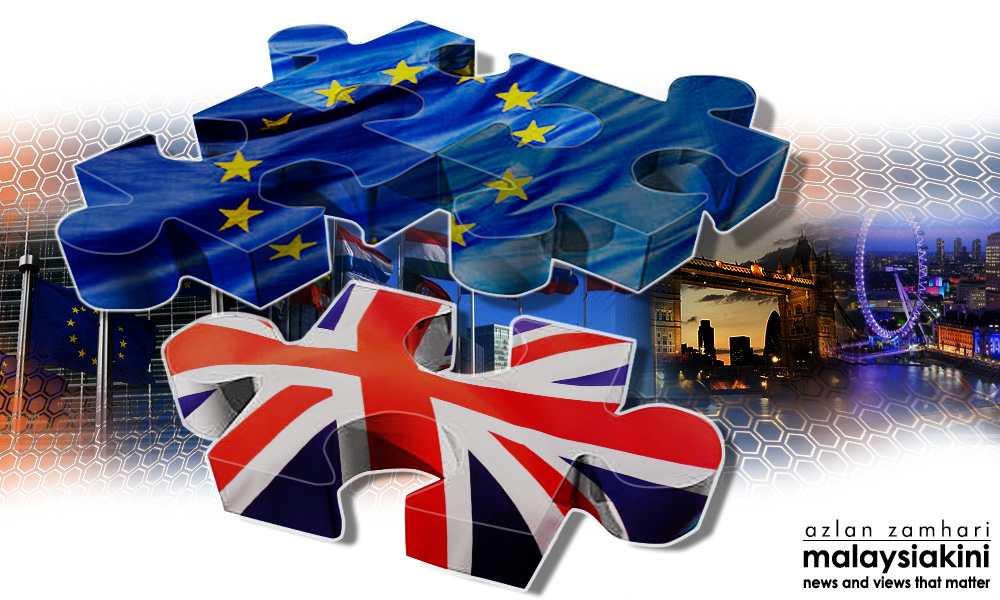

Voting for 'Bremain', a no-brainer?
COMMENT Yesterday, I was among millions who voted in the referendum on whether the United Kingdom should remain in the European Union or leave. This is a subject so momentous that it may well change the destiny of this great nation.
I voted for the UK to "remain" in the EU, or "Bremain" as it is often called. I cast this vote even though I am not a citizen of the UK. However, all Commonwealth citizens residing in the UK are allowed to do so.
Just a day before, a colleague asked me this: "Why are you voting? Shouldn't you be leaving the citizens of UK to make their own choice?"
COMMENT | A M'sian student explains why he voted in UK's referendum yesterday on the European Union.
COMMENT Yesterday, I was among millions who voted in the referendum on whether the United Kingdom should remain in the European Union or leave. This is a subject so momentous that it may well change the destiny of this great nation.
I voted for the UK to "remain" in the EU, or "Bremain" as it is often called. I cast this vote even though I am not a citizen of the UK. However, all Commonwealth citizens residing in the UK are allowed to do so.
Just a day before, a colleague asked me this: "Why are you voting? Shouldn't you be leaving the citizens of UK to make their own choice?"
"But this is a matter that affects not just the UK. It is a global one. Everyone has a stake in this," was my reply. As a global citizen empowered to act through the laws of this country I reside in, I have (voted).
Two interesting points struck me about the referendum which I wanted to share.
First, the enormity of the issue at hand, similar to the Scottish independence vote last year, was such that every single resident of the UK was allowed to voice their opinion. It was not just delegated to a few elected representatives to decide.
Democracy, in its truest sense, is an exercise of the entire population. As is their right. This is what is signified by national referendums on matters of import. This is a valuable lesson to learn indeed from the country that gave us the Westminster form of government.
Facts vs scare tactics
Second, all residents, and not just citizens, were allowed to vote. Everyone who resides in the UK is impacted by decisions made-for-all and thus they are given the right to have a choice in making them.
In an increasingly global world, citizens are no longer those who are born in one country, rather they are those who live and contribute to a country, wherever they are.
However, this seems to be the antithesis of the entire 'Leave EU' campaign. Around Kingsway yesterday, a van with loudspeakers trumpeted, "There will always be an England," exhorting "patriotic English citizens to perform their patriotic duty and vote to leave the EU".
Proponents of the "leave", or "Brexit" campaign, argue that Britain has lost its 'sovereignty' to the EU Parliament and receives a poor deal in terms of needing to pay more to the bloc while being forced to stomach a multitude of regulations.
Also on the cards is the disgruntlement of the Brexit campaigners with free movement of people across the EU. In an almost Trump-esque echo across the Atlantic, immigrants have been blamed for the lack of jobs, worsening economy and even for 'future' terrorist attacks in the UK.
Many of these concerns have been debunked systematically as scare-mongering, however, by both British and international experts. In fact, listening to the experts, the evidence very clearly points towards a UK that will be far worse off both economically, socially and politically if it chooses to exit the EU.
Academics have largely come out in favour of Bremain. Both my schools (the London School of Economics or LSE and the London School of Hygiene and Tropical Medicine or LSHTM), for example, have, like other leading academic institutions, scientifically concluded that the benefits are far larger for the UK to remain IN.
Brotherhood of nations and people
These logical arguments and facts certainly contributed to me supporting a Bremain vote. However, the reason why I actually registered and walked out to a polling station to vote was this.
Despite its various shortcomings and, there are many, the EU remains a truly successful example of the unity that may, one day, be possible amongst the brotherhood of nations and people.
Though the union continues to undergo turbulent times, it has done much to build a common platform for liberal rights, policies of social justice and, above all, bring about equality for within and without its borders. Ironically, most of these policies were championed by Britain itself.
Indeed, the global community has been inspired by the successes of the EU and seek to embrace it, even in our necks of the woods as we embark on the Asean Economic Community (AEC) this year.
As a nation, we would do well to take home some lessons from the referendum. First, as we embark on a closer economic union ala the EU via the AEC, it is crucial to remember that 'its not all about money, money, money..."
Deep roots need to be built among the Asean neighbours, not superficial ties that become frayed as they did last week when tugged on by our large Eastern neighbour.
Like the EU, not all Asean nations are starting off as equal partners. While it is easy to forge a purely economic relationship like the EU, true regional understanding and union will only develop over decades of understanding and trust, built and invested in across peoples and communities. The question remains on whether Malaysia would be willing to take such a lead.
The distrust and dislike of the continent which still remains deeply-rooted amongst some Britons underlies the Brexit campaign. Indeed, it is the isolationism that Brexit espouses that undermines seriously the principle of international unity and solidarity, which is laughable in this era of borderless skies and the information-free universe of cyberspace.
Brave people like Labour MP Jo Cox died this week for these very ideals. Global citizenship. Solidarity. A union of nations, and someday, the dream of a union of a world; of peoples; of equals.
As a global citizen, this is why I cast my vote for Britain to remain in the EU.
DR M MURALLITHARAN is a public health physician. He is currently pursuing a master's degree at the London School of Economics and Political Science and the London School of Hygiene and Tropical Medicine under the Chevening Scholarship programme.
Related reports
Britain votes to leave EU in historic divorce
Sterling, stocks plunge as UK on brink of leaving EU
Cameron to resign, Najib says as democrats, vote must be respected


