


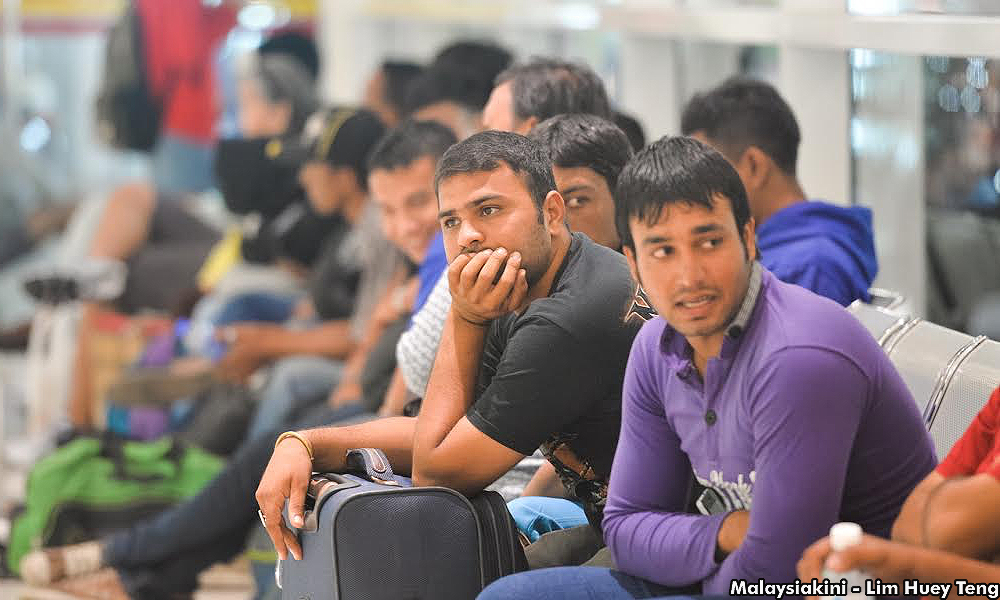

FMM: Malaysia needs consistent policy on foreign labour
Malaysia should formulate a long-term policy on foreign workers and stick to it, said Federation of Malaysian Manufacturers (FMM) president Saw Choo Boon.
He said the government is currently mismanaging its foreign labour by making decisions in an ad hoc matter, and this is hurting businesses.
“It needs a coordinated, holistic and long-term policy on the management of foreign workers, which today is lacking.
Malaysia should formulate a long-term policy on foreign workers and stick to it, said Federation of Malaysian Manufacturers (FMM) president Saw Choo Boon.
He said the government is currently mismanaging its foreign labour by making decisions in an ad hoc matter, and this is hurting businesses.
“It needs a coordinated, holistic and long-term policy on the management of foreign workers, which today is lacking.
“The government’s response to foreign workers today is very ad hoc. Today it makes this decision; tomorrow it makes that decision, it complains… You can’t manage it that way, and it is hurting businesses.
“Businesses, as long as they know in advance what is coming and is stable, they can prepare for it and take action. But if you keep on changing demands, it is very difficult for businesses,” he said.
Saw was speaking at the Global Economic Conference 2016 in Petaling Jaya today, which is organised by Associated Chinese Chambers of Commerce and Industry of Malaysia’s (ACCCIM) think-tank, the Socio-Economic Research Centre (SERC).
Saw, who is a director at SERC, said he has no solutions to this quandary, but said various parties were in talks with the government in hopes of hammering out a deal.
The government had previously wanted to bring in additional migrant labour from Bangladesh, but slapped a moratorium on the import of all migrant labour on Feb 19 this year pending a review of Malaysia’s labour requirements.
https://www.malaysiakini.com/news/330955 ( additional migrant labour)
https://www.malaysiakini.com/news/330985 ( moratorium)
On May 12, Transport Minister Liow Tiong Lai was reported as saying that the moratorium has been lifted, but only for four industrial sectors; namely manufacturing, construction, plantation, and furniture production.
https://www.malaysiakini.com/news/341215 (lifted)
Meanwhile on a related matter, Saw said Malaysia needs to do more to automate its production and move away from its dependence on low-wage workers.
He said some governments had adopted policies to (encourage) their companies to change.
For example, Singapore does not have policies limiting the number of foreign workers in the country, but does make it more expensive for employers who hire more and more workers.
This would make Singaporean companies find ways to boost productivity, he said.
“This model (of depending on low-wage workers) is not sustainable, going forward. Therefore, we either remain as we are and die, or we change and prosper for the next century to come,” he added.
He explained that 4.5 million jobs had been created between 2000 and 2014, but 74 percent of these new jobs are in the low-skilled and mid-skilled category.
At the same time, productivity growth is slowing and wage growth is slower still.
He said Malaysia needs a highly skilled labour force, but while universities have no problems churning out fresh graduates, there is a mismatch between the graduate’s skills and the industry’s demands.
“Industry needs graduates with a technological background.
“The worrying thing is that the percentage of students interested in STEM (science, technology, engineering, and mathematics) is low in Malaysia – between 20 and 30 percent, and is declining,” he said.
As for acquiring new technologies, Saw said it can either be acquired through foreign direct investment (FDI), or home-grown through research and development (R&D) initiatives.
However, he said Malaysia’s FDI is low compared to its rivals, and various programmes to promote R&D in Malaysia are facing challenges in their implementation.


