


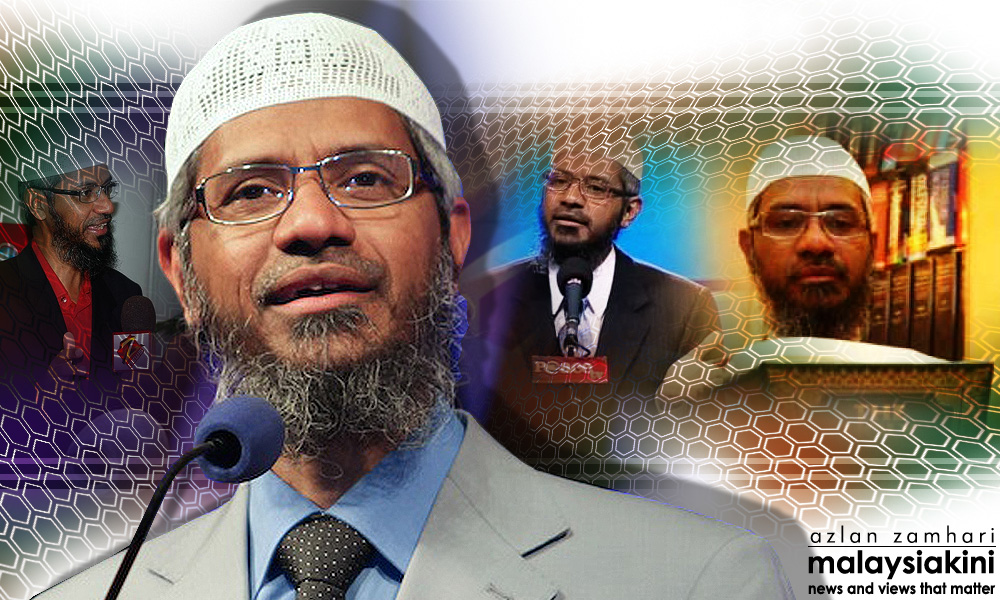

What Dr Zakir Naik should be speaking about...
The topics that Dr Zakir Naik had chosen to speak on are, frankly speaking, irrelevant and counter-productive for Malaysian Muslims.
Instead of lecturing, for example, on whether the Quran is the Word of God - a cornerstone of the Islamic faith - Zakir should be helping those Muslims concerned (i.e. the ones who have been indoctrinated and brainwashed about the political and ideological superiority of Muslims) to think through practical questions relating to their lives as good citizens (and it goes without saying especially in a society that is pluralistic and diverse) such as what is the proper attitude to be adopted towards non-Muslims (kafirs or unbelievers) and their status in a Muslim-majority country (i.e. “how to view non-Muslims from a theological perspective”).
In other words, Zakir’s lectures should aim at making Muslims to be better at living out their religion in relation to non-Muslims. As a counter-factual, we do not want our beloved tanahair to eventually turn into a failed state in terms of nation-building with the knock-on effects on the economic growth and political stability - like Pakistan and Nigeria.
In an age of Islamisation where there is renewed emphasis on sharia law, he should be emphasising on the real nature of Allah who is just, merciful and oft-forgiving as embodied in the Bismillahi so that such divine attributes can in turn be reflected in those Muslims concerned - in state and society.
He should be concerned to be promoting the role of Islam which is the official religion of Malaysia in contributing towards a more peaceful, harmonious and just environment. Indeed, the Bismillahi does not open and end with Allah as the law-giver.
Instead, to recite Bismillahi is precisely to confess and profess in word and deed the compassionate nature of Allah - as epitomised in maqasid sharia (the virtuous principles and purposes of the legal code). The will of Allah therefore cannot reducible to a legal system as the highest expression on earth.
But as the almighty, Allah is above and beyond such laws and wills as He pleases (predestination) and yet preserves His ummah by His power alone. It is ironic that some Muslims like to wrongly accuse Christians of physicalising the nature of God as expressed in the doctrine of Trinity.
But then at the same time, some Muslims physicalise the nature of ummah such that its preservation and expansion comes primarily, if not exclusively, from physical means alone such as coercion to compel someone from apostatising. Zakir should be admonishing these Muslims to reflect on the will of Allah which is almighty and not always transparent and revealed all the time. For otherwise, how can one distinguish between the divine and human will (and ego)?
Furthermore, where is the space for the compassionate nature of Allah - His mercy and grace - to be demonstrated so as to lead to eventual repentance and return to the fold of Islam?
In view of the many abuses of sharia law leading to injustices (such as in the cases of unilateral conversions) and simultaneously encroachment into the religious space of non-Muslims (e.g. the prohibition of the use of the word ‘Allah’ for Christians in the peninsula) that have taken place in Malaysia, it behoves someone of the stature of Zakir to correct the mentality of the religious authorities and Muslims “in general” (at the risk of over-generalisation) here.
He should be reminding the state and society that religious authorities are not infallible (maksum) to the point that their opinions can ossify into fixed and immutable laws (jumud).
Encouraging inter-faith dialogue
And Zakir should be encouraging Muslims to engage in inter-faith dialogue to build bridges and promote better understanding. He should dismiss the idea advocated by the religious authorities that inter-faith dialogue is a threat to the integrity and standing of Islam as the only true religion of Allah and as the official religion of the land.
As he himself has admitted, the oneness of Allah is not unique to Islam alone. In addition to Judaism and Christianity, Hinduism and Sikhism also believe in the oneness of God (‘Supreme Being’). The difference lies in the ‘how’ of the oneness of God is expressed. (Even here it has to be stressed that the Christian difference should not be overly-exaggerated - for there is a similar Triad in Hinduism, too - of Shiva, Brahma and Vishnu).
It is critically important and necessary therefore for Zakir not to caricature the Christian dogma of the Trinity as some Muslims are wont to do due to misunderstanding. The oneness of God in Christianity is secured by the Father Who alone is the source and font of divinity (i.e. not by an abstraction, impersonal ‘essence’ or ‘substance’ - ‘thing-ness’).
This is why God the Son is the Only-Begotten One of the Father and the Holy Spirit is the One Who eternally proceeds from the Father. The equality therefore is sameness of the divine essence or nature which is the Father’s.
In other words, the Trinity is a Family. Therefore, in the Trinity, the one is not opposed to many, singularity is not opposed to multiplicity, and sameness is not opposed to difference. The first key is that the oneness and threeness of God is not a mathematical one and three so that both share the same logical status with other numbers - that which can be conceptualised by reason alone.
The divine ‘one’ and ‘three’ has no direct equivalence with creation; and is eternal, uncreated and transcendent (i.e. beyond and above creation) and can only be known in revelation.
The other key distinction is between person and nature. Here again there is no direct equivalence (‘univocity’) but analogy - not of ‘being’ but of ‘relations’ (compare with the molecular structure of a DNA - as the basic genetic form of life - and how the double strands are bound together as one within the nucleus cell, i.e. the three inseparable components).
We are all children of Adam
Just as the human nature does not exists apart from the human person who embodies and concretely expresses it in a unique, unrepeatable and singular manner, likewise each of the divine Person is unique and different from the other although sharing in the same divine essence wholly, entirely and indivisibly. We are related to each other not because we share the same abstract general humanity but are all children of Adam.
This means that the Christian doctrine of the Trinity does not appeal to reason but conviction borne out of a divine-human encounter in the proclamation of the gospel in word and sacraments: The preaching of the gospel which is embodied in the voice of the preacher and visibly enacted in baptism and the Lord’s Supper.
In other words, the doctrine of the Christian God is inseparable from the Christian doctrine of humanity (trust in the Creator = Saviour as the core of what it means to be human). The one mutually reveals and discloses the other. (Like in Hinduism, the divine is embodied by the human - that is, the humanisation of God and not the deification of the human).
Zakir should also be advocating the distinction between aqidah (belief as embodied in the shahadah) and wadah (life and witness - practice) as the only best way to promote and testify for Islam in this old, passing creation. This is paralleled by the distinction (neither confusion nor separation) between religion and politics.
The great Reformer, Dr Martin Luther who ignited the 16th century Protestant Reformation turned Christendom inside out precisely because of his rediscovery of the distinction between ‘that which belongs to God’ and ‘that which belongs to Caesar’. This means that no longer was the church bound to fanatically advance the cause of religion by temporal means save in the name of natural law, namely common good and preservation.
Not forgetting to that Zakir should be explaining why the ideology of IS is un-Islamic although it has captivated and captured the minds of not quite a few Muslims in this region, including Malaysia. He should be saying that the proponents of IS ideology are indeed playing God. This is syirik and idolatry.
He should be exhorting Muslims in general to be more at ease and secure in Islam rather than adopting a siege mentality and victimhood - accusing the other of Islamophobia - when the root cause lies with the thinking and action of certain Muslims themselves.
Zakir should be teaching and exhorting Malaysian Malay-Muslims to be better persons in their respective vocations and calling in this life - a better spouse, a better teacher (is he aware of the incident at Sekolah Menengah Bandar Tasek Mutiara, Penang that took place only recently?), a better employee in the private sector, a better policeman, a better civil servant, a better politician and even a better driver or motorcyclist.
In short, Zakir should focus his mind and effort towards moulding and shaping Muslims to be a better human being in this world.
Where are these much needed counsel and imperative?


