


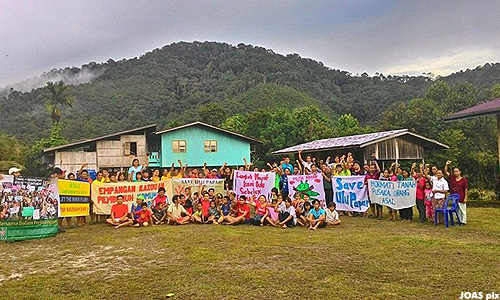

Blockade to save Sabah paradise on the cards
Sabahan Nousi Guin has not been sleeping well since February 2008.
That was when he found out that the state government had granted approval for authorities to carry out feasibility studies and submit technical proposals for the implementation of the Kaiduan Dam project in his lush hamlet of tranquillity, Ulu Papar.
Dams, as we know them, are man-made monstrosities of gushing water – with the larger ones towering between 13 and 230 metres high – long promoted as a source of hydro power generation and water supply.
Sabahan Nousi Guin has not been sleeping well since February 2008.
That was when he found out that the state government had granted approval for authorities to carry out feasibility studies and submit technical proposals for the implementation of the Kaiduan Dam project in his lush hamlet of tranquillity, Ulu Papar.
Dams, as we know them, are man-made monstrosities of gushing water – with the larger ones towering between 13 and 230 metres high – long promoted as a source of hydro power generation and water supply.
According to a The Rakyat Post report in March, 2015, an estimated 2,000 indigenous Kadazandusun people will lose their homes, livelihood and heritage, should the Kaiduan Dam be constructed.
Nousi vowed he would not stay idle as the Kaiduan Dam project loomed ever closer.
Today he leads a movement, the Task Force Against Kaiduan Dam (Takad).
Takad recently announced that the authorities must consult and gain the permission of impacted Ulu Papar villages before researchers are allowed to carry out a Social Impact Assessment (SIA) for the proposed Kaiduan Dam.
If the villagers decide that they do not wish to allow researchers from the Institute for Development Studies (IDS) Sabah to visit them, they will form a blockade to keep them out.
At last week’s briefing organised by the Sabah Water Department, Takad informed an IDS representative that the movement could not speak for communities and needed to hold discussions with them.
Public forum
Then, Penampang district officer Luvita Koisun had announced IDS was going to enter Ulu Papar this month to start the SIA process, while the Sabah Water Department had shared its plans to hold a session at Kampung Terian and Kampung Buayan next month.
“Communities will make a decision whether to allow researchers in. It is not for us, IDS or the Sabah Water Department to make this choice. If they say yes, then researchers will be allowed in and if they say no, the parties in this matter must respect that choice.
“We understand that villagers will hold a blockade if they say no and their wishes are not respected,” Nousi said in a statement in response to the recent Kota Kinabalu Water Supply Phase Three (Kaiduan) briefing.
Nousi also called for the establishment of a public forum that involves the impacted villagers to ask questions and voice concerns regarding the project.
“We disagree with Sabah Water Department deputy director Teo Chee Kong’s statement that a public forum can only be held after the social and environmental impact studies.
“Based on the briefing, it was clear to us that there are still many matters that must be addressed before any impact study can be undertaken,” he added.
Nousi also mentioned that the survey form for one study focuses mainly on the issue of compensation, instead of more important matters.
He reiterated Takad’s stand that a comprehensive study is needed on alternative water supply for the Sabah west coast’s long-term needs.
“Takad wishes to state that the alternative of an off-river intake such as the one at the Telibong water treatment plant is the best option. It’s efficient, cost-effective, easy to manage and will not destroy the river system (unlike a dam),” the Takad chairman added.
Rich heritage
Nousi also said that some community representatives who were present at the briefing were offended by a video that promotes the Kaiduan Dam by saying it would bring the villagers benefits in terms of tourism, culture preservation and reforestation efforts.
“Ulu Papar is already a tourism destination due to its natural environment and rich heritage.
“Culture can only remain alive if there are people there to practise and protect it. A dam will displace communities, forcing them out of their homes,” he added.
For the time being, Nousi’s hamlet of tranquillity remains untouched by mankind’s zeal for pulverising development.
With heroes like Takad persevering against the establishment, Ulu Papar natives can continue to harbour hopes to safeguard their paradise and way of life.


