



Syed Husin Ali won't label himself a leftist
INTERVIEW It was 3.01pm when I walked into the room for an interview with Syed Husin Ali to find him already seated and waiting for the journalist who was less than two minutes behind in his appointment.
"Where have you been? I am very particular about time," it was the first thing he said.
The interview looked like it had started off on the wrong foot but a journalist should not be so easily scuppered.
I reminded myself that a typical old left is strict about time and schedule.
INTERVIEW It was 3.01pm when I walked into the room for an interview with Syed Husin Ali to find him already seated and waiting for the journalist who was less than two minutes behind in his appointment.
"Where have you been? I am very particular about time," it was the first thing he said.
The interview looked like it had started off on the wrong foot but a journalist should not be so easily scuppered.
I reminded myself that a typical old left is strict about time and schedule.
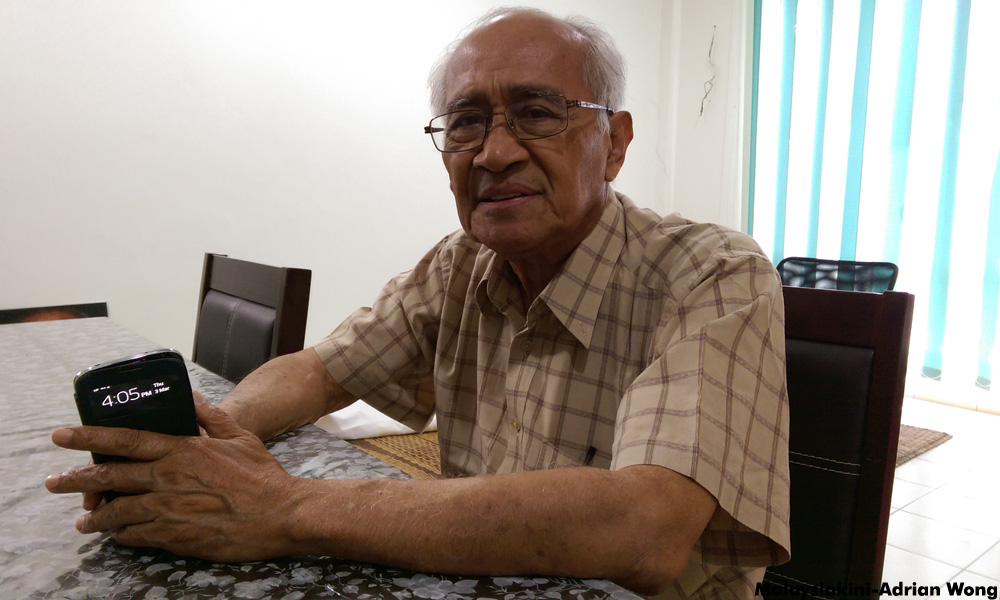
Syed was sitting behind a desk in front of me in a room used by the People’s History Centre - a small outfit that he helped found - at the office of local publishing house Gerak Budaya.
He was wearing a beige-coloured plaid shirt and had a pair of slippers on. He looked like a no-frills bespectacled Malay uncle who moved into the surrounding Petaling Jaya neighbourhood with his young family a half century ago. (But if you paused to observe closely, you may catch a glimpse of this uncle’s steely reserves.)
One could hardly imagine this slightly built octogenarian once led protests to show solidarity with peasants and urban pioneers, suffering six years behind bars under the Internal Security Act, Malaysia’s detention without trial law.
Nor would one think he was once a president of a small political party fighting against the BN juggernaut for years.
I don't believe in labels
Syed was also an author of a number of books - including ‘Ethnic Relations in Malaysia: Harmony & Conflict’, ‘Two Faces: Detention Without Trial’, ‘The Malays: Their Problems and Future’, ‘The Malay Rulers: Regression and Reform’.
He was, as well, a teacher to students from both political divides, including former opposition leader Anwar Ibrahim, veteran activist Hishamuddin Rais, former minister Rafidah Aziz, and minister Ahmad Shabery Cheek.
This man - scholar, writer, and politician - has been practicing what Karl Marx has preached: ‘The philosophers have only interpreted the world in various ways. The point, however, is to change it.’
In December last year, Syed retired from being a senator appointed by the Selangor government after his two terms ended. But he still plays various roles - as Usman Awang Foundation chairperson, People's History Centre chairperson, PKR political bureau member, as well as a grandfather, father, and until his wife’s death not that long ago, a husband.
Roles may have changed, but his routine remains. His daily schedule is as usual: Morning focus is on writing, afternoon is spent meeting friends, while night time is for staying at home reading and playing with his grandchildren.
The brief one-hour interview with Syed was held earlier this month, during which he shared his views with Malaysiakini on various issues, ranging from current affairs, to the prospect of left ideology, to his use of technology.
He spoke English in a crisp Malay accent and each time he paused, the phrase " Apa ni ……" would tumble out.
As for the inevitable interview question, Syed tackled it with much gusto.
Q: Can we call you...old left? Leftist?
A: I don't believe in brands. I believe my struggle is for the people, if the struggle is called leftist, socialist. When you start having brands, it's easy for your enemy to destroy you. You claim to be this, claim to be that. Don't call me anything, call me by my name - saudara Syed Husin.
Born in era of red flags
Be that as it may, Syed's lifelong struggle is intertwined with the left ideology.
In 1936, Syed was born in a small kampung in Batu Pahat. As a young boy, he lived under British rule and witnessed the Japanese invasion of Malaya and the return of the colonial master. In 1956, the year before Malaya’s independence, he went to Singapore and studied at University of Malaya.
It was an era where red flags waved freely in the skies.
As people were heatedly debating about nation-building, Syed was busy with extracurricular activities on campus and made new friends who are leftists, names that grace our history bookshelves, such as Poh Soo Kai, Lim Chin Siong, Abdullah Majid, M K Rajakumar, and Kassim Ahmad.
Chia Thye Poh, who was the longest detainee in Asia, was his deputy at a student organisation.
It was also an era where genius came in groups. Back then, Malay daily Utusan Melayu headquarters was still in Singapore. A lot of talented writers were based in Singapore. Through movements like Asas 50, Syed became friends with literary giants like Usman Awang, A Samad Said, Abdul Samad Ismail, and Kamaluddin Muhamad.
Coincidentally, he also got to know luminaries such as Ahmad Boestamam, Burhanuddin al-Helmy, and Ishak Haji Muhammad, which provided him a glimpse into how anti-colonial fighters work.
These experiences had a great significance on Syed. ‘Malay Peasant Society and Leadership’, his doctoral thesis, indicated that peasant, minority, ethnic relationship, social justice, leftism have always been in his mind.
Asking since childhood
As mentioned in his memoir ‘Two Faces’, the journey in quest of the answer for "what is a socialist" seems to have begun early in his childhood.
"One evening, I returned home from religious school and Tuk and Wak (his father) were sitting across the table in the middle of the house. They seemed to be very deep in conversation. Suddenly Tuk turned to me and asked, “Husin, what is a socialist?” I was stunned for a while because I did not know the answer.
"……Tuk's question had two effects on me. First, it made me very curious to know what a ‘socialist’ really was……In fact, only after entering the university and interacting with some personalities inside and outside the university, attending talks and discussions, and having a chance to read certain books, that I began to really understand the significance of these political concepts," read the memoir.
Later, Syed started teaching and researching at the University of Malaya, but unlike others, he did not hide behind the ivory towers of academia.
Instead, he was one of the contributors who helped found Universiti Kebangsaaan Malaysia. He also joined Parti Rakyat Malaysia (PRM) and got involved in politics; and participated in forums and promoted human rights.
Among others, the most well-known event, perhaps, was Syed joining student protests in solidarity with marginalised groups, eventually ending up in jail.
In 1974, the student movement was at its heyday. Being a teacher, Syed took part in protests with students to uphold justice for the struggles of Baling peasants and Tasik Utara's homeless. Abdul Razak Hussein’s government was frustrated.
Then education minister Dr Mahathir Mohamad arrested a large number of students and professors under the Internal Security Act. Syed was one of the victims. He was jailed for six years, and once shared the same cell with his student Anwar, who is now back behind bars.
Nothing to do but write
What was most torturous about being in jail was having nothing to do and succumbing to feelings of emptiness.
Once, Syed was thrown into solitary confinement for six months. As he exercised in the small cell to maintain his physical health, he was pondering what to do to kill time:
"So, I thought of what to write. I came out with an idea of writing on Malay problems. I went through my mind what I wanted to write, until I cleared my mind - what are the chapters, even what are the pages - in my mind."
"When I was sent back to my camp, I still was not mixed with others. I was separated in a different cell but they (the prison authorities) got me a typewriter and papers, and my wife brought a carload of books for my reference.
"Then, I started writing. I finished my books in twelve days," he said, with a sense of achievement revealed on his face. There was no doubt that his steely reserves would ever fail him, even in prison and separated from his family.
This book is titled ‘The Malays: Their Problems and Future’, one of his academic masterpieces.
TOMORROW: Who’s the bigger enemy, mulls Syed Husin


