


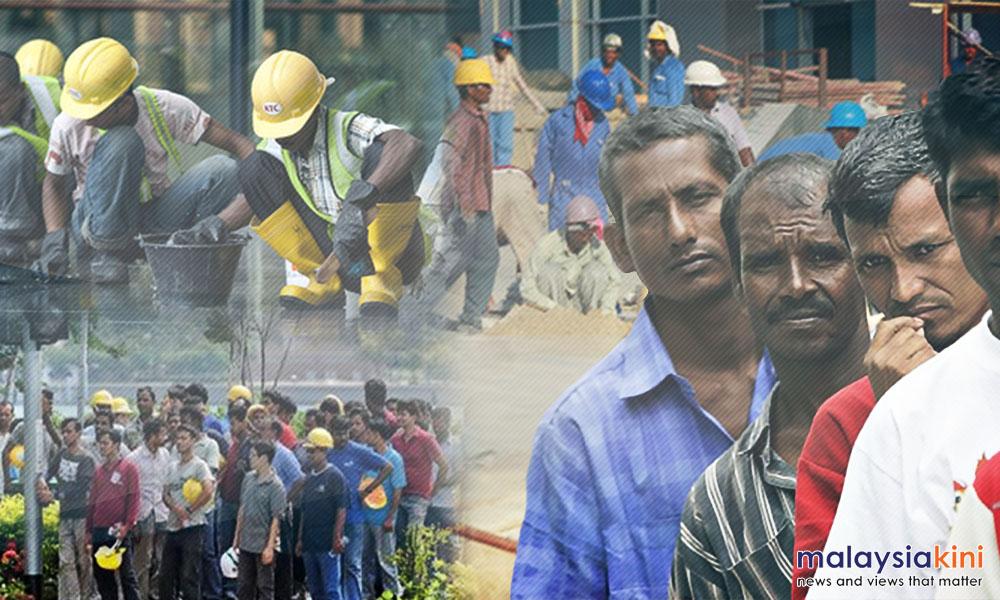

One Bangladeshi in 1.5 million
The news about the planned 1.5 million Bangladeshi workers brought with it the same panicked, xenophobic responses: the “Banglasia” invasion, the impending crimes of robbery and rape, the phantom voters conspiracy.
Some people thought this was new, or that the racism against Bangladeshis has somehow become worse in the last few days compared to before.
To me, it was business as usual.
The news about the planned 1.5 million Bangladeshi workers brought with it the same panicked, xenophobic responses: the “Banglasia” invasion, the impending crimes of robbery and rape, the phantom voters conspiracy.
Some people thought this was new, or that the racism against Bangladeshis has somehow become worse in the last few days compared to before.
To me, it was business as usual.
I’ve told this story many times before, with every new spike of anti-Bangladeshi sentiment: being born and raised in Johor Baru by migrant Bangladeshi parents, a school system that kept trying to kick me out on the guise of ‘visas’ but really because they could not deal with a high-performing ‘lain-lain’ (others), and the byzantine citizenship process.
It’s become such a well-rehearsed performance that sometimes I get bored of my own story.
And yet, somehow, it still surprises people. Just a few days ago a friend from secondary school - who’s known me for nearly 15 years now - said that she was surprised to learn that I was Bangladeshi: “I’ve always seen you as Malaysian.”
She extended a gesture that is at once sweet and sad: she sees me as Malaysian first, more than most people would, yet she does not see me as Bangladeshi because I’m not like those “Banglas” that spark these moral panics. I’m different. I’m an outlier.
And indeed, I am very much an outlier. My father was one of a group of engineers and doctors specially invited to work in Malaysia in the 1970s and eventually led a property-development company; he would have been the boss of the people who hired the companies that recruited Bangladeshi construction workers.
We had enough money to mitigate the effects of opportunities denied due to our race, for my sister and I to find better lives elsewhere, to live and thrive wherever we are.
My family does send money to relatives in need overseas, but it’s not quite the same hardship as it would be for a labourer.
In so many ways, my family’s class privilege insulated us from the worst consequences of being from such a vilified country. But it couldn’t protect us from everything.
It could not protect me from the years of torment at my supposedly “premier” national schools, where teachers told their students to “not let the Bangla kid do better than you” and didn’t care that their constant harassment drove an 11-year-old to attempted suicide.
It could not protect us from the headaches of applying for Malaysian citizenship, over 12 years after an equally-fraught permanent residency process, where an interviewer told me that my most important responsibility as a new citizen was to “vote for the ruling party”.
And where my parents were first denied because their Bahasa Malaysia language essay was a few words too short and because they falsely-claimed that I was never a permanent resident to start with - you can’t appeal, you can’t tell them they’re flat out wrong, you had to apply all over again.
It could not protect me from being unable to register as a voter in what may have been my first general election ever in 2013 (I was studying overseas at the time and didn’t realise that I could only register in the country).
Nor could I avoid the disappointment of learning that PKR had based their entire campaign around claiming that people like me were “phantom voters” for BN, and urging their followers to force anyone in the voting queue who “looked like a Bangladeshi” to sing the Negaraku.
Because Malaysian citizens of Bangladeshi descent apparently cannot exist.
Look, suppose PKR was right and BN is hiring non-citizen Bangladeshis and other migrant labour en masse to vote for them fraudulently. Do you seriously think these voters want BN to be in power?
Has it not occurred to you that they’re being exploited, that they’re likely hired under duress, already vulnerable because of maltreatment against migrant labour?
That if their living and working situations were better, they would not feel forced to take unethical jobs?
These attitudes cut across many of us ‘lain-lain’ and migrants, labourer or not. They affect our ability to get jobs, especially when many employers want ‘X-race only’ or assume that our English and BM skills are sub-par.
They interfere with our ability to navigate the immigration system. They get in the way of a good education, of a beautiful childhood, of friends and community.
Criminals, or victims?
And if I - with my relative advantages - still have difficulty, just imagine how it would be like for the labourers you demean so much.
The agent fees and visa fees cutting into their income. The distrust they face because everyone thinks they’re a criminal, rather than a victim.
The false promises they were made of “a Muslim brotherhood” - only to arrive in Malaysia and discover that no one wants them here.
But it doesn’t have to be this way.
It was heartening to see people be more open to supporting Bangladeshis in the wake of the 1.5 million workers controversy - more than I have ever heard in the last 30 years.
But this can’t just stop at heartfelt comics about a worker calling his wife ‘panchi’ on the phone, or promises to not write ‘Banglas’ in news reports.
Stop the hate. Bangladeshis are humans too! Panchi means free bird in Bengali and is a name used for females in Bangladesh. #PanchiLove
Posted by Sukhbir Cheema on Tuesday, February 16, 2016
You need to actually reach out to Bangladeshis in our shared community, you need to highlight our stories, you need to give us the platform to speak honestly - and you need to listen.
If you talked to us Bangladeshis, really get to know what our lives are like, why we are here, and how we are coping, you could learn a lot about our situation and find ways to help us survive.
You could protect us from feeling the need to take on exploitative work. You could work with us to create positive change, not just for Bangladeshi labourers, but for other migrant workers, for other immigrants, for Malaysians overall.
You have a head start: you’re listening to me. But don’t just listen to me, the outlier.
Listen to the millions that are already here, trying to eke a living in a hostile world. We can make this world less hostile for them, for us - so let’s work together.
CREATRIX TIARA is passionate about liminality, inclusivity, and intersectionality, especially in arts, media, tech, education, and activism. Her philosophy is to ‘sign up for anything that looks interesting’, and is currently open to opportunities in Malaysia, Australia, and elsewhere. Visit her at creatrixtiara.com


