



Transforming the sidewalks for Chow Kit’s poor
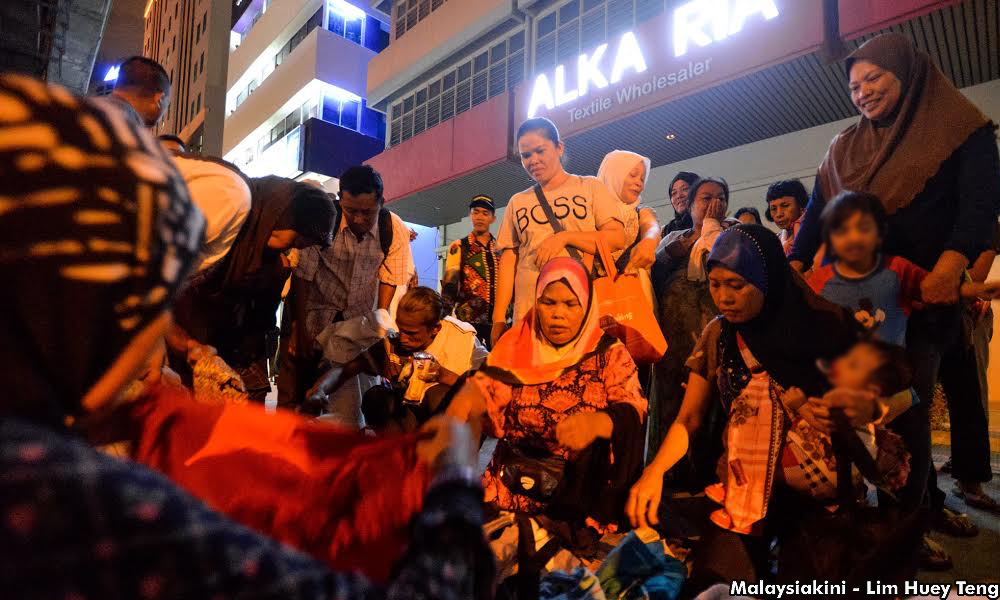
FEATURE When night falls and workers at Alka Ria store on Jalan Tuanku Abdul Rahman pull down its shutters, scores of mothers converge on the sidewalk in front of the textile shop.
One of them is Nori, whose real name is Norisumaliza.
Like the rest, Nori, 33, has brought her children along. They sit together on plastic mats on the walkway, waiting for non-government organisations (NGOs) or charity groups to arrive to distribute food.
FEATURE When night falls and workers at Alka Ria store on Jalan Tuanku Abdul Rahman pull down its shutters, scores of mothers converge on the sidewalk in front of the textile shop.
One of them is Nori, whose real name is Norisumaliza.
Like the rest, Nori, 33, has brought her children along. They sit together on plastic mats on the walkway, waiting for non-government organisations (NGOs) or charity groups to arrive to distribute food.
It happens to be a Sunday night. This means Nori’s children will be joining the makeshift tuition class held by activist Benz Ali and his friends in the alley behind the shop.
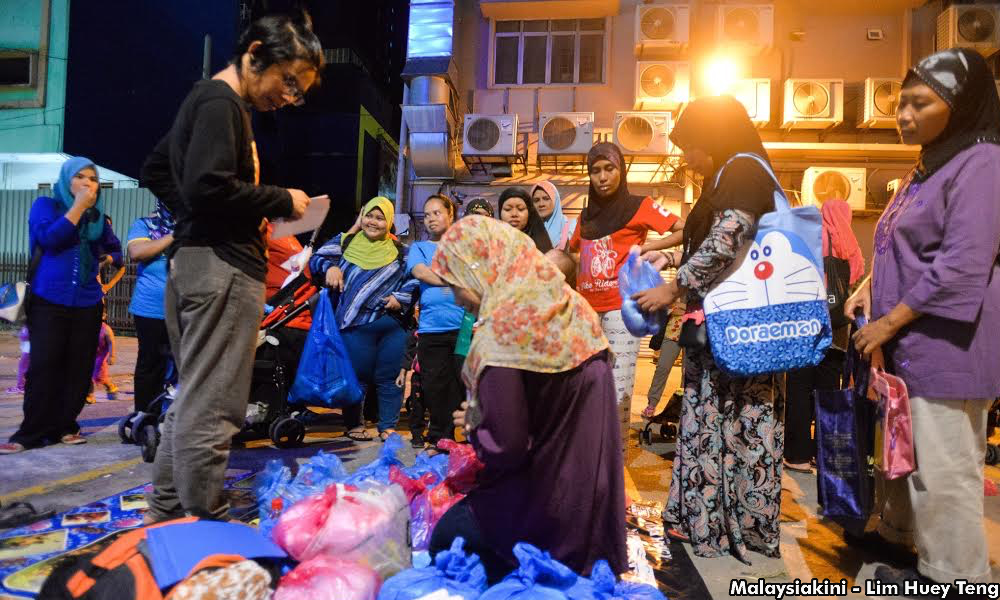 A minute later, Nori stands up and walks over with a few others to Medan Tuanku - approximately 400 metres away - to pick up nasi lemak being distributed by a charity group.
Every night, many NGOs and charities distribute food or essential items on the sidewalk of Alka Ria. Adults and children congregate at 9pm sharp, waiting for the free distribution.
The adults and children who queue up to receive aid are neither vagrant nor homeless - they are the urban poor who live around the Chow Kit area.
Their monthly income - whether they be local or migrant families - ranges from RM1,000 to RM1,500.
Most of the women, like Nori, are mothers who bring their children along with them.
Nori and her five kids stay at a wooden house not far from the textile shop.
For her and others, trying to find a steady income enough to live by in Kuala Lumpur is difficult. That is why they depend on the assistance - in food and kind - to help support themselves.
Flash mob distribution helpful?
At 9.15pm, several young women and men can be seen ferrying supplies of buns and mineral water to be distributed to the poor mothers. Upon seeing this, the mothers line up and within minutes, all the food is gone, handed out to them.
Later, the young men and women take out some clothes and footwear and the mothers lined up again but by that time, the youths had already left, leaving behind clothes and footwear on the floor.
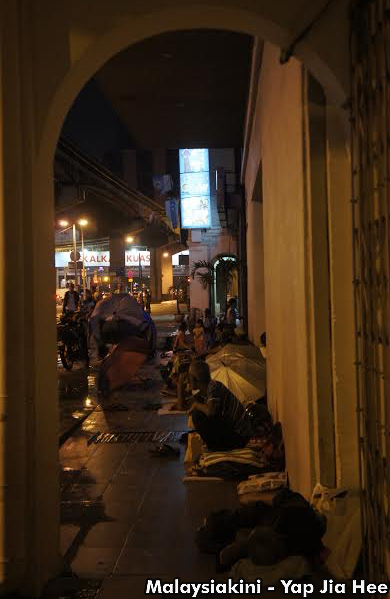 Seeing this, one of the mothers volunteers as the ‘distributor’. She arranges the clothes and shoes neatly, asking if any of them need the items.
Such a scene is common late at night in Chow Kit. Several NGOs arrive to perform ‘flash mob’ charity, distributing food, shoes, or clothes. A few literally drop their stuff on the kerb and leave.
Benz, one of the founders of ‘ Buku Jalanan Chow Kit ’ questions whether such aid truly helps or is just a temporary solution.
The earnest bespectacled 28-year-old has done his homework. From conversations with the mothers, he finds out that they need baby diapers, milk formula, and other supplies.
Benz decided to help, but in a different way - he has to somehow ‘walk in their shoes’.
To truly live the idea of ‘community service’, he relocated to the area, renting a small room at a four-storey shophouse on Jalan Chow Kit Kiri.
“My view is this: if you want to change the situation in a particular location, you cannot stay far from the area. You have to immerse yourself in that location, then only will your actions be effective.
“Can a person transform Chow Kit if, say, he lives in Bangi? Why not go to Kajang, then? There are more poor people in Kajang and Semenyih (than in Chow Kit).”
Building trust, sincerity
Among Benz’s first tasks after moving to Chow Kit is to gather data from the poor mothers who live in the area in order to identify their needs.
“Sometimes, when you give baby diapers or school shoes, these things may not be beneficial to someone who does not have children. The person who obtains it may sell them off for some cash.
Benz and his band of activists decided to try something different. They repackage rice that is to be handed out in bags of 1.5kg each, in the hope that the food supplies will not be sold off.
He started distributing goods to the poor families four months after he opened up the street tuition. The activity is done together with the tuition class, on Sunday nights.
Besides chatting with the mothers, Benz also visits their houses to get to know or observe how they live. To date, he says he has already gathered data from about 60 to 70 families.
When it comes to the distribution, Benz innovates. He divides the mothers into two groups - A and B - and only gives each person one 1.5 kg rice pack and one can of sardines.
“This week is group A’s turn and next week, group B’s. With this, every month, each mother would get three kilos of rice and two cans of sardines,” he said, adding this is one way to foster trust and discourage them from being too reliant on aid.
He said the contributions come from the public through an unregistered NGO, Institut Memali, managed by him. Among the regular contributors are Hafiz, Izzah and Toh.
On tuition nights, when the class is halfway through, Benz halts the lesson, takes out a notebook, calls the names of recipients, and hands them rations. That night was group A’s turn.
Just before Benz darts off to the back lanes to wrap up the distribution, a few cars arrive and some youths step out to distribute more goods. It is the fourth batch of aid to reach the urban poor in that area that night.
According to Benz, the mothers used to quarrel between them over whose turn it was to collect the rice and sardines.
But over time, attitudes change. One day, a mother told him, “Cikgu Benz, we don’t need diapers because we don’t have children; we just need rice.”
In another instance, one mother, when her name was called out, said, "Last week, I already took my share."
Lessons on self-reliance
For Benz, this is an opportunity for the community to experience trust and sincerity.
“It can be done. It just needs time and is something that must come naturally," said Benz.
Benz and his friends are no stranger to the concept of “giving them fish” and “teaching them how to fish”.
His vision is that by next year, he will have set up an operation centre so that the mothers could have a go at job opportunities, such as grinding coffee.
“The income from selling coffee can then be used to pay for their needs. This is among the plans that we have for them so they will understand that they cannot rely on help from others forever,” said Benz.
It has even crossed his mind that if only someone would allocate a plot of land, the urban poor can use it for planting, smack in the middle of the city.
Since moving into the area, Benz has vowed to stay put in Chow Kit for the next 10 years in a bid to help the urban poor.
Ending the vicious cycle
"Have you ever seen anyone finish paying off their debts to ‘ah long’? Benz asks.
He is referring to many among the poor who are caught in the cycle of debt with moneylenders, whether licensed or not.
Benz says sooner or later, a debtor family would feel they are at their wits’ end and take the easy - and dangerous - way out.
“Perhaps their son will solve the problem by killing the Ah Long... The only thing that we can do is help remove them from such a cycle," said Benz.
It can be said that every poor mother who sits on the sidewalk of Alka Ria has her own set of problems (and dreams).
Some of them, as told by Benz, have debts with loan sharks; others do not have a place they can call home.
The migrant mother who marries a local worries if their children will not be able to attend school without a birth certificate.
Nori, who hails from Pahang, is one of those who do not make enough to live in a house of her own.
She lives in part of a wooden house owned by an elderly guy called Pak Man. Nori met Pak Man at the sidewalk in front of Alka Ria, while waiting for food donations to arrive.
Nori’s husband works at a restaurant in Petaling Jaya, bringing in a monthly income of RM900. Due to economic constraints, she can only afford to send her children to Sekolah Bimbingan Jalinan Kasih, which offers free education.
When I follow Benz on a visit to Nori’s dwelling, she confides that she hopes to be able to afford her own place one day.
Looking at the situation she is in, it is hard for her to imagine ever reaching that dream.
For now, Nori is happy just to be at the sidewalk in front of Alka Ria every night because besides collecting aid, she also gets to catch up with her friends.
Sidewalks belong to poor
Nor Noraida, 41, is an Indonesian migrant who married a local man. She lives with her husband in a small room at the Selayang Flats; their rental is RM400 a month.
Their family income is not as dire as Nori’s because Noraida’s husband is a security guard and brings in about RM2,300 a month.
But what comes in one hand goes out the other, just as fast. Every month, RM1,000 goes to settle a debt with the loan sharks.
“My husband is a guarantor for a friend and owes them RM15,000," Noraida explains.
Her visits to Alka Ria to pick up food donations and other items are also to alleviate her husband’s economic burden.
Noraida has made a vow: the day they pay off all their debts is the day she stops queuing up to receive aid.
“The sidewalk belongs to the poor,” she says. “Only those who are really poor can go there to get help”.
Readers who would like to make contributions to the poor children or mothers of Chow Kit can contact or follow Facebook page Buku Jalanan Chow Kit or Benz Ali's Facebook page .
Yesterday: In search of knowledge in the back alleys of Chow Kit


