




Don rides train from India to Vietnam to defend 1MDB deal
An academic has defended the deal involving 1MDB and China Railway Engineering Corporation (CREC).
Responding to its critics, Universiti Teknologi Mara's Prof Ismail Sualman cited analogies of a Malaysian company investing in Vietnam and the construction of railroads in India.
"Just say if YTL invested in another country, for example Vietnam. Surely, this would involve the sale of shares and so forth.
"Would this mean Vietnam is selling its national asset by accepting an investment from a Malaysian company?
"Similarly, if we do a railroad project, for example in India. Does this mean India is selling its national asset to us? Of course not.
"The same goes for what the (Malaysian) government is doing with regard to Bandar Malaysia," he told Umno Online .
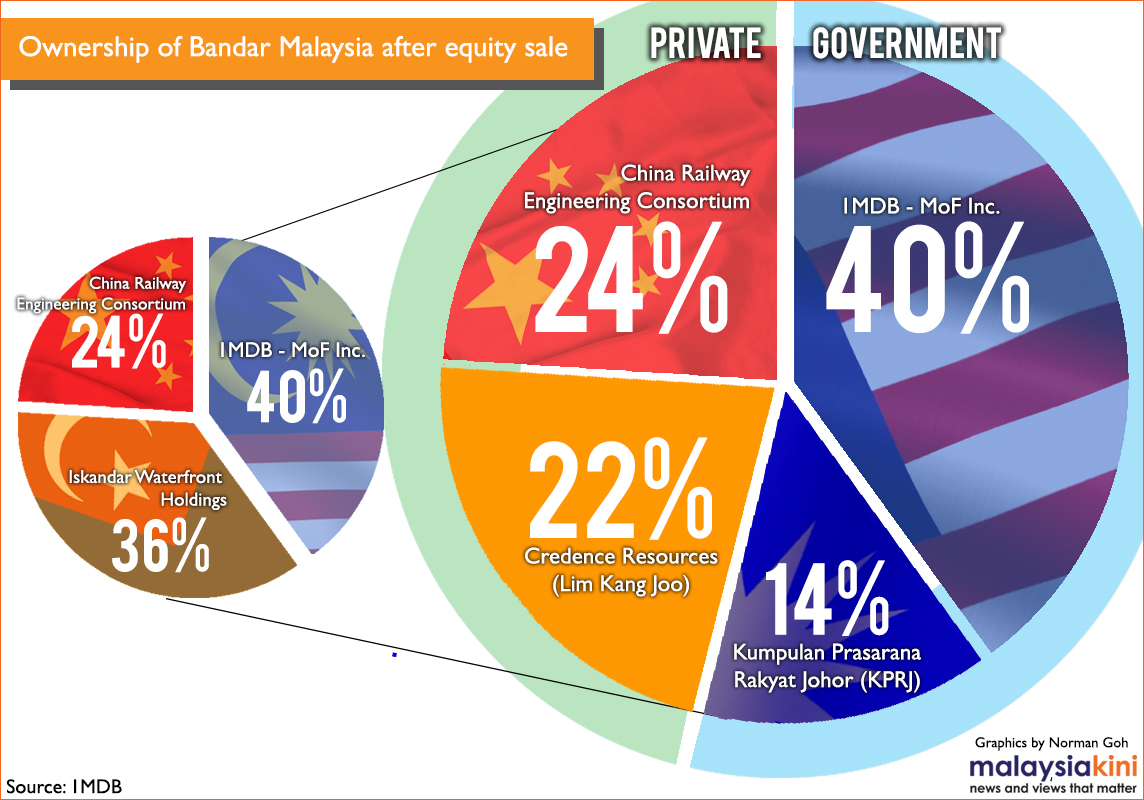
1MDB's sale of 60 percent equity stake of Bandar Malaysia to a consortium comprising Iskandar Waterfront Holdings (IWH) and CREC in a bid to pay its mounting debts had sparked outrage.
Among others, critics questioned why the firm was selling prime land it obtained from the government for a song to a foreign entity.
This was compounded when CREC’s notice to the Hong Kong Stock Exchange showed a price tag lower than what was announced by 1MDB.
Critics also raised concern the sale would raise CRECS' chances of winning the bid for the High Speed Railway project from Bandar Malaysia to Singapore.
1MDB president and executive director Arul Kanda Kandasamy denied that the Bandar Malaysia project was sold off to the Chinese.
"If you look at the new ownership, IWF is 60 percent of the consortium. When you add (the percentages), you would see the eventual ownership is 76 percent Malaysian, and 24 percent CREC.
"The ownership is 54 percent federal and state (Johor) government. The rest is with the private sectors. It's a win-win partnership, with it being owned in majority by Malaysia," he added.
Issue manipulated for political purposes
Meanwhile, Ismail claimed that the 1MDB deal had been manipulated by certain quarters for political purposes.
He said the issue was made viral on social media by those with political interests to create a negative perception.
"If we look at the social media, that is what they are saying (selling national asset). But that is not true at all. To me, there is nothing wrong with the transaction and process," he added.
The lecturer also noted that in Iskandar Malaysia and Penang, foreign firms owned shares and land.
"Why dispute the cooperation between 1MDB and the Chinese firm but not Iskandar Malaysia or the Penang government's action which also have similar dealings?" he asked.
Ismail said Malaysia had laws and all business transactions must follow the regulations.
"I am certain Malaysian leaders are not those who would simply sell national assets. They have legal advisers and understand that Malaysia is a sovereign nation with pride," he said.
Therefore, he urged the public to research the information circulated on social media to avoid misunderstandings and wrong perceptions regarding the government's efforts.
"We must be cautious with the information on social media. Not all of them are true," he added.
Ismail said such information should be verified in a rational manner and based on facts, not assumptions and emotions.


