



'Why sign TPPA at the expense of Chinese trade?'
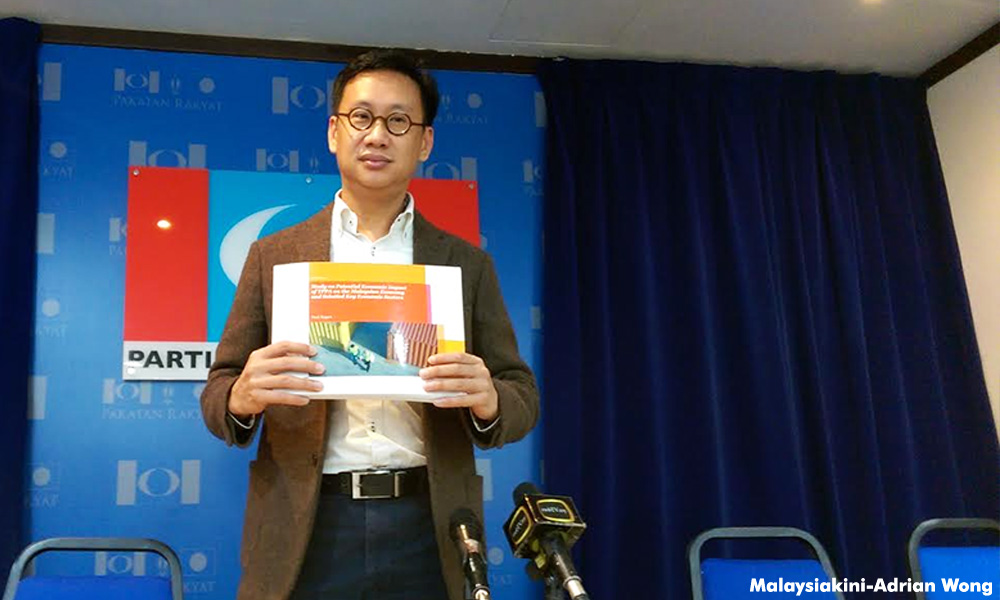
Malaysia will join Trans-Pacific Partnership Agreement (TPPA) for geo-political reasons instead of achieving economic benefits, said PKR lawmaker Wong Chen.
He said this was what was revealed in an analysis by top audit firm, PricewaterhouseCoopers (PWC).
The best the country can get from the signing of TPPA will be a 1.15 percent growth in gross domestic product (GDP) annually, he said at a press conference in Petaling Jaya today.
Malaysia will join Trans-Pacific Partnership Agreement (TPPA) for geo-political reasons instead of achieving economic benefits, said PKR lawmaker Wong Chen.
He said this was what was revealed in an analysis by top audit firm, PricewaterhouseCoopers (PWC).
The best the country can get from the signing of TPPA will be a 1.15 percent growth in gross domestic product (GDP) annually, he said at a press conference in Petaling Jaya today.
"The GDP growth is not significant. This is not enough for us to say that we should give up parliamentary and sovereign rights," he said.
The 25 percent reduction in non-tariff barriers to trade as stated in the TPPA is a non-binding term, he said.
Worse, the trade balance of Malaysia will reduce by 30 percent after the country signs TPPA, he added.
"So, why are we signing a trade agreement if not to increase our trade balance?" he asked.
He was responding to Foreign Minister Anifah Aman, who slammed the PKR Kelana Jaya parliamentarian for his biased position on the TPPA analysis and disregarding the positive developments and achievements of the trade pact.
"The PWC analysis is not a cheer-leading report; it is a neutral one. The neutrality of the PWC report showed that there is no issue of economic and international trade, but rather a geo-political and politic issue," Wong said.
"It is crazy if Anifah said this is the foreign policy of the government: to give out a few lousy dollars by giving up our severeignty; his foreign policy is wrong," he said.
"Why is our Prime Minister Najib Abdul Razak patting the back of US President Barack Obama?” he asked.
"China is our number one trading partner, while US is only number five. Why are we signing a deal with the Americans to potentially upset Chinese trade?"
Najib has disregarded the non-aligned policies which his predecessors, including Dr Mahathir Mohamad, had adopted, he said.
The PWC report, dubbed 'Study on Potential Impact of TPPA on the Malaysian Economy and Selected Key Economic Sectors', has pointed out that the oil and gas, palm oil, and construction sectors are likely to face setbacks.
"These are the so-called losers that will face challenges, while the three winners are electrical and electronics, textiles and automotive," Wong said.
"The three sectors (oil and gas, palm oil and construction), which are a significant source of national income, will be losing out,” he said, adding that the country would risk having foreign firms repatriate the money earned from these sectors.
The electrical and electronics industry is controlled by foreign firms, while the textile industry is a small, sunset business, he said.
"The only true Malaysian winner is the automative component industry, which is mostly Malaysian owned," he said.
TPPA will not the be main reason to attract the foreign direct investments, he added.
"Serious investors contemplating a major investment will consider factors such as land availability, labour, democracy and governance, infrastructure, and the banking environment," Wong said.
"We will be able to attract more investments from resolving the 1MDB issue, corruption, and governance problems," he added.


