



Legitimacy requires transparency
COMMENT It is no longer about the legitimacy or paper approvals that could be done by state governments to convert any piece of land for development or mining.
Ordinary people are just concerned that change to their landscape can be done at the stroke of a pen, without them even being informed of what is happening to a particular development.
They may have bought a piece of property just at the fringe of a forest reserve, but the next thing is that a few blocks of multi-storey high buildings emerge on the forest land, creating a potential traffic congestion to the area.
COMMENT It is no longer about the legitimacy or paper approvals that could be done by state governments to convert any piece of land for development or mining.
Ordinary people are just concerned that change to their landscape can be done at the stroke of a pen, without them even being informed of what is happening to a particular development.
They may have bought a piece of property just at the fringe of a forest reserve, but the next thing is that a few blocks of multi-storey high buildings emerge on the forest land, creating a potential traffic congestion to the area.
On investigation, the land had been de-gazetted and approvals for land conversion had been obtained without even the state representatives being adequately briefed of the conversion of land use, making the word ‘gazette’ almost meaningless.
When asked, there is always the cloud of secrecy at both the state administration and the local councils. It is the people who are in the dark as to what suddenly appear in their neighbourhood and when protests are made, it is too late for a reversal.
A good example is when Permai Lakeview Apartment owners in Tambun discovered that a piece of land originally meant for utilities was earmarked for the development of a multi-storey apartment building project. The residents managed to get a court injunction, and in the process, discovered some discrepancies where approvals had not even been given to the developer. The case is pending in the courts.
More transparency required
Changing land use may well be within the powers of the state governments (in Malaysia, land is a state matter), but it is a question of transparency that does not reflect well on the menteri besar or chief minister as the head of the state administration.
For example, in Perak (which is my current focus), a land grab has become a major issue that the people have to contend with. Their complaints to the authorities have fallen on deaf ears in some instances; therefore, they turn to both the opposition and non-governmental organisations such as Sahabat Alam Malaysia (SAM), Malaysian Nature Society (MNS), Reach and Pertubuhan Pelindung Khazanah Alam Malaysia (Peka).
As more issues are being raised by the various stakeholders, the response from the state has not been as expected, although the administration currently under Menteri Besar Dr Zambry Abdul Kadir could have been more proactive.
In some cases, the people, including the state assemblypersons themselves, are unaware of the development within their constituencies, especially when it involves the livelihood of the people and environmentally-sensitive areas such as gazetted forest reserve areas.
The state administration needs to be more transparent in order to douse the concerns expressed by the people. In some cases, it continues to ignore the people’s concerns until the subject is raised in broad daylight.
For example, in Kuala Sepetang, state assemblyperson Chua Yee Ling had to write an open letter to Zambry: “Last Tuesday, Nov 25, I went back to my constituency after a week in Ipoh for the state assembly session. While it was good to be back in Kuala Sepetang, I was shocked to see a big part of the Matang mangrove forest completely cleared.”
Following her letter on Dec 1 , a week later, it was reported that the Perak government had issued a stop-work order pending investigation into land clearing on the fringe of the world-renowned Matang Mangrove Forest Reserve.
In the first place, why did the work begin on the mangrove swamp without the people first being informed of the change of land use? It was learnt that the swamp was to be developed into a housing project and if Chua had not raised the objection by the people, work would have continued and soon the country would lose yet another mangrove forest reserve.
The question is, whenever approvals, if any, were given for the conversion of a piece of land, including Orang Asli land, farmland (sitting on state Temporary Occupancy Licence), mangrove swamps and forest reserve, why were the atate assemblypersons themselves never informed of the land conversion, despite that any new development could affect the livelihood of the people, including changing the ecology of the area?
It is not that the people refuse to see development coming to the state, but it is the lack of openness about state approvals given to a piece of development that make them cringe. Often, when work had begun, not even the state assemblyperson, including BN state assemblypersons, is able to do anything to reverse the project because the necessary approvals and paper works have been obtained.
In some cases, especially in the Cameron Highlands, it has caused some landslides and change of the ambience in the hill resort.
Umno state rep also left in the dark
Apparently, Chua alone is not being sidelined. Even Hulu Kinta state assemblyperson Aminuddin Mohd Hanafiah has been kept in the dark over some recent development near to the Haven Resorts and Permai Lakeview Apartments in Tambun, Ipoh.
On further follow-up with Aminuddin, there was still no clear answer as to what kind of development was being planned by either the state or the local council.
“I was informed by MBI (Majlis Bandaraya Ipoh) that the parcel was approved those days as ‘Rezab Khas’ in the master layout for the area. It is now earmarked for ‘school reserve’, not for housing scheme. It is now being levelled according to the plan by MBI. All the necessary approvals have been obtained.”
A copy of the Ipoh Masterplan cited by Malaysiakini showed that part of the land being cleared was designated for a housing project, while the portion behind the Haven Resorts and Residences was believed to be gazetted as forest reserve. No one has disputed or confirmed this allegation made by concerned residents.
Residents are more concerned that the land clearing activities beyond the designated housing scheme will encroach further into what they believe is their forest reserve.
“Work on clearing the forest land is not abating and now there are trailers carrying pre-cast drains into the area,” said a concerned resident. “We simply do not know what is being planned here.”
On a section of the land clearing, there was a signboard showing Majlis Bandaraya Ipoh, but there is no further information about its use. Attempts to contact the mayor have been in vain, but Tambun Member of Parliament, Ahmad Husni Mohamad Hanadziah promised that he will arrange a meeting between the residents and the mayor.
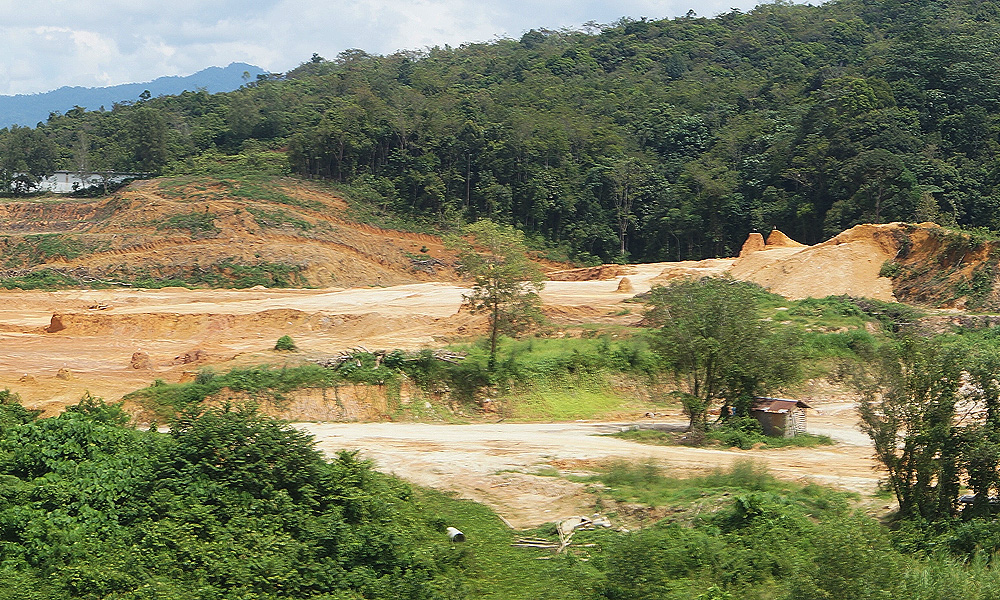
At least, Husni is seen doing something but at the state level, the menteri besar should at least be more proactive in wanting to protect state land, if it is gazetted as forest reserve, or if not, he should state otherwise. Meanwhile, on the ground, trees are being bulldozed and the landscape, as one resident put it, has appeared like “Mars on Earth”.
According to Perth-based environmentalist Steve Oh, in Australia, cutting down trees would be considered a crime. “I own acres of land but I cannot knock down a single tree without local council approval,” he said. “There are huge fines for illegal clearing of land. Huge swathes of land are protected bushland. You cannot simply cut down trees and carve away a hill and cart away the earth unless the land is zoned for resource exploitation.”
In Malaysia, approvals are given for deforestation, a concern which has gone on for many years in Sarawak under the former chief minister Taib Mahmud, and now, increasingly threatening the forest lands in peninsular Malaysia.
Are the federal and state governments serious about preserving the green belts in the country? This is a question on many people’s minds for a long time now.
MBI another 1MDB?
It is the lack of transparency that is being called into question. Due to the lack of privileged information, the opposition has raised the ire of Zambry when they attempted to liken Perak Menteri Besar Incorporated (MB Inc) to 1Malaysia Development Berhad (1MDB), calling it “a potential scandal in the state”.
Zambry immediately dared the opposition to lodge a report with the Malaysian Anti-Corruption Agency (MACC) over their allegations against MB Inc, stating that he had nothing to hide, to which state assemblyperson for Teja, Chang Lih Kang interjected, saying that the opposition was merely raising the questions to seek clarifications.
"As we are not in the government, we don’t have privileged information. Our intention is noble,” Chang was reported as saying. Chang, like others, was of course expressing the concerns of the constituents as an elected representative.
Perhaps, one clarification made by Zambry explains it all. “We work with certain companies and have (non-disclosure) clauses in the agreements,” he had said in reply to Terence Naidu, state assemblyperson for Pasir Bedamar, who wanted to know if the MB Inc’s accounts would be made available to the public.
In another report, Zambry had said that “state government agency reports such as on the State Economic Development Corporation, State Agricultural Development Corporation, Perak Water Board, State Secretary Incorporated and Institut Darul Ridzuan would not be tabled.”
This, of course, has made opposition whip Ngeh Koo Ham unhappy with Zambry’s answers. “Non-disclosure clauses were usually meant for defence contracts,” he said. "In terms of business, I don’t see the sensitivity, especially since MB Inc is a state agency managing public funds.”
We will follow-up to see if Kepayang state assemblyperson Nga Kor Ming has lodged an MACC report, if MB Inc’s audit reports were not furnished to the state assembly by a certain deadline.
In my opinion, the MACC may not even be able to find any discrepancies as far as paperwork is concerned, but it is the public perception that is being formed, when the state government chooses to operate under some non-disclosure clauses, especially when Zambry himself said he has nothing to hide.
If there is nothing to hide, why hide behind the non-disclosure clauses or even sign them in the first place?
STEPHEN NG is an ordinary citizen with an avid interest in following political developments in the country since 2008.


