




A teacher's urging for a better education system
COMMENT It’s a disheartening, saddening and disappointing time for me to mark the papers for the final exams of my lower class Form 4 students. A whole year’s effort, down the drain.
I had taught them, again and again, how to simply copy points to get marks and ways to ‘cheat’ the system in an effort to get at least a few marks for a test that is 11 years too advanced for their level. And yet, I still get papers with nothing but doodles.
COMMENT It’s a disheartening, saddening and disappointing time for me to mark the papers for the final exams of my lower class Form 4 students. A whole year’s effort, down the drain.
I had taught them, again and again, how to simply copy points to get marks and ways to ‘cheat’ the system in an effort to get at least a few marks for a test that is 11 years too advanced for their level. And yet, I still get papers with nothing but doodles.
At first, I felt angry and irritated that my students refused to even follow my simple instructions to copy this and that and use specific words, which I guaranteed could get them 20+ (out of 155) marks in the exam. They didn’t need to understand what was before them, they just needed to copy parts of the questions.
Then, I felt like an idiot, wasting my time marking papers that were impossible to do for my students. Students, who barely have the English proficiency of a four-year-old, are forced to do papers meant for 16-year-olds. What a joke, our national education system is.
And then I remembered how ridiculously stupid this whole affair was - getting marks for the sake of improving grades, not learning. I remembered that when I was their age, I hated Sejarah and Moral so much and absolutely refused to study for those subjects and even follow the teachers’ tips to get ‘free marks’.
I had given up even trying to do the tests. I had given up on those subjects.
And then I remembered where my students were coming from.
Kampung school, kampung life, virtually nobody to practise English with, bad parents, bad teachers, bad school administrations, bad childhood education, bad discipline, bad cultural and community influences, poor financial backgrounds, divorced parents... And the list goes on.
Escaping from sad reality
Being pushed through a system that forced them to do tests that were too hard for them, being scolded for being ‘stupid’, being labelled as failures in every exam, sitting in examination halls and sleeping for two-and-a-half hours because the words in front of them don’t make any sense… all for 10 years of schooling. They have given up on education.
And so they turn to other things to escape from their sad reality - monkeying around in class, ponteng class, ponteng school, smoking, wandering around aimlessly on their motorbikes without driving licences, going on ‘convoys’ with their ‘members’, doing menial low-paying jobs and some of them even dropping out of school.
With all of this in mind, it seems like that it’s hard to blame them, but at the same time you can’t deny the fact that they are also responsible for the choices that they make.
You can’t completely exonerate a teenager who has robbed a store or killed someone. You can’t completely free children from blame when they have stolen something, especially when they know it’s wrong. They know it’s wrong, they know what’s good for them.
Why can’t they choose to attend extra classes? Why can’t they do their homework even when it’s easy and doable? Why can’t they just bother and try to read the notes that I labouriously typed out, photostated and translated for them?
Why can’t they stop being monkeys in class even when they know that what they are doing is wrong? Why do they make stupid, annoying bird noises in the middle of a lesson? Why do they chat freely during exams without giving two hoots about others and the teacher in the class?
A massive problem
What’s the source of all this? How can we fix it? How can we raise the standard of education in Malaysia? The answer is complex. It’s intricate. Every problem is connected with one another. All I know is that being silent and ignoring it is not going to solve it.
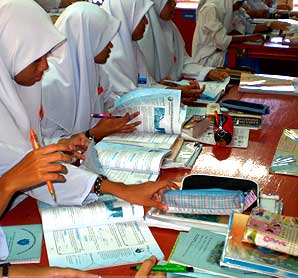 Sooner or later, these students, those whom the country has failed to educate, will come back to get you, me, us. I guarantee it. Be it in the form of desperate thieves and robbers, rempit, gangsters, unemployed, unemployable and incompetent workers, uneducated voters…
And these aren’t only a handful of the nation’s population. Almost 15 percent of the total students in Malaysia failed SPM in 2014 and mind you, that’s even with the passing mark lowered to as low as 25 for Sejarah and BM, the compulsory passing subjects. (Only six for English, FYI).
And the number of failing students is only going to grow if we don’t do anything about it. If you’ve made it this far and want to be part of the solution, then, good on you.
Because there are ways we can work together to solve this problem but it’s going to take effort and resources (meaning you can’t just sit around and expect things to happen) because, as I’ve said earlier, it’s a massive problem.
If you really want to help in any way possible, here are some suggestions:
1. Donate in any way you can - money, time, resources, volunteer work, furniture, etc. There are many good sincere teachers out there who lack the resources to fund their community projects. The lowyat.net forums are a pretty good place to look in, but I do not know anything regarding the reliability and trustworthiness of the people there.
On the other hand, here is one website I trust which helps to connect willing donators to trustworthy teachers in need. All of the donations go towards the students or the projects . Bottom line is - just donate. Donate to whomever you can, with whatever you have, wherever you are.
2. Be more involved in education. Be more involved in policy-making. Voice out your opinion on what you think should be done in schools. Don’t just complain about what’s bad in our national education system. Take part in discussions and properly evaluate and analyse the pros and cons of each system/project.
Give suggestions on how you think the system can be improved. Don’t just rant on Facebook. Write a formal letter to the authorities detailing your suggestions and criticisms. Take part in community projects. Spend your Saturdays giving free tuition or visiting a volunteer centre for underprivileged children. In short, find out how you can help.
3. Beat, punish and discipline your own children. Almost every teacher I’ve talked to in my school has said that many students nowadays do not respect their teachers as much as they used to in the past. Many students in my school are the products of failed parenting and I can clearly see which students have been properly disciplined and which have not.
Get involved
Punish mistakes and discipline your own children. Teach them respect and teach them manners. Beating/punishing your children because you hate them is called abuse. Beating/punishing your children because you love them and don’t want them to repeat the same mistakes is called discipline.
4. Demand transparency of information. Why are the number of SPM failures not published in the main media? Why are the passing marks for SPM not readily available to the public? What are the statistics of illiteracy in Malaysia?
How are the marks calculated for SPM? How is an SPM paper actually like? Can we trust it to be of the same standard as other top countries?
5. Demand for a better government. A government that is serious about education, serious about teaching the future generation manners, knowledge and skills that will help them succeed in life and be useful and competent global citizens.
A government that doesn’t say stupid things, like ‘If you don’t like our country’s national education system, you can send your children overseas’ (or something along those lines), while the ministers themselves send their children to international schools.
A government that doesn’t try to cover up how bad the national education system is. A government that doesn’t force teachers to give marks to students even when they don’t deserve it, just to push the average marks up. A government that doesn’t force stupid burdensome procedures upon its teachers.
A government that doesn’t force teachers to blindly menurut perintah (follow orders) without questioning the orders. A government that gives teachers a voice and the opportunity to speak out against policies or projects that do more harm than good and do not benefit the students in their communities.
A government that respects and celebrates teachers that have sacrificed much for their students. A government that listens to the people of this country.
But if the current government doesn't want to listen to the people, parents and teachers, and refuses to provide the best for the children of this country, then vote for one that does.
And finally, if you agree with at least some of the points in this article, share it and spread awareness regarding our country’s national education system. Get more people to be involved in the education of our youth. Get yourself to be more involved in the education of your future countrymen and women.
JOSEPH TAN is a 26-year-old Monash University English Language graduate who recently completed his post-graduate diploma in education.


