




Opposition's Hobson's choice
COMMENT To collaborate or not to collaborate?
That seems to be the question facing the opposition, excepting PAS, and civil society groups vis-a-vis the former prime minister Dr Mahathir Mohamad in the current stalemate between the forces wanting Najib Abdul Razak's ouster and the praetorian guard surrounding the prime minister.
COMMENT To collaborate or not to collaborate?
That seems to be the question facing the opposition, excepting PAS, and civil society groups vis-a-vis the former prime minister Dr Mahathir Mohamad in the current stalemate between the forces wanting Najib Abdul Razak's ouster and the praetorian guard surrounding the prime minister.
Much of the opposition and the NGOs have come around to accepting as consensual wisdom that Najib has leveraged on the trammels that Mahathir had contrived to impose on constitutional safeguards against executive tyranny.
As Tawfik Ismail, son of the late Dr Ismail Abdul Rahman who increasingly has come to occupy a special place in the country's pantheon of constitutional forebears, pithily observed that while Najib is biologically the son of Abdul Razak Hussein, our second PM, he is more nearly the political heir of Mahathir.
Malaysia's fourth PM must find this perception galling but more repugnant to him still would be if he has to accept defeat in his bid to oust Najib.
Mahathir is the sort who - setting his mind on a goal - will not be appeased with anything short of victory.
So not just personality traits can be relied on for the continuation of Mahathir's struggle to depose Najib, futile as it may seem at this stage, but something else in the man can surely be depended on to keep driving him to unhinge the incumbent.
This is that aspect of Machiavellian political craft that requires of its practitioners to employ in gaining an objective both fair and foul means, provided the methods don't result in breaking the fabric of society.
This is an imperative requirement in Niccolo Machiavelli's counsel to leaders with responsibility for ensuring the peace and prosperity of their polities.
In tandem with Mahathir
Machiavelli's prince should not scruple to employ foul means to gain what he said was a noble end - the tranquillity and well-being of the citizenry.
In other words, the prince can break rules but he must not allow too much to become weak at the broken places.
From this standpoint, it would be mortifying to Mahathir that Najib is seen to exploit the holes Mahathir bored into the system with none of the compensations - strong economic growth and an appeased citizenry - that the former PM obtained for the country during his long tenure (1981-2003).
In fact, the threat of Malaysia becoming a failed state from a combination of a falling currency, galloping inflation, mounting debt and a restive citizenry, has become more real than ever.
Mahathir would be loath to accept this looming possibility; he will strive to avert it.
It would be irresponsible for the opposition to be bystanders while the country is thus imperilled.
They will have to assist Mahathir in his quest to do something about Najib's brazen finagling of the system to keep his hold on power.
Putting the skids under Najib
The opposition and civil society groups will have to approach matters in the same way as Jaime Cardinal Sin, the late Archbishop of Manila, contrived to in the last few years of Ferdinand Marcos' dictatorship in the Philippines.
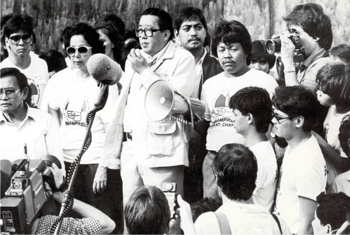 The Cardinal had been since the assassination of Benigno Aquino Jr in 1983 the focal point of opposition to Marcos but altered his stance in the last few years prior to Marcos' overthrow by engaging in what he called ‘critical collaboration’ with the Philippine president.
By this manoeuvre, he enticed Marcos into thinking and acting like he could get the Philippine Church to be on his side in upcoming elections and he thus refrained from taking the more extreme measures of repression that his earlier behaviour seem to propel him to.
As the political scientist Alexis de Tocqueville noted, a long-standing tyranny is never in greater danger than when it takes the first faltering steps to reform.
That was what Marcos, under the promptings of Sin's astute ‘critical collaboration’, did in the years immediately preceding his overthrow in February 1986.
Critical collaboration is what the opposition and civil society groups should adopt in tandem with Mahathir in the battle to oust Najib.
While lobby groups like G25, the group of eminent retired senior civil servants, diplomats, and judges, work to bring influence to bear on Najib to restore democratic institutions that Mahathir's premiership had enfeebled, the opposition can collaborate with Mahathir to put the skids under Najib.
The alternative of standing by while the country slides to perdition is actually no recourse at all, not for a responsible people who put nation before their selfish interests.
TERENCE NETTO has been a journalist for more than four decades. A sobering discovery has been that those who protest the loudest tend to replicate the faults they revile in others.


