




Lawyers grill Anwar on credibility, commitment
Lawyers grilled former deputy premier Anwar Ibrahim over his credibility as a political leader and his personal commitment on reform yesterday.
Lawyers grilled former deputy premier Anwar Ibrahim over his credibility as a political leader and his personal commitment on reform yesterday.
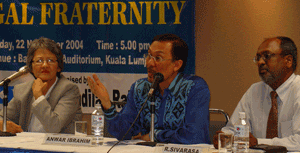 In a two-hour dialogue with some 300 lawyers in Kuala Lumpur, Anwar was fired with questions over his reform policies when he was in the government and several controversial issues like the 1987
Operation Lallang
which he was seen as supporting, even against a wide public outcry.
In a two-hour dialogue with some 300 lawyers in Kuala Lumpur, Anwar was fired with questions over his reform policies when he was in the government and several controversial issues like the 1987
Operation Lallang
which he was seen as supporting, even against a wide public outcry.
"I know people would ask me why didn't you do this when you were in the government. What else can I say? I thought I was smart but I was not, people said I was naive," he said in his short speech before the dialogue.
But he defended himself well declaring that he was committed to reform even when he was with the government as he wanted to make changes within the system.
He explained that he was unable to control all the failures of the government in the past although he had tried to correct them quickly, citing his decision to investigate into the Perwaja case in 1996 as an example.
"I had requested for an independent investigation on Perwaja in Parliament as we had detailed account of corruption and mismanagement involving RM2 billion, but it was only in 2004 that Eric Chia was charged," he said.
Must move on
Another example of his effort to reform was in tabling the Anti-Corruption Bill.
"When I tabled the bill, it caused much anger and resentment among my colleagues in the government. The main provision was that after five to 10 years upon leaving the government, you can still be charged for any corrupt practice.
"I think this is a very fair provision, I asked them why do you have to worry if you are innocent?" he quipped, drawing laughter from the ground.
 Anwar was also asked why he did not do anything when former Lord President Salleh Abas (
photo
) was sacked in 1988.
Anwar was also asked why he did not do anything when former Lord President Salleh Abas (
photo
) was sacked in 1988.
"Falling in love is never too late. I can say it (the sack) has caused a lot of uneasiness among my colleagues within the government too.
"I agree it was the beginning of the erosion of public confidence within the judiciary. But we have to move on, I don't think it's late, we have a duty to perform," he stressed.
Anwar also responded to a question as to why he did not resign in order to be accountable for the misconduct of the government during Operation Lallang in 1987 and the use of the Internal Security Act against al-Arqam followers in 1994.
"I did not resign as I believe there was an avenue for change within the party. I tried to repeal the Universities and University Colleges Act when I was education minister but it was not approved by the cabinet."
Oppose Bakun, Ops Lalang
He claimed that he was advised by his colleagues to be patient as the changes would come slowly.
"I did all I could to create changes and reform. But I was not in the position to go against all of them," he claimed.
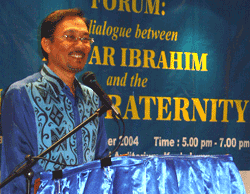 The former deputy premier also revealed that he opposed the Bakun Dam project in Sarawak "but eventually, I had to tell the NGOs that the only thing I could do was to ensure that there was minimal destruction to the environment as I was over-ruled by Parliament".
On Operation Lallang in which more than 100 opposition leaders, academicians, activists and trade unionists were arrested, he claimed he tried to appeal to the then prime minister Dr Mahathir Mohamad on the next day of the operation.
"I was told by Mahathir that I have to understand national security," he said.
"I was twice a victim of the ISA, so don't say it would not be you. It's shameful, cruel and inhuman. You can't expect people who had gone through that experience not to be against it (ISA)," he added.
Very consistent
A lawyer then stood up and told Anwar: "People on the ground do not trust you. You have never said you don't want to rejoin the government. You never say you subscribe to human rights. You are only making political rhetoric."
 Rebutting the statement, Anwar declared that he has been very consistent and has never indicated that he wants to rejoin the government.
"I am very specific on corruption. But I don't want to be seen as against the grassroots. Many Umno members are very innocent. You want me to condemn all of them?" he asked, adding that he should be given flexibility to interact with people.
"I must be given a chance not to go against the party, but policies are different. I stand for the agenda of reform. How can you ask me to give proposals on politics, economic and education when I was released just two months ago?" he argued.
Asked if his ex-colleagues in the government understand the rule of law, Anwar said, "I believe they understand, but it's hard to find dissenting voice in the government, the question is their commitment."
 Asked what were the differences between the current and previous prime ministers, Anwar said "the only difference is that if Mahathir was still in power I would still be in jail".
He however added that there was no fundamental difference between Mahathir and Abdullah as the latter was still "part of the system".
"Abdullah is very hesitant to make changes. There's no fundamental difference between them after one year. There's more rhetoric than actual actions," he claimed.


