



PKR gets the ally it deserves
COMMENT Though Charles de Gaulle in a famous formulation noted that friendships are transient but interests are permanent, the maxim is taken to refer to the world of big power politics.
The realpolitik that governs relations between big powers should not be equated to the politics of parties operating within national boundaries.
In the latter arena, if interests predominate over principles, as in realpolitik, political parties get into twists that would reduce them to ciphers rather than contenders for power within national settings.
Wth the announcement yesterday that PAS is teaming up with Malay rights pressure group, Perkasa, on matters of mutual interest, the insistence of PKR - against the better judgment of their more reliable allies - to continue wooing PAS to sign on to a combined opposition pact becomes even more difficult to bring off...
COMMENT Though Charles de Gaulle in a famous formulation noted that friendships are transient but interests are permanent, the maxim is taken to refer to the world of big power politics.
The realpolitik that governs relations between big powers should not be equated to the politics of parties operating within national boundaries.
In the latter arena, if interests predominate over principles, as in realpolitik, political parties get into twists that would reduce them to ciphers rather than contenders for power within national settings.
Wth the announcement yesterday that PAS is teaming up with Malay rights pressure group, Perkasa, on matters of mutual interest, the insistence of PKR - against the better judgment of their more reliable allies - to continue wooing PAS to sign on to a combined opposition pact becomes even more difficult to bring off.
PKR, at one time the principal adhesive in an opposition coalition that grouped them with secular DAP and theocratic PAS in a loose arrangement called Pakatan Rakyat, ought to be reeling at the announcement that PAS has teamed up with Perkasa.
Perkasa was set up in 2008 to stand athwart the economic and political reforms set in train by the denial of Barisan Nasional's supermajority in Parliament in the March 2008 general election.
That game-changing denial was largely the work of PKR, its leader Anwar Ibrahim ( photo ) having leveraged brilliantly on the currents set off by the first Bersih march of early November 2007, followed by the wave for the opposition triggered by a Hindraf-organised street protest later the same month.
The combined effect of all three factors culminated three months later in what is now regarded as the game-changing denial of BN's traditional two-thirds majority in the federal legislature.
No other group has stood more implacably in opposition to changes to the political landscape that were set off by that denial than Perkasa.
But even Perkasa is riled by Sosma
Though these changes, or reforms, have not panned out in the political arena, their approximations - critics would say contortions - have.
One is the Security Offences (Special Measures) Act 2012 (Sosma). It was supposed to have replaced the draconian Internal Security Act (ISA) 1960.
The Najib Abdul Razak government said, when enacting it, that it would only be used to combat terrorism and its pepetrators.
But the use of Sosma against the scandal-plagued 1Malaysia Development Bhd critics, Khairuddin Abu Hassan, and his lawyer, Matthias Chang, over their alleged economic and banking sabotage, has riled even nominal government supporters like Perkasa.
The NGO has now made common cause with PAS not only to fight Sosma's abuse but also to oppose the Trans-Pacific Partnership Agreement (TPPA), a trade pact among 12 nations, including Malaysia, that will be formalised next month.
Although PKR opposes both Sosma's abuse and the TPPA, the party would rather steer clear of Perkasa because of the racism that colours the outlook of the Malay rights pressure group.
PAS' association with Perkasa, highlighted at a meeting between the Islamist party and the NGO yesterday, would place PKR under further jeopardy in respect of its standing among opposition groups, where it is regarded as sturdy proponents of the political and economic reforms broadly opposed by Perkasa.
In short, PAS' embrace of Perkasa poses questions about the advisability of PKR's efforts to include PAS in a combined opposition grouping that includes PKR, DAP and the newly formed Parti Amanah Negara (Amanah).
PAS insists it does not want to be part of the grouping - the fledgling Pakatan Harapan - but does not mind an electoral pact with PKR only.
Reviled by DAP, spurned by PAS and Amanah
PKR, on the other hand, persists in wanting PAS in on Pakatan Harapan, but this persistence is now imperiled by the PAS embrace of Perkasa, a body that is reviled by DAP, and spurned by both PKR and Amanah.
Latest reports say even sections of PAS, specifically its Selangor chapter , look askance at Perkasa and don't want any ties to it.
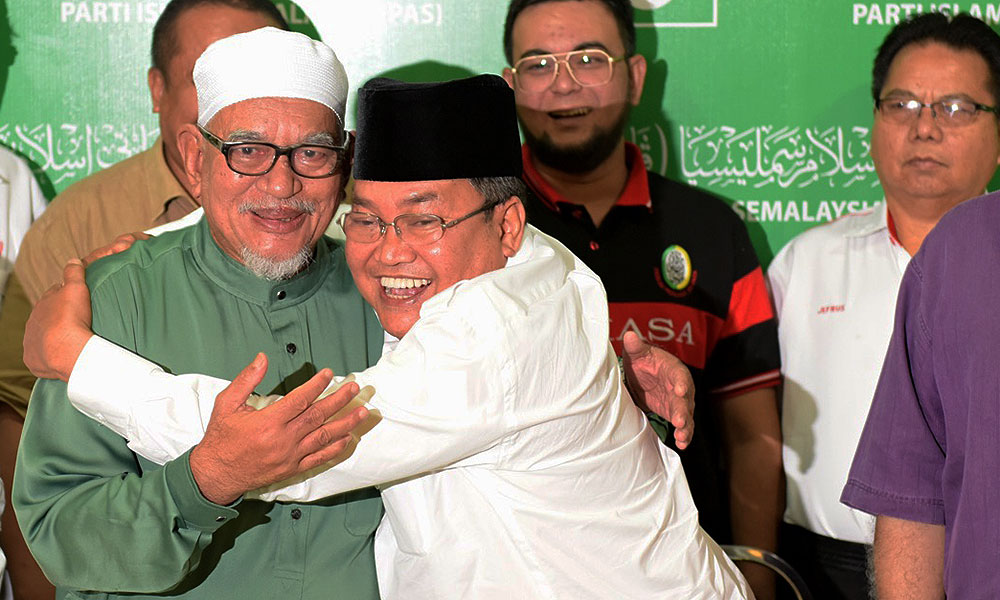
The evolving contretemps regarding PAS' newfangled connection to Perkasa underscores, yet again, the tendency of PAS president Abdul Hadi Awang ( photo ) to act in a unilateral way, with scant consultation with the rest of the party's leadership and little regard for past history and legacies.
If not ill-informed, Hadi is inept and not quite aware of the need to be consistent, for example, in avoiding for his party the taint of racist connections to sectarian bodies like Perkasa that would weaken the universalist percepts of Islam.
Despite these obvious drawbacks to dealing with a PAS that is erratically led by Hadi, PKR plans to forge on with efforts to include PAS in an opposition pact, as an emergency meeting of its central leadership council last Sunday resolved to do.
That already fragile resolve has been rendered more threadbare by the latest developments between PAS and Perkasa.
TERENCE NETTO has been a journalist for more than four decades. A sobering discovery has been that those who protest the loudest tend to replicate the faults they revile in others.


