




Experts: Before congestion charge, improve public transport first
FOCUS | Serving the border between Kuala Lumpur and Selangor along the Federal Highway, the Kota Darul Ehsan arch is one of the spots of high daily traffic congestion on the highway.
It was all red on the navigation system - indicating the severe traffic jam along the route. Apart from that, the repetitive traffic reports on local of radio stations added anger to the frustrations of motorists.
They were hoping for an end to their traffic jam nightmares.
FOCUS Serving the border between Kuala Lumpur and Selangor along the Federal Highway, the Kota Darul Ehsan arch is one of the spots of high daily traffic congestion on the highway.
It was all red on the navigation system - indicating the severe traffic jam along the route. Apart from that, the repetitive traffic reports on local of radio stations added anger to the frustrations of motorists.
They were hoping for an end to their traffic jam nightmares.
On the Kuala Lumpur side of the arch, Mayor Mohd Amin Nordin Abdul Aziz mooted “congestion charge” as a cure to the horrific traffic jams - a fee that is to be imposed on vehicle users in congested areas of the federal capital once the MRT is completed in 2017.
While concurring that public transport will remain inadequate in 2017, Amin later clarified that Land Public Transport Commission has the final say on the imposition of the congestion charge.
Public transport is the cure
The fact is, efficient public transport will be the cure to traffic jams.
Malaysiakini interviewed three public transport experts who all agreed that an efficient, complete public transport is a pre-requisite to the congestion charge.
A well-known public transport NGO, Transit, has been advocating for the government to pay attention to the insufficient public bus service and connectivity issue.
“The biggest problem is the MRT will not cover the first and last mile. If you study the Klang Valley map, MRT isn’t everywhere,” Transit adviser R Rajiv said.
First and last mile refers to the commuters’ connectivity before taking public transport and reaching their destinations.
The Klang Valley suburbs, from Bukit Rahman Putra in the north to Bukit Jelutong in the south, are not within the MRT’s walking range, Rajiv explained.
He described MRT as human spine, which needed a bus service to act as its arteries and veins to connect passengers from their homes to their final destinations.
Bus supply inadequate
Unfortunately, the number of public transport buses in Klang Valley is well below the numbers required.
According to the Singapore Land Transport Authority, London, Hong Kong and Singapore have 9,061, 5,760 and 4,725 buses respectively.
But the main Klang Valley bus operator, Rapid KL, only has 1,500 buses, according to Bernama .
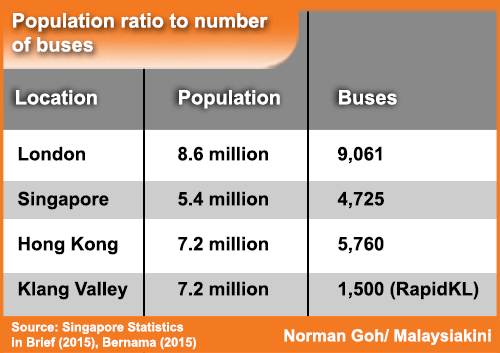 Owing to the lack of drivers, RapidKL is only able to put 900 buses into service.
Rajiv, who is the DAP Bukit Gasing assemblyperson, said the Klang Valley buses are not able to meet the needs of the passengers, leave alone the service quality.
“The point is that the Klang valley has little railway lines compared with Hong Kong and Singapore… We should have more buses to compensate the lack of rail.”
He pointed out that the tight supply has affected the bus routes. Should a bus be damaged, there is also no sufficient back-up.
Buses arriving late on their routes not only make the passengers very annoyed but also force them to turn to private cars.
Klang Valley will have six railway routes by the completion of MRT Line 1, the others being the current two LRT lines, a monorail route and two KTM Komuter routes.
However, London has 11 underground and nine national railway systems. Both the island states of Singapore and Hong Kong have nine and 22 railway routes respectively.
Despite London and Klang Valley sharing a similar population and size, the Klang Valley is far behing the public transport system provided in London, Rajiv lamented.
Walkways in dire state
Aside from bus routes, walkways play an important role in connectivity for public transport.
Many walkways in the Klang Valley are in a dire state, ranging from heavily littered routes to potholes and blockages by streetlight poles.
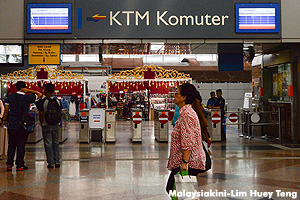
This has been making life harder for commuters travelling between LRT and KTM stations.
Admitting to the importance of these walkways, Rajiv said the lack of planning and human traffic assessments also contributed to the public transport defects.
“When we (build) walkways, it’s based on the space. If the space is big, then we build big, if small we do small.
 “By right, we should consider human traffic in designing these pathways,” the assemblyperson added.
Rajiv, who served as a Subang Jaya municipal councillor before, said the pathway between the Asia Jaya LRT station and Federal Highway is narrow.
“There is only three feet. But the volume of commuters there is very high. It needs to be much bigger to cater to the volume.
“We didn’t design the walkway lah. The space between the buildings is narrow…one of the solutions is to cover the drain, which will indirectly expand the walkpath.”
Congestion charge should replace tolls
As for the betterment of public transport, Rajiv agreed that the congestion charge should be imposed and this should replacing the current road toll charges in the Klang Valley.
This, together with an efficient public transport system, he said, would be able to bring down the numbers of private vehicles in congested zones.
“You could use the congestion charge to balance the traffic (along highways). Among the routes from Subang to Kuala Lumpur during peak hours, the Federal Highway is the most congested, New Pantai Expressway (NPE) the next and Kesas is the least.
“We could charge RM2 (as congestion charge) on the Federal Highway, RM1 on NPE and make it free on Kesas. You will push the people to Kesas to balance the highway traffic,” he said.
Rajiv added that the congestion charge should not be for profiteering but for optimising the use of all highways in the Klang Valley.
The devil in the details
Town planning expert Yong Sun Yong said the details of the congestion charge are crucial, aside from an efficient public transport service.
“It’s quite important to note the costs and benefits. If the charge is set at RM10 and the cost of public transport far exceeds it, why shouldn’t I drive? Don’t forget the time wasted on the roads as part of the cost.
“Not everyone travels point to point. Many would have to travel to other places during working hours. We should look into this as well,” Yong said.
He also pointed out that given the vast size of Kuala Lumpur, the city authority should determine whether the congestion charge is to be implemented on every road heading towards the city.
“Maybe you could implement it in Sungai Besi. However the motorists may take advantage of a smaller route, such as Puchong, to avoid the charge,” Yong said, adding that the residential areas may be affected if this was the case.
Meanwhile, Malaysian Institute of Planners president Md Nazri Md Nordin said members of the public should know how the congestion charge would be used.
“I think the congestion charge should be poured back into improving roads and connectivity for public transport users. It can even go to subsidising public transport,” Md Nazri added.
Traffic congestion charges are in force in Singapore, London, Milan and Stockholm.
Related report


