




A sweet conjunction
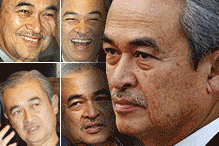
 Today marks the passing of the first year that Abdullah Ahmad Badawi has served as the fifth prime minister of Malaysia.
It is perhaps too early for us to say that there is such a thing as 'Badawirism', though we have already begun to see the embryonic gestation of such a concept. It cannot be denied that the landslide victory of Abdullah was partly (some would say largely) due to his articulation of the concept of Islam Hadhari. Others would note that the man's less than confrontational style and accommodative approach may have turned the tide of votes in his favour.
 For better or worse, the more aggressive posturing of the Mahathir years has given way to a more public-friendly approach that cynics might argue is the more sophisticated face of authoritarianism at work. While the discourse of the political elite in Malaysia today is certainly more accommodative and reflective, the fact remains that oppressive laws such as the Internal Security Act (ISA) remain in place.
And if there was any doubt that the state's maximalist propensity towards social control had abated somewhat, the recent shameful fiasco over the allegedly offensive statements made by an Internet user going by the name of 'Anwar', who made the ill-worded comparison between the state's official doctrine of Islam Hadhari and faeces, is a case in point: The whole episode demonstrated that the state remains as the sole arbiter of what is good and right in the country, and will not allow alternative voices (no matter how articulate or inarticulate they may be) on the scene.
As this week marks a landmark of sorts in the country's history, there will undoubtedly be others who will write on this subject. This writer will choose to focus on one issue in particular, which we would argue deserves greater attention and participation from the public as a whole - though the human costs of such engagement might prove to be higher than anticipated.
This is the thorny question of the state's relation to religion in general, and Islam in particular.
Why religion and why Islam? Why indeed. The question might not have even arisen had it not been for the fateful decision of the previous administration to play into the hands of the Islamist opposition and enter the discursive fray over the meaning and content of Islamic discourse itself.
 Today marks the passing of the first year that Abdullah Ahmad Badawi has served as the fifth prime minister of Malaysia.
It is perhaps too early for us to say that there is such a thing as 'Badawirism', though we have already begun to see the embryonic gestation of such a concept. It cannot be denied that the landslide victory of Abdullah was partly (some would say largely) due to his articulation of the concept of Islam Hadhari. Others would note that the man's less than confrontational style and accommodative approach may have turned the tide of votes in his favour.
 For better or worse, the more aggressive posturing of the Mahathir years has given way to a more public-friendly approach that cynics might argue is the more sophisticated face of authoritarianism at work. While the discourse of the political elite in Malaysia today is certainly more accommodative and reflective, the fact remains that oppressive laws such as the Internal Security Act (ISA) remain in place.
And if there was any doubt that the state's maximalist propensity towards social control had abated somewhat, the recent shameful fiasco over the allegedly offensive statements made by an Internet user going by the name of 'Anwar', who made the ill-worded comparison between the state's official doctrine of Islam Hadhari and faeces, is a case in point: The whole episode demonstrated that the state remains as the sole arbiter of what is good and right in the country, and will not allow alternative voices (no matter how articulate or inarticulate they may be) on the scene.
As this week marks a landmark of sorts in the country's history, there will undoubtedly be others who will write on this subject. This writer will choose to focus on one issue in particular, which we would argue deserves greater attention and participation from the public as a whole - though the human costs of such engagement might prove to be higher than anticipated.
This is the thorny question of the state's relation to religion in general, and Islam in particular.
Why religion and why Islam? Why indeed. The question might not have even arisen had it not been for the fateful decision of the previous administration to play into the hands of the Islamist opposition and enter the discursive fray over the meaning and content of Islamic discourse itself.
Politicisation of Islam
The 1980s and 1990s witnessed what can only be described as the 'Islamisation race' in Malaysia. When Dr (now Tun) Mahathir chose to confront Umno's nemesis PAS in the discursive arena of Islamist discourse, he sealed the fate of the country and committed Malaysia to a host of policy options that have incurred a cost in terms of the loss of other alternatives. Mahathir's co-optation of the young Islamist activist Anwar Ibrahim in 1982 escalated the race somewhat, as it merely led to the split among the leaders of the Malaysian Islamic Youth Movement (Abim) and the flight of a host of Abim leaders to PAS. (1)
The 1980s witnessed the growing hostility between Umno and PAS, and the unfortunate appearance of the tactic and practice of takfir (Muslims accusing each other of being kafirs , or un-believers) between the two parties. It was left to Abim, then under the leadership of Siddiq Fadil, to repair the division in Malaysian society and to inject some sanity into the deteriorating relationship between the two political organisations. (Sadly, the pivotal role of Siddiq Fadil during this time has never been really acknowledged, though it was he who attempted a consistent and thoughtful critique of the culture of takfir during that tense and destructive period of Malaysian history. (2))
Over the past two decades, when Umno remained under the leadership of Mahathir and PAS under the leadership of the so-called 'ulama faction', the two parties have contributed to the narrowing of public discursive space on matters related to normative Islam and Muslim concerns. Neither Umno nor PAS have demonstrated a willingness to allow other actors and agents to enter this heavily-contested discursive arena, and both parties have added to the politicisation of Islam in this country. As a result of this race to demonstrate their Islamic credentials, both parties have come up with policies, laws, institutions and practices that have diminished and eroded the democratic culture of Malaysia.
PAS's hate-engine has come up with countless conspiracy theories, plots and narratives about how Islam is allegedly 'under threat' in Malaysia - from a host of evil-doers ranging from Christian missionaries to urban liberals, from Western pop stars to secular democrats said to be in the pay of 'Jewish agents' from abroad. Not to be left behind, Umno's own hate-machine has come up with other, equally laughable though ultimately dangerous conspiracy theories, from allegations against the infernal international Jewish conspiracy to so-called underground militant cells said to be operating in the country - though little evidence has been forthcoming to back up any of these claims thus far.
The cost, however, has been borne by us, the Malaysian public. Malaysia today is a decidedly less free country than it was two decades ago. Social pressure has forced Malaysians - and Malay-Muslims in particular - to conform to norms set by a minority of self-righteous religious communitarian bigots and self-proclaimed 'defenders of the faith'.
We now live in a country where hearsay is enough to get one accused of blasphemy or 'insulting Islam' (I speak from personal experience on this matter). And we labour under the same government whose leaders have come up with mind-numbingly stupid policies such as 'faith rehabilitation centres' for 'deviant Muslims' or, worse still, the threat of having antiquated Hudud punishments such as public stoning and beheadings imposed on us. What, as the old question goes, is to be done?
The sweet conjunction
Fate, it seems, still has Malaysia at heart and has not abandoned us. For thanks to the conjunction of a number of wholly-unpredicted variable factors, the political terrain in Malaysia has experienced a paradigm shift unparalleled over the past quarter of a century.
Ironically, the aftermath of Sept 11 has forced Islamists all over the world to re-think their methods and tactics, and to accept the painful reality that many of their projects have failed utterly. Perhaps the only positive outcome of the nefarious global campaign against the bogeyman of 'Islamic terror' is that it has forced Muslim governments, political parties, NGOs, popular movements and spokesmen to be more cautious and circumspect when articulating their exclusive communitarian concerns.
Mindful of the fact that we now live in the age of American militarism and unilateralist intervention, even the most hot-headed Islamists have been cautious when issuing their (often misguided) calls for Jihad. So deep and widespread is this fear of Uncle Sam's big heavy stick that even the most bellicose, reactionary and downright fascistic Islamist organisations are trying to show a more politically-correct face to the world: Note the moderation of the rhetoric of Islamist groups from Egypt to Pakistan. In Indonesia some of the more militant groups like the Laskar Jihad have even disbanded altogether. And in Malaysia even the otherwise conservative PAS has begun to offer us piecemeal (though nonetheless important) gestures such as their public campaigns and projects like the new Chinese mosque in Tumpat, Kelantan. (3)
The most significant development to note, however, remains the near-total defeat of the Islamists at the polls in both Malaysia and Indonesia this year. In Indonesia, the Islamist parties put together could not even win five percent of the total vote and were all but wiped out during the first round of elections. The only party that managed to secure a respectable vote count was the Partai Keadilan Sejahtera led by Dr Hidayat Nurwahid - a modernist cadre-based Islamist party with a clearly technocratic, managerial outlook and not overly bothered with abstract theological-legalistic reasoning or empty nostalgia for the golden age of Islam centuries ago. Its relative success proves that the Indonesian electorate is thoroughly fed up with emotive issues such as the call for Hudud punishments and syariah law. The PKS's victory was rather due to its campaign against corruption and for democratisation and transparency in the country.
In Malaysia, the 'Islamisation race' has taken a bizarre though not unwelcomed turn for the better. Rather than follow the destructive course of the past, practically all the major Islamist parties and groups in the country are now racing to show how moderate they are: Umno now claims to be the champion of 'Islam Hadhari'; PAS is pushing for the de-racialisation of Islam and its anti-corruption campaign; Abim and JIM (Jemaah Islah Malaysia) continue to emphasise the values of civil society; while the return of the prodigal son Anwar Ibrahim heralds the possibility of yet another new voice of Islam that speaks about democracy, civil society and human rights. We are indeed fortunate for this year we seem to have a bumper crop of Muslim moderates! (Along with the bumper crop of Datuks.)
Where do we go from here? Well, from this point onwards it is up to us (that's you and me, dear reader) to demand from all these moderate-wannabes a genuine commitment to democracy, civil society, human rights and the rule of law. It is we, the Malaysian public, who stands to gain the most through an active participation in this debate, and it is we who stand to lose the most if we opt out of it.
The race is on
For too long, the entry of religion into politics and the politicisation of religion have been conducted by political elites who seem to think that they alone know what is good and right for the masses. The paradigm shift away from the discourse of religious authenticity and religio-legal obscurantism to a more pragmatic, use-friendly and accommodative discourse of religion means that all these groups and actors will have to take into consideration the needs, wants and aspirations of the Malaysian public as a whole. This Malaysian public in turn is one that is multi-layered, plural, hybrid, dynamic and evolving.
If the leaders of Umno, PAS, Abim, JIM and even the good Mister Anwar himself want to present themselves as spokesmen of a progressive, tolerant and democratic Islam, then what we ought to demand of them is their demonstration of their commitment to democracy. This would mean that Umno has to rethink its own understanding of power and governmentality, seriously addressing issues such as the ISA and the structural failure of the institutions of the state.
It would mean PAS seriously re-thinking its understanding of the Islamic state, the place of women in society, and questions related to syariah law and hudud punishments. It would mean Abim and JIM seriously attempting to expand and develop their bridging capital with other NGOs and social movements who are not Muslim-based. And it would mean Anwar Ibrahim spelling out clearly and consistently his stand on the Islamic state, Islamic laws and Islam's relations with the West.
All of these parties, groups and actors will have to show how open-minded, tolerant and pluralist they are at heart - and they can begin by courting public opinion (rather than talking down to us) and accepting the fact that differences of opinion are bound to occur, is normal and even healthy for a genuine democracy. And all of them will have to show how their understanding and practice of Islam accommodates and caters to the needs of society that includes such large Christian, Hindu, Buddhist, Confusianist, Sikh and Animist groupings that they should not even be referred to as 'minorities'.
All in all, these are serious and heavy tasks. No doubt such a radical departure from established norms will not be palatable to many. (Already we have seen and heard rumblings of discontent in Umno and PAS, from more conservative members who shudder at the thought of any internal doctrinal reform). But I for one sincerely believe that Islamism is a dynamic, proactive, modern and adaptable ideology that can and should be suited to the realities of the age we live in. Such a reform programme is not impossible: It simply requires the political will to push it to its logical conclusion.
So one year on, with a new administration in power, Malaysia is once again at the races. This time, the race is to show who can be the most moderate among all. Compared to the previous Islamisation race that had distorted Malaysian politics and social life so badly, this 'moderation race' is far more benign and ultimately laudable. May the best man (or woman) win - my only regret being that this is another race I cannot put my money on!
Endnotes:
(1) Anwar Ibrahim's resignation from the post of Abim president caused a major split within the Islamist movement. Some Abim leaders like Ustaz Fadzil Noor, Ustaz Abdul Hadi Awang, Ustaz Nakhaie Ahmad, Mohamad Sabu and Syed Ibrahim Rahman chose to leave the movement and become more active in PAS. Mohamad Sabu had gone one step further and denounced Anwar in public by calling him a munafik (hypocrite) and a traitor to Islam and the Islamist cause- something that Anwar himself had accused Sanusi Junid of in the mid-1970s.
(2) Siddiq Fadil was the product of religious education and in Malaysian Islamist circles was well known as a respectable Islamic scholar, teacher ( ustaz ) and preacher. He was born in 1947 at Sungai Tiang Darat, Bagan Datoh, Perak and was a student at several local madrasahs during his childhood. During the 1980s, when PAS and Umno were at each other's throats, Abim under the leadership of Siddiq Fadil published works like ' Kebangkitan Islam - Dicelah Golongan Penentang dan Ekstrimis ', (Abim, Kuala Lumpur, 1986.): a translation of Sheikh Yusuf al-Qaradawi's al-Shawat al-Islamiyyah - Bayna al-Juhud wa al-Tattaruf (The Islamic Resurgence - Between the Opposition and Extremists), Qatar, Matba'ah al-Umm, 1980. The best academic work that has examined the role of Abim during this period remains Muhammad Nor Manuty's ' Perceptions of Social Change in Contemporary Malaysia: A Critical Analysis of Abim's role and its Impact on Muslim Youth ', (Temple University, Ph.D dissertation, 1988.)
(3) Though as we have pointed out elsewhere, the Chinese mosque being built in Kelantan by PAS was planned long ago, before the present climate of defensiveness had taken hold in the region.
Dr FARISH A NOOR is a Malaysian political scientist and human rights activist. He is presently an academic researcher at the Zentrum Moderner Orient (ZMO) in Berlin, and is the author of ' New Voices of Islam ' (ISIM, 2002), ' The Other Malaysia ' (Silverfish, 2002) and ' Islam Embedded: The Historical Development of PAS 1951-2003 ' (MSRI, 2004). He is also a radio essayist for the BBC World Service. His column ' The Other Malaysia ' is an attempt to write a deconstructive account of Malaysian history, seen from the point of view of the Other and the subaltern.


