




Pacific War in Msia, Spore remembered (Part 2)
After explaining why he and colleague Kelvin Blackburn still find the Pacific War in Peninsular Malaysia and Singapore a relevant theme of research and writing after some 60 years, Oxford-trained historian Karl Hack proceeds to discourse the similarities and differences between Malaysia and Singapore in their experiences, narratives and collective memory.
After explaining why he and colleague Kelvin Blackburn still find the Pacific War in Peninsular Malaysia and Singapore a relevant theme of research and writing after some 60 years, Oxford-trained historian Karl Hack proceeds to discourse the similarities and differences between Malaysia and Singapore in their experiences, narratives and collective memory.
Malaysiakini: Compared to Malaysians, Singaporeans seem to have done a remarkable job of preserving the collective memory, narratives and discourses of the Pacific War in Peninsular Malaysia and the island itself not only in writings but also in the forms of museums, monuments and memorial structures. Why?
Karl Hack : Malaysia does have a lot of its own. There is Abu Talib's 'The Malay Muslims, Islam and the Rising Sun', 1941-45 (Kuala Lumpur, JMBRAS, 2003), Cheah Boon Kheng's 'Red Star over Malaya' (Singapore: Singapore University Press, 1983), and Patricia Lim and Diana Wong's edited 'War and Memory in Malaysia and Singapore' (Singapore: Institute of Southeast Asian Studies, 2000), just for a start.
 This is without mentioning a stream of recent works in Chinese and the two recent works on Chin Peng which
malaysiakini
has featured. Paul Kratoska also spent many years in Penang, working on war-related issues, before crossing the causeway and publishing 'The Japanese Occupation of Malaya' (NSW: Allen and Unwin, 1998). As for monuments, Patricia Lim mentions no less than 14 Chinese-supported monuments in Johor alone, with ceremonies at some into the 1990s. I also understand a great deal of oral history has been done at Universiti Sains Malaysia in Penang. There has also been some commemoration of the Malay Regiment' s role from the 1950s.
This is without mentioning a stream of recent works in Chinese and the two recent works on Chin Peng which
malaysiakini
has featured. Paul Kratoska also spent many years in Penang, working on war-related issues, before crossing the causeway and publishing 'The Japanese Occupation of Malaya' (NSW: Allen and Unwin, 1998). As for monuments, Patricia Lim mentions no less than 14 Chinese-supported monuments in Johor alone, with ceremonies at some into the 1990s. I also understand a great deal of oral history has been done at Universiti Sains Malaysia in Penang. There has also been some commemoration of the Malay Regiment' s role from the 1950s.
So the real question is, why are monuments to the war in Malaysia and books on the war less prominent in schools and in the media, compared to Singapore?
One answer may be that the war is not as central to Malay, and Malaysian, myths and stories about nation-building and decolonisation, as it is for Singaporeans, or at least for the Singaporean government. For Malays, Semangat 1946 and the fight against British (and communist and PAP) images of a multi-racial 'Malayan' and then 'Malaysian' Malaysia may be more important. And the Malayan Emergency, which has less resonance in Singapore, is also important as a time of growing Malay confidence - whether as police, as Malay Regiment soldiers or as politicians - to increasingly able to shape events. These stories and the gradual construction of inter-communal understandings and alliances, loom larger than the Pacific war.
By contrast, the Fall of Singapore and occupation lie close to a 'Singapore Story' of creating a multi-racial, independent nation. In this story the war comes as a sharper break from a pro-colonial, pre-war mentality - we need to remember Singapore was part of a Colony, the Malay States were not - to one where self-government was seen as desirable, and as a sharper lesson in the need for a community to be self-reliant, and defend itself.
Hence the Singapore government has made use of the war story for national education purposes, in schools and beyond. In the first phase from the 1960s, it helped to reshape the Chinese-initiated project to set up a memorial to the 20,000-30,000 sook ching victims on the island. That is, to those killed - mainly Chinese - in Singapore during the Japanese 'cleansing' operation from February to March 1942. The government helped to see that the resulting 'Civilian War Memorial', which now stands near Raffles Hotel, was built as four pillars or 'Four Chopsticks' - one for each of the four main groups Chinese, Malay, Indian, and Eurasian. This fitted with the theme of a nation emerging through common suffering and struggle, and of a common recognition that relying on the British was not enough.
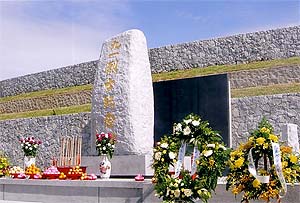 Compare this to Malaysia's
sook ching
and Malayan People's Anti-Japanese Army (MPAJA) monuments. The latter retains their intimate link with events, and emotions, but as a result 'belong' to one community. At best they are limited in scope, at worst they may remind people of tensions during and after the war between anti-Japanese forces, and those who served in the police or Japanese militias. In Singapore, the Civilian War Monument takes on a wider significance. The downside, of course, is that people's understanding of this extraordinary monument - extraordinary because below it, smack in the middle of a modern, global city, are the remains of 20,000 plus victims - was diluted. Its emotional force was dissipated, even as its message was widened. There is no ducking it, the issues here are difficult.
Compare this to Malaysia's
sook ching
and Malayan People's Anti-Japanese Army (MPAJA) monuments. The latter retains their intimate link with events, and emotions, but as a result 'belong' to one community. At best they are limited in scope, at worst they may remind people of tensions during and after the war between anti-Japanese forces, and those who served in the police or Japanese militias. In Singapore, the Civilian War Monument takes on a wider significance. The downside, of course, is that people's understanding of this extraordinary monument - extraordinary because below it, smack in the middle of a modern, global city, are the remains of 20,000 plus victims - was diluted. Its emotional force was dissipated, even as its message was widened. There is no ducking it, the issues here are difficult.
How does one retain the authenticity of monuments, and their umbilical cord to the groups affected and actual events, while still creating an overall commemorative environment which unites more than it divides? Malaysia's and Singapore's, and Malaysians' and Singaporeans' different approaches both have their strengths and pitfalls. Are either, or both governments and sets of people ready and able to improve on matters?
You know, beyond this, it is very strange for a historian such as myself, who has taught in Singapore since 1995. One half of me empathises with the Singapore narratives, of each community individually and of the struggle to create a multi-racial nation despite tensions (my parents were in Singapore during its 1964 riots). The other, British half of me sees the oddity of The 'Fall' being represented over and again, and then again.
Not only is Feb 15 marked as 'Total Defence Day' - in contrast to many other countries which mark the end of their wars - but the 'Fall' can be seen in a waxwork model diorama at Sentos's 'Images of Singapore', in Percival's underground bunker at 'The Battlebox' on Fort Canning Hill, and from next year at the Ford Factory, which will open as an interpretative centre. This British part of me says: what psychological and political needs demand so much concentration on the act of defeat, compared to the daily reality of occupation or local comfort women, or understanding what drove Japanese actions? Or, on the desire to focus on the end of war as a date for commemorating the fallen not just from one set of dates or one conflict, but of all the nation's fallen: present, past, and future.
Anyway, in a second phase, from the 1980s, and more so from the 1990s, Singapore seems to have determined to remind its new, post-1960s 'aircon generation' of the struggles and vulnerabilities which the government believed had shaped the early state and nation-building. So the war was emphasised in schools, in television series such as 'The Price of Peace' and 'A War Diary' and by marking historical sites, almost as a symbol for the island-state's survival, in the widest sense, depending on people recognising that it could only thrive by constant struggle in every sector. The 'Fall' seems to have become a useful symbol for something much bigger. Its projection was also linked to the continuing need for National Service, despite threats seeming less immediate.
Finally, one might argue that Singapore has more war sites simply because there was more war, more military here per square mile of territory, than there was or is in Malaysia's larger expanses. The battle and the bombing came to the city itself in a way it did not, perhaps, to many Malaysian towns. Singapore was bombed on and off from the night of Dec 7 and 8, 1941 right through to the bitter end, with storm drains taking on a new role as ubiquitous, handy air-raid 'shelters'.
The sook ching also wiped out a small but not inconsiderable percentage of the island's adult male Chinese population. People were killed on beaches in Changi, but also by being machine-gunned in the waters off today's Sentosa, so there are sook ching concentration and massacre sites across the island. And Singapore had vast military installations, the naval base and barracks covering much of Changi, as well as a coastal gun system, headquarters and civilian employees of the military. Even when Singapore had fallen, it still remained more of a military epicentre, with the Changi POW camp, and Indian POWs. Sentosa Island for instance, within sight of Singapore's Central Business District, is still covered with barracks and old coastal gun sites, and areas around Portsdown Road and much of Changi still bear the imprint of the British military.
In one, final sense, however, both Malaysia and Singapore share additional dilemmas and difficulties about remembering the war.
In both cases the Malayan Communist Party played a dynamic part in organising Chinese resistance to Japan, going back to 1937, and forward to the MPAJA. In Singapore it was the Malayan Communist Party (MCP) which helped recruit Chinese volunteers to fight alongside the British in 1942. It was also the MCP which first tried to commemorate Feb 15, in 1946, until a march their affiliates helped organise was halted by police and gunfire - at least one marcher died - outside today's Singapore Art Museum. This in itself is an incredible moment to contemplate.
During the first post-war anniversary of Feb 15, the marchers assembled and arrived at what was then St Joseph's Institution en route to the Padang. And then the police arrived and shots were fired. But of course the post-war struggles of the PAP and of the Alliance against communists have made it difficult to integrate this anti-Japanese story into mainstream accounts. In Singapore, the Chinese, Guomindang nationalist Lim Bo Seng remains an acceptable war hero, but Chin Peng who met him from a submarine off Malaya's coast, and his colleagues, are not. This is a question that future generations may ponder more, as the Cold War recedes into memory post-1989, and as we recognise how many of those who fought did so not primarily or only as communists, but also as patriots of one sort or another.
In both Malaysia and Singapore, as well, one has to acknowledge that different communities had different experiences, and that the respective peoples and governments may find it difficult to both recognise difference, and yet also create stories usable at a national level. How does one integrate both the anti-Japanese fighters, and the Indian National Army which fought alongside Japanese? How about the stories of those who worked with Japanese, and found them considerate as employers, with others who lost family to the sook ching ?
Also, 'collaborator' is a loaded word; people work with various regimes to further their own, sometimes personal and sometimes nationalist, ends. But nevertheless the complexities, practical and emotional, of living under a Japanese regime have not been adequately explored, in books or on film. And this is without even mentioning the communal violence which broke out in August to September 1945, when the MPAJA emerged from the jungle, and some Malays took exception to attempts to mete out 'justice' on 'collaborators' and to wield influence.
Dr Blackburn and I are revisiting these thorny problems and varied memories in a book we are just finishing, on Asian Memories of the war and occupation, and of notions of heroes, villains and victims. Here we not only look at national narratives, but also at the different experiences of each community, and even for different parts of each community.
Note: Part 3 will be published on Friday
JAMES WONG WING ON is chief analyst of Strategic Analysis Malaysia. He is a former DAP member of Parliament for Kampar (1990-1995) and a former columnist for the Sin Chew Jit Poh Chinese daily (now Sin Chew Daily). He read political science and economics at Monash University in Melbourne, Australia.


