




Selective amnesia - the curious case of Dr M
This the season where politics in Malaysia, to borrow the famous words of Lewis Carroll, becomes 'curiouser and curiouser'.
It is a time where villains transform into heroes and heroes transform into villains, friends become foes and foes become friends.
It is also a period of selective amnesia.
COMMENT This the season where politics in Malaysia, to borrow the famous words of Lewis Carroll, becomes 'curiouser and curiouser'.
It is a time where villains transform into heroes and heroes transform into villains, friends become foes and foes become friends.
It is also a period of selective amnesia.
Dr Mahathir Mohamad is now concerned that Malaysia is becoming a police state and objected to the arrest of journalists .
Rewind to 1987. The police mounted an operation codenamed after Imperata cylindrica , which is commonly known among others as Japanese bloodgrass.
In Malaysia, it is called lalang - a term which is also used to berate those who change their stand and view according to circumstances.
More than a hundred people were nabbed under the now defunct Internal Security Act, which allowed for detention without trial.
Permit revoked for 4 papers
This included opposition politicians and activists. It also saw the revoking of the publishing licenses of two dailies, The Star and Sin Chew Jit Poh and two weeklies, The Sunday Star and Watan .
This occurred when Mahathir was prime minister, a post he had held for more than two decades until 2003.
However, he only accepted responsibility for the crackdown last year after initially claiming that he was in China when the police dragnet was cast.
"If I made a mistake, I made a mistake. As you know, I'm an old man, 89 years old, prone to forgetting and I forget my dates," he had said then.
However, Mahathir, who ruled with an iron fist and ensured that not a finger is lifted without his consent, continued to deny ordering the mass arrest.
"Even if the decision was made by somebody else, it is in the cabinet and I accept responsibility.
"What we did was to ensure stability and peace in this country," he said, alluding to the claim that the detention was to prevent racial riots but which detractors argue was a calculated strike on dissenting voices.
Realigning allegiances
Since Mahathir launched his tirade against Prime Minister Najib Abdul Razak some two weeks ago, there has been a shift of the political tectonic plates.
Those who once sang praises of Mahathir are now tapping their feet to a different tune.
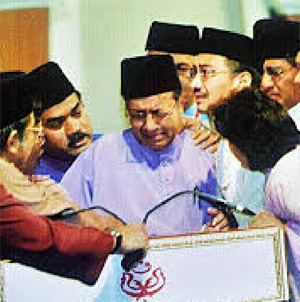 During the 2002 Umno general assembly when Mahathir broke down and announced his intention to resign for having failed to uplift the Malays, Hishammuddin Hussein was among the first to persuade him not to do so, and a
news report
then stated that the latter was heard saying, "No. No."
During the 2002 Umno general assembly when Mahathir broke down and announced his intention to resign for having failed to uplift the Malays, Hishammuddin Hussein was among the first to persuade him not to do so, and a
news report
then stated that the latter was heard saying, "No. No."
But now Hishammuddin believes that it is best to ignore the former premier's ranting against his cousin.
On the other hand, those who once condemned Mahathir as a despot and corrupt politician are now rallying behind him, hoping that it would divert attention from their own imbroglios and at the same time inflict irreparable damage on the ruling coalition.
Malaysians have grown accustomed to such twists and turns, especially with Mahathir being the catalyst over the last two decades.
A similar scenario unfolded when the former premier went on the offensive against his handpicked successor Abdullah Ahmad Badawi ahead of the 2008 general election.
Prior to that episode, Anwar Ibrahim went from premier-in-waiting to opposition cause celebre. Then too, adversaries became comrades and comrades became adversaries.
To quote a wise observer, "Good politicians do not know boundaries and Mahathir is a master at statecraft".
Then again, the former premier - irrespective of his motivation - has raised several pertinent questions.
RK Anand is a member of the Malaysiakini team.


