


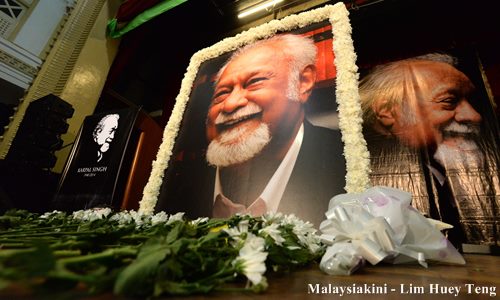

Karpal Singh's longest day
COMMENT Early in 1987 I was instructed by my then boss, Graeme Jenkins, who was the general manager of the New Zealand Press Association, to jump on a plane from Hong Kong, fly down to Penang and have a chat to this lawyer by the name of Karpal Singh.
I was under orders to cover the case of Lorraine and Aaron Cohen who were both from New Zealand and facing the death penalty for drug trafficking, under Section 39B of the Dangerous Drugs Act 1952. Karpal represented both the New Zealanders.
In the later part of 1987, Lorraine Cohen was sentenced to death and her son Aaron was sentenced to 20 years’ imprisonment, plus six strokes of whipping.
When I first met Karpal, I instantly liked this big, burly Sikh lawyer with the big belt. He liked a Tiger or two - so did I - and we got on well...
I was under orders to cover the case of Lorraine and Aaron Cohen who were both from New Zealand and facing the death penalty for drug trafficking, under Section 39B of the Dangerous Drugs Act 1952. Karpal represented both the New Zealanders.
In the later part of 1987, Lorraine Cohen was sentenced to death and her son Aaron was sentenced to 20 years’ imprisonment, plus six strokes of whipping.
 When I first met Karpal, I instantly liked this big, burly Sikh lawyer with the big belt. He liked a Tiger or two - so did I - and we got on well.
With Lorraine Cohen parked up on death row in the Penang Prison in late 1987, Karpal found himself in the Kamunting Detention Camp.
You can imagine how the Cohens - who were both facing the death penalty and were appealing to the Supreme Court - must have felt during the 15 to 16 months their lawyer was on the inside at Kamunting.
During that time I came to know Karpal, his wife Gurmit Kaur and their young family as people who could all see beyond their own very considerable problems.
Fourteen months after he was detained without trial I visited Karpal on Dec 16, 1988, at the Kamunting Detention Camp.
During that visit I joined the doubting Thomases and asked Karpal about his thoughts on whether or not Lorraine and Aaron Cohen should get themselves another lawyer.
Karpal was not impressed by this line of questioning. Rather than give me a verbal response he sat down and produced a written note which he asked me to pass on the Cohens in Penang Prison.
 Somehow this note summed up for me the type of people Karpal, Gurmit (seated on the left) and their family are: “Dear Lorraine and Aaron,” he wrote in part, “do not fear. There is no doubt I will be allowed to appear for you and Aaron at the hearing of your appeal.
“I was allowed to argue the United Engineers Malayia (highway construction case) appeal in January this year. There is provision in the Internal Security Act to allow a detainee to appear in court.
“The minister for home affairs invoked the provision in the ISA for me to appear before the Supreme Court and argue in the UEM appeal.
“With warm regards to both, Aaron and yourself. Rest assured I will do my best in your appeal. Yours is a criminal appeal involving the death penalty. The UEM appeal was a civil appeal.
“Surely if I could be allowed by the minister to appear in a civil appeal, I should have no difficulty in getting the minister for home affairs to allow me to appear in your appeal.
“All is not lost. It cannot be. Both Aaron and you are always in my thoughts. Take heart. We must not lose heart. Every cloud has a silver lining. That lining will enlighten that which has been plunged into darkness.”
I read that note and told Karpal I would make sure it was published and the Cohens would received his message via newspaper clippings. I said goodbye to Karpal at Kamunting for the last time and wished him a Merry Christmas. Karpal reacted with a wry smile and a shrug of the head.
Lorraine’s longest hour
The longest day of Lorraine Cohen's life was spent in the Kuala Lumpur Supreme Court on Aug 9, 1989, as she waited for the court to tell her whether she would live or die on the Pudu Prison gallows or her life would be spared.
Two years earlier she had been sentenced to hang by the neck until dead for trafficking in 140.78gm of heroin, by judge Dzaiddin Abdullah, the man known in Australia and New Zealand as the ‘hanging judge’.
 The Lorraine Cohen (right) I knew while covering three years of courtroom drama in Malaysia was a pleasant, likeable toughie.
I'll never forget the look of belligerence she gave the hanging judge as he sentenced her to death.
The same judge had spared her son, Aaron, who was 18 when he was arrested in Penang.
Aaron Cohen told the High Court he was in fact born a heroin addict.
Justice Dzaiddin told Aaron when sentencing him that he had escaped the gallows by the "skin of his teeth". Instead, he was sentenced to 20 years in jail and six strokes of the rotan for possession of 34.61gm of heroin for his own use.
I was there sitting on the Supreme Court appeal press bench in Kuala Lumpur when Lorraine Cohen's death sentence was overturned and replaced by a 20-year jail term.
Throughout proceedings in the stately courtroom, Lorraine publicly put on a brave front for her son. Away from the limelight, however, it was a different story.
In the lock-up, her hands shook uncontrollably. She couldn't even light a cigarette for her son.
For his part, Aaron took the appeal proceedings in his relaxed stride. He slept through most of the submissions in which prosecutors appealed to have his life sentence and six stroke whipping increased to a death penalty.
The longest hour of Lorraine Cohen's life began when the appeal court rose to consider its verdict.
I remember vividly too a lawyer - and would-be palmist - taking her hands in his own, looking into her eyes, studying the configurations on her palms and pronouncing positively that she would enjoy a long life.
'If I go down now, I'm finished'
I recall Cohen also speaking quietly to her own lawyer Karpal Singh. "This is it, mate. If I go down now, I'm finished," she said.
Karpal for his part was at his stereotypical, soothing best as he always was when dealing with his death penalty clients.
“Not to worry Lorraine, I’ll do the necessary,” he used to say to her.
Lorraine Cohen had difficulty standing between two female wardens for the verdict in front of her son. Aaron, for his part, was handcuffed to a male warden at the rear of the dock.
The lord president of the Supreme Court first of all dismissed the public prosecutor's appeal seeking the death penalty for Aaron, and the defence appeal seeking a reduction of his jail and whipping sentences.
Aaron looked at me from the dock with an inquiring look on his face, seeking an explanation of what had happened. I told him: "You will live, but you have been sentenced to 20 years in jail and a six-stroke whipping." He was not impressed.
Attention then turned to his mother, who was told Judge Dzaiddin in Penang had done her a favour. The Supreme Court disagreed with his findings that the needle marks on her arms had been caused by bashings from a de facto husband.
Instead, it found the marks on her arms were those of a multiple intravenous drug user. Her death penalty conviction was reduced from trafficking to possession.
Like her son, she, too was sentenced to 20 years' imprisonment. They went on to serve 11 years in the Penang Prison, before being released under a royal pardon and returning home to New Zealand.
Karpal Singh was at the airport, as he always was with his high profile clients, to wish them bon voyage and a safe journey.
Oh yes, and by the way, miraculously Lorraine Cohen did outlive her lawyer, by six weeks. She died of cancer in Auckland in late May 2014.
Re-arrested within hours
Now let me switch the clock back by 27 years. In 1987 Malaysian Prime Minister Dr Mahathir Mohamad was struggling to achieve the rock-solid control of his ruling Umno political party that would inevitably come his way over the next decade.
He was confronting major problems on many fronts, particularly from within the Umno establishment via a strong challenge to his leadership from Trade and Industry Minister Tengku Razaleigh Hamzah.
 It was a time when Karpal, working alongside his lifelong friend Lim Kit Siang, successfully obtained an injunction temporarily blocking the PLUS highway project from proceeding.
For the first time in his political career Karpal was using his legal skills to go after the prime minister. Mahathir was, at that time, fighting for his own political survival.
In March 1988 a bench of five Supreme Court judges in a 3-2 decision dissolved Lim Kit Siang’s earlier interim injunction, thus allowing the North-South Highway deal of United Engineers Malaysia Bhd (UEM) to proceed.
The highway construction went ahead of course. Knowing what we know now, with the benefit of hindsight, there is more than a certain fatalistic irony in Karpal going to court to prevent the construction of a highway upon which he himself would die 27 years later.
To cut a long story short, on Oct 27, 1987 Karpal found himself swept up in Operation Lallang by Special Branch head Abdul Rahim Noor and detained indefinitely without trial under the Internal Security Act.
As soon as possible, following his arrest and first 60-day detention period in strict isolation at the Police Remand Centre near the Batu Caves, Karpal embarked upon a campaign of action to obtain his own freedom from Kamunting Detention Camp via a writ of habeas corpus.
On March 9, 1988, he managed to successful argue for his own release in front of a very brave judge, Justice Peh Swee Chin, in the High Court in Ipoh.
Arguing for his own freedom in the court, Karpal was at his flamboyant best.
To my mind, this was Karpal’s longest day. It was a day in which he would experience many different emotions from the euphoria of his release to the despair of rearrest later that night.
It was a day when he learned how his clients feel when they are both unexpectedly released and rearrested on the same day. I think that particular day made him very sensitive to the emotions his clients were going through for the remainder of his career.
Arguably the happiest three hours of his professional life as a lawyer were spent in the Long Bar at the Ipoh Club on that day.
His fellow lawyers, brother Manjit, Mariadas, Assamaley, Oh Choon Ghee and Kartar Singh were among the members of the profession called to the bar to celebrate Karpal’s shortlived freedom that day.
Free, but for how long? That was the question on Karpal’s mind as he and his family left the Ipoh Club at about 6pm for the two-hour drive to Penang, with driver Jeffrey at the wheel of their 300D Mercedes.
As we all know, Karpal’s freedom was short-lived on that particular day. It ended at a police roadblock outside the Nibong Tebal Police Station.
About the time Karpal was being rearrested I was getting off a flight from Hong Kong, via Singapore.
After landing at Penang I went immediately to Karpal’s Jalan Utama home where I received the news Karpal was already back inside after achieving short-lived freedom – his accommodation had rather abruptly switched from the Kamunting Detention Camp to the cells of the Penang police headquarters.
I got a cab, checked in at the City Bayview where my wife Gabrielle and I will once again catch up with doorman Abdul while checking in again there the next morning.
 From the City Bayview I walked down Penang Road to the police station, not knowing what to expect. There I met up with Gurmit Kaur and her eldest son Jagdeep (left), her brother in law Dr Nirmal Singh and his wife Manjit Kaur.
It was then that I realised, as I stood alongside them all during a three-hour vigil outside the police station, that this was not a family to kow-tow in front of any man or woman.
An incorrigible, talented woman
Gurmit Kaur that night reminded me of Lorraine Cohen on the day she was sentenced to death in the Penang High Court a year earlier.
When Lorraine Cohen was sentenced to death by the man then known as the hanging judge in Australia and New Zealand, Dzaiddin Abdullah, I recall the look of belligerence on Lorraine Cohen’s face as the death sentence was handed down.
When I looked at Gurmit Kaur on the night of March 9, 1988, I saw the same sort of strength and defiance which somehow, some people can muster when confronted by impossible odds.
As I stood alongside her on that night, I remember in particular Gurmit Kaur walking over to the iron fence of the police station and shouting out to no one in particular - ‘he needs a doctor’.
It was on that night that I realised Karpal Singh had married an incorrigible, talented woman when he married Gurmit Kaur on July 30, 1970.
As a believer in karma, I think it is no coincidence that that marriage took place 44 years ago today.
I remember too, in particular on the night Gurmit Kaur - while looking at a blind man trying to make a living by selling tissue paper at 30 sen a packet - saying to me there was always someone worse off than yourself.
It has been a long and enjoyable journey since we all first travelled together from Penang Island to the Kamunting Detention Camp with Karpal’s young children then singing ‘we’re going to bring the old man home’ in the back of the car.
The record now shows they did indeed bring the ‘old man home’ every step of the way throughout his life.
 I have admired the in-house gallows humour of Karpal and his extraordinary family, having been privileged to closely study their hard-headedness, patience and fortitude over the years in overcoming many trials and tribulations.
I also marvelled in recent years at the round-the-clock unswerving support Karpal received from his personal assistant Michael Cornelius, a humble man who gave his life for his boss.
Following the prayers at the Sikh temple in late April 2014 I said goodbye to Karpal’s family, before once again returning to New Zealand and the small Maori township, a world away in Raetihi.
When I said goodbye to the family at their Western Road (Jalan Utama) home in Penang, Ramkarpal was there with his campaign manager, Gurmit Kaur.
At this time I would like to pay a special tribute to Gurmit Kaur, Karpal’s lifelong campaign manager, wife and protectress. She was the woman who helped her husband plan each often seemingly impossible charted course.
In the words of Frank Sinatra himself the record shows, together they stood tall and saw it all through, regardless of the consequences. Amidst their grief there was the certain knowledge that Ramkarpal’s first election victory in the Bukit Gelugor electorate would be landslide - and indeed it was - by a majority of 37,659 votes.
Ramkarpal’s destiny, like his brother Gobind’s, was to become an MP in the Malaysian Parliament.
TIM DONOHUE is author of ‘Karpal Singh, The Full Biography, Tiger of Jelutong’. The book is to be launched in Penang tomorrow (July 31) at 7.30pm at Wawasan University. The above is an abstract of a prepared speech for delivery at the Kuala Lumpur 2014 Bookfest today.


