




Deep waters, deep pockets - behind the Kajang Move
COMMENT Once in a blue moon, an explanation comes along that makes something inscrutable suddenly become clear as day.
Some of us use the term Kajanggate. This obviously references the Watergate scandal, which resulted in Richard Nixon becoming the only president of the United States to resign while in office. ‘All the President’s Men’, a movie about how the scandal broke, apparently popularised the phrase “Follow the money.”
This is invariably good advice when trying to understand politics.
Let me open with a number of very simple questions regarding an important and very much overlooked factor in Kajanggate: the Selangor water industry...
COMMENT Once in a blue moon, an explanation comes along that makes something inscrutable suddenly become clear as day.
Some of us use the term Kajanggate. This obviously references the Watergate scandal, which resulted in Richard Nixon becoming the only president of the United States to resign while in office. ‘All the President’s Men’, a movie about how the scandal broke, apparently popularised the phrase “Follow the money.”
This is invariably good advice when trying to understand politics.
Let me open with a number of very simple questions regarding an important and very much overlooked factor in Kajanggate: the Selangor water industry.
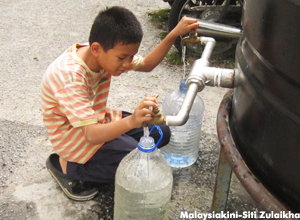 Assuming the current menteri besar of Selangor is to be replaced, will any individual seeking to replace him:
a) Promise to continue the state government’s efforts in reclaiming control over Selangor’s water industry from private corporations.
b) Promise not to offer a higher price (to any individual water concessionaire) to buy over Selangor’s water industry back from the water concessionaires than the most recent offer made by the Selangor state government, as of December 2013.
c) Promise that any contract given to a private entity to run Selangor’s water industry after the takeover be made through a completely open and transparent tender.
There may be more options to get the best deal for the rakyat, but any attempt to present one had better include very detailed explanations. Any such alternative/explanation which would result in private corporations making more profit (than other deals proposed by the state government to date) may be viewed with considerable suspicion.
If any aspiring menteri besar would sign a legally binding document promising the above, I think it would go a long way in putting to rest a number of concerns that may arise in this recent power grab.
To understand why this is so, we need to revisit the long, dirty history of Selangor’s water industry.
How we got here
Allow me to quote from a Selangor Times report from last year:
“In the 1980s, before the era of privatisation, state-owned Jabatan Bekalan Air Selangor used to manage the state’s water services and was making annual profits of between RM50 million to RM80 million.
“But in 1997, the Barisan Nasional-led state administration decided to split the industry and privatised the profitable water treatment service to three companies.
“It wasn’t until 2004 that Syabas took over the loss-making water distribution service and was granted a 30-year concession, allowing them to raise water tariffs every three years from year 2009.”
Basically, BN took a huge profit-making monopoly, privatised it to cronies, who then siphoned out all the money, making it a loss-making enterprise, and then gave it to people (Syabas) who siphoned even more money out of the industry. That is what Selangor inherited in 2008.
The article goes on to say:
“The Energy, Green Technology and Water Ministry and the National Water Services Commission (Span) are supposed to regulate the country’s water sector under the Water Services Industry Act 2006 (WSIA).
“Indeed, Section 114(1) of the Act allows the minister to assume complete or partial control of water assets and business ‘for national interests’, which ‘shall not be challenged, appealed against, reviewed, quashed or questioned in any court’.
“In the spirit of WSIA, the federal government had originally given Selangor’s investment arm Kumpulan Darul Ehsan Bhd the green light to begin the state’s water restructuring exercise before the 2008 general election.
“However, after Pakatan Rakyat took over the Selangor state administration, its efforts to consolidate the water sector for the past five years have not been backed by Putrajaya.
“Splash and Abbas accepted one of the state’s offers in June 2009 but Syabas and PNSB (Puncak Niaga) have consistently rejected all bids, including from the federal government and Splash major shareholder Gamuda in 2010.”
The abhorrent ways in which the crony culture of Syabas has become a black hole of public funds has been documented elsewhere .
By 2006, even the federal government was forced to admit how badly privatisation was ruining the Selangor water industry and proceeded to enact laws that would have allowed the state government to take over. In 2008, as the state government changed hands, the federal government changed their minds - putting partisan political interests above public ones.
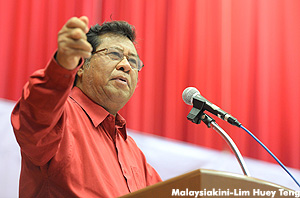 Khalid Ibrahim has been relentlessly pursuing a solution to this problem from the minute he took office, only to be frustrated constantly by the water concessionaires who seem to be holding out for bigger buyouts, and the federal government, who seem to be catering to vested interests of their own.
By 2014, the deadline for a ‘willing buyer willing seller’ solution to the water industry takeover expired. Using Section 114 of WSIA 2006 means that the federal and state governments would in effect jointly force a takeover of Selangor’s water assets, to be administered by the Selangor government and/or its representatives.
Despite all the other hubris (some propagated by yours truly), it is possible that the single biggest factor that led to Kajanggate is the fact that Khalid decided to pursue using Section 114 of WSIA 2006 to resolve this crisis.
Once Section 114 is invoked, the price for any buyout/takeover becomes set by the federal government, and is no longer in the hands of the menteri besar. Any opportunity for the state government to facilitate a sweetheart deal would thereafter be lost.
Dramatis personae
Let’s take a quick look at the four water concessionaires in Selangor: Syabas, Puncak Niaga, Splash and Abbas.
I think there has been enough said about Syabas and its parent company Puncak Niaga. Their case brings to mind some of the worst cronyism and mismanagement the country has ever seen.
Splash is a much smaller water concessionaire, compared to the likes of Syabas, but that doesn’t mean they are small. In the latest buyout offer made by the Selangor government, Splash was valued at RM1.83 billion.
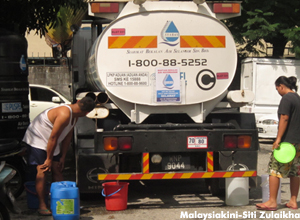 The major shareholders of Splash are: Kumpulan Perangsang Selangor Bhd (a Selangor government-linked company) - 30 percent, Gamuda (the company some linked to the Perak crisis of 2009) - 40%, and Wan Azmi Wan Hamzah (via Sweet Water Alliance Sdn Bhd) - 30 percent.
Wan Azmi is one of Daim Zainuddin’s blue eyed boys from back in the day - he has been involved over the years in some of the biggest corporate wheeling and dealing that Malaysia has ever seen - the man is certainly no stranger to multi-billion dollar deals.
Like every intelligent businessman, Wan Azmi seems perfectly happy to play both sides. I don’t think it is a secret that he has been very supportive of PKR and its top leaders over the last few years (one cannot say for sure if he has simultaneously shed his Umno links. In his position, I certainly wouldn’t).
One of the few very ways this support has been visible is through his support of Institut Rakyat, where he is on the board of directors alongside some top PKR leaders, and is possibly its bankroller. It is unclear what or who else in the party he may or may not have financed.
As an aside, I have taken issue with a great many things that blogger Raja Petra Kamarudin has written over the years. Put simply, he has sometimes been very right, and sometimes been very wrong. In relation to this issue, the internal PKR dynamics he describes in this article is in my view inaccurate or at the very least out of date. Readers will have to judge for themselves however, whether what he has written about other people in that article is true.
Suspicious chronology?
At this point, we must tread very carefully. Whatever we may hear on the grapevine, it is of course only ethical not to make baseless accusations.
I don’t think it is unfair to say that if PKR replaces Khalid with a new menteri besar that goes on to approve a sweeter deal for certain water concessionaire owners than the one Khalid proposed, eyebrows may be raised.
The chronology of this entire affair may also make some uneasy.
Khalid decided to accede to pursuing Section 114 of the WSIA just around the new year.
Soon after, on Jan 14, Rafizi Ramli, self-proclaimed architect of Kajanggate, released an official statement in his capacity as PKR director of strategy, criticising the federal government for invoking Section 114, and stressing that certain water concessionaires must not be ‘punished’ as a result of this move. Abbas, the company closest in nature and scale to Splash, was named as an example.
Following this, rumours of Khalid being replaced went into high gear, and on Jan 27, Lee Chin Cheh announces his resignation.
There may be more circumstantial evidence surrounding this timeline, but it is probably currently premature to pursue those details in the media.
In summary, making the pledges outlined at the beginning of this article would of course go a long way in putting any undue doubts or suspicions at rest.
Any failure to do so, and/or evasion of this topic, on the part of those promoting a change of menteri besar should perhaps motivate us to pursue clarity on the matter with greater vigour.
NATHANIEL TAN has been thinking of animal farms. He tweets @NatAsasi .


