




A word's not anything one says it means
COMMENT "So you are a mercenary, lah ," quipped judge Richard Malanjum from the bench yesterday while Muhammad Shafee Abdullah was holding forth.
The senior counsel was expatiating on the list of parties and politicians he had appeared for in the course of a long career - a variety, he submitted, that would attest his professional skills more than his partisan affiliations.
A titer of laughter ran through the crowd at the Federal Court as Malanjum interjected to make the comment.
But the matter at hand - a defendant's right to a fair trial - was not a trifling one.
It concerned whether Shafee, who has been prolific in advocacy of clients regarded as adverse to the defence, could perform without presumptive bias the deputy public prosecutor's role in the government's appeal of the High Court acquittal for sodomy of Anwar Ibrahim...
COMMENT "So you are a mercenary, lah ," quipped judge Richard Malanjum from the bench yesterday while Muhammad Shafee Abdullah was holding forth.
The senior counsel was expatiating on the list of parties and politicians he had appeared for in the course of a long career - a variety, he submitted, that would attest his professional skills more than his partisan affiliations.
A titer of laughter ran through the crowd at the Federal Court as Malanjum interjected to make the comment.
But the matter at hand - a defendant's right to a fair trial - was not a trifling one.
It concerned whether Shafee, who has been prolific in advocacy of clients regarded as adverse to the defence, could perform without presumptive bias the deputy public prosecutor's role in the government's appeal of the High Court acquittal for sodomy of Anwar Ibrahim.
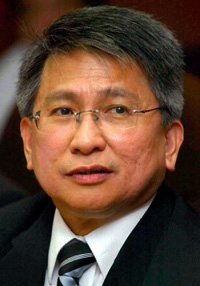 Malanjum (
left
), Chief Judge of Sabah and Sarawak, together with four others, was on a panel to decide a defence application to disqualify Shafee from appearing as DPP.
Malanjum (
left
), Chief Judge of Sabah and Sarawak, together with four others, was on a panel to decide a defence application to disqualify Shafee from appearing as DPP.
Malanjum made the remark as Shafee was attempting to rebut the defence argument that he was a political partisan, a hack with a bias for Umno briefs.
Anwar's lawyers had argued that Shafee's past advocacy on behalf of a political entity seen as patently adverse towards their client had saddled him with bias sufficient to disqualify him for the role of DPP in the government's appeal of Anwar's acquittal.
Hearing of the appeal is scheduled for today and tomorrow at the Court of Appeal.
Amiable ribbing or deliberate putdown?
Shafee, whose riposte to Malanjum's remark was that his was the business of professional practice of the law, was keen in comments to an inquiring press after the hearing, to make the point that Malanjum's quip was to be taken in the spirit of banter.
Whether Malanjum's comment was amiable ribbing or deliberate putdown, the nature of the profession is such that no lawyer can behave like a mercenary and at the same time be true to the profession's ethics.
It would be a suicidal loss of essence to the concept of the rule of law if an officer of the court is motivated by mercantile considerations: a duty to the service of justice which underpins the whole concept of law's rule and an attitude of hiring oneself out to munificent bidders is like water and oil - they can't mix.
Given the gravity and majesty of the rule of law, Malanjum's remark about the range of Shafee's clients cannot be viewed as innocuous banter.
But Shafee ( right ) chose to interpret it in the spirit of Humpty Dumpty who famously held that "A word is anything I say it means"
However, the rule of law and the words used to formulate and interpret it cannot adopt the attitude of Humpty Dumpty whose creator, Lewis Carol, it is instructive to recall, was a mathematician and logician.
Precision in the making and interpretation of the law are an integral part of its panoply so that one cannot make light of a ranking judge's remark such as Malanjum's, more so when that advocacy is being commandeered for a public prosecutorial role that, by definition, is free of any presumption of bias.
Also, the practice of law is a tradition, with a known set of rules and attached meanings.
This tradition is an accumulation of nuance given pith and moment by the behaviour of the profession's leading lights.
Evidence given by a critical witness
In the course of his submissions yesterday on the matter of his fitness for the role of DPP, Shafee mentioned that he had assisted the late and eminent Raja Aziz Addruce in a 1987 court case that eventuated in the illegalisation of Umno.
Judge Harun Hashim's decision to render Umno illegal triggered a concatenation that saw then Lord President Salleh Abas hauled before an international tribunal of judges to be impeached, an episode that Salleh's predecessor, Suffian Hashim, would bemoan as the most "shameful" in our judicial history.
Perhaps the most excruciating aspect of the whole charade was the presence as head of the tribunal of Abdul Hamid Omar, the judge who stood, in terms of promotion, to gain from Salleh's impeachment.
Salleh was impeached and Hamid duly promoted to the vacant Lord President's position.
After that, for as long as Hamid was head of the judiciary, Raja Aziz ( left ), the Bar's preeminent member at that time, chose as a matter of principle not to appear before any panel of the apex court that included Hamid. The protest meant that Raja Aziz had to forgo much in the way of professional fees.
This is the type of conduct that added several cubits to Raja Aziz's already high standing among peers and lent luster to the ethical bases on which the legal profession stands.
Shafee has been on public record on the line of argument he will take in the appeal of Anwar's acquittal for sodomy.
From what he has said, he will necessarily rely on the evidence given by a critical witness, DSP Jude Pereira, whose handling of DNA exhibits High Court judge Zabidin Mohd Diah found to be unreliable and therefore inadmissible as a basis for convicting Anwar of sodomy.
In a Human Rights Commission (Suhakam) inquiry in 2009, as panel chairperson, Shafee impugned the probity of the same police officer whom the chair found unreliable as a witness in a matter concerning the violation of the rights of five lawyers who had complained to the commission on their treatment.
Today and tomorrow's hearing on the appeal of Anwar's acquittal will go a long way in establishing whether Shafee can with a straight face argue that what has not been good for the Suhakam goose can be good for the Court of Appeal gander.
TERENCE NETTO has been a journalist for four decades now. He likes the profession because it puts him in contact with the eminent without being under the necessity to admire them.


