




The essence of journalism
COMMENT The worst headline that can greet a journalist is this: Malaysia records worst-ever ranking on press freedom. Let's face it, we have reached rock-bottom.
COMMENT The worst headline that can greet a journalist is this: Malaysia records worst-ever ranking on press freedom. Let's face it, we have reached rock-bottom.
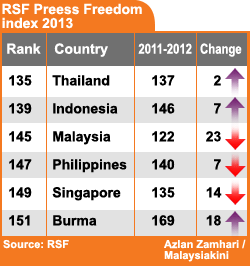
In the latest World Press Freedom Index compiled by Paris-based Reporters Without Borders, Malaysia dropped 23 spots to a new low ranking of 145 out of 179 countries.
Some are quite happy to live with this sorry state of affairs. After all, we are three steps ahead of Singapore, which is ranked lower than Malaysia at No 149.
But this is no consolation, considering that Bangladesh, Libya, Kyrgyzstan, Thailand, Indonesia and Brunei are better off than us. And if that's not bad enough, Burma is fast catching up - it climbed 18 spots to No 151, just two steps behind us.
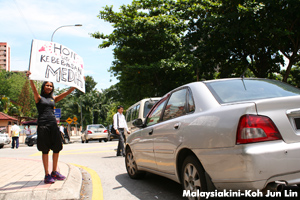 The moot point is that journalism as practised in Malaysia has fallen from grace.
Journalists, particularly senior editors, should start redeeming the profession.
Sure, there are many things we can't influence or change, but one thing we can do: We can change our attitude towards journalism and believe that press freedom is not only possible but essential.
That begs the question, what is journalism? The world over, journalists who treasure press freedom subscribe to what is universally known as the ‘Ten Commandments' that define the essence of journalism.
These are:
Journalism's first obligation is to the truth.
We can't serve two masters. We either pursue the truth or pander to half-truths and languish in self-deceit.
Its first loyalty is to the citizens.
Our first duty is not the ruling or opposition coalition or to advertisers and media owners but to citizens. It is they who give us the primary reason for our being.
 Its essence is a discipline of verification.
A good journalist is a professional and responsible one. Nothing is fit to be published until and unless the information received is verified. This requires time and hard work, but needs to be done.
Journalists must maintain an independence from those who cover.
This is easier said than done in our prevailing culture, but it is no excuse for not trying to be independent. We cannot afford to succumb to biased reportage.
It must serve as an independent monitor of power.
Again, this is easier said than done. So, like it or not, someone has to bell the cat. If we are afraid to do so, then don't be journalists.
Journalists must have an obligation to exercise their personal conscience.
If journalists do not exercise their conscience, they pose the first hindrance to press freedom.
Citizens, too, have rights and responsibilities when it comes to the news.
We can never understate the right to a citizen's privacy and protection from defamatory speech.
It must keep the news comprehensive and in proportion.
Essentially, news must have context and even-handedness. A case in point is the current 'Allah' controversy. The reportage thus far lacks both context and balance.
It must make the significant interesting and relevant.
The Malaysian experience, sadly, has been one that news which is significant is often hidden between the lines.
It must serve as a forum for public criticism.
Such forums are often self-censored and I can find no reason for it. I can see merit in self-restraint or prior censorship, but never in self-censorship.
Break these Ten Commandments and we may end up burning in hell.
BOB TEOH is a journalist. He authored the book ‘Allah - More Than A Word' and was once secretary-general of the Jakarta-based Confederation of Asean Journalists.


