




The social contract is ours to create
 University Sains Malaysia associate professor P Sivamurugan (
right
)
sycophantically counselled
that "this social contract must be strengthened for greater improvement," and to add to his rather disingenuous diatribe linking criticisms of the so-called social contract to a misunderstanding of the constitution, he weaseled in "it is up to majority who do (understand), to defend the constitution"...
University Sains Malaysia associate professor P Sivamurugan (
right
)
sycophantically counselled
that "this social contract must be strengthened for greater improvement," and to add to his rather disingenuous diatribe linking criticisms of the so-called social contract to a misunderstanding of the constitution, he weaseled in "it is up to majority who do (understand), to defend the constitution"...
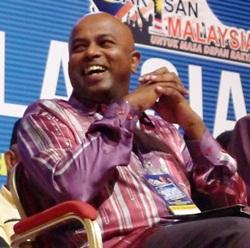 University Sains Malaysia associate professor P Sivamurugan (
right
)
sycophantically counselled
that "this social contract must be strengthened for greater improvement," and to add to his rather disingenuous diatribe linking criticisms of the so-called social contract to a misunderstanding of the constitution, he weaseled in "it is up to majority who do (understand), to defend the constitution".
University Sains Malaysia associate professor P Sivamurugan (
right
)
sycophantically counselled
that "this social contract must be strengthened for greater improvement," and to add to his rather disingenuous diatribe linking criticisms of the so-called social contract to a misunderstanding of the constitution, he weaseled in "it is up to majority who do (understand), to defend the constitution".
The central thrust of Mavis' argument is encapsulated (in my opinion) in two quotes which I reproduce here. The first:
"Central to the narrative of the inter-ethnic bargain is the power-sharing arrangement in which the leaders of the political parties of the Alliance government set out the rules for the sharing of the nation. Nation-building was based on the theme of the making and sharing of nation among its multi-ethnic citizens within a framework which entails the maintenance of the special position of the Malays. It was clear that at the heart of the debate was the issue of power-sharing between the two main ethnic groups, Malays and non-Malays, within a democratic framework."
And the second:
"In the first 10 years after Independence, the balance of power between the two main parties, Umno and the MCA, was more or less equal. After 1969, however, the balance of power within the ruling coalition shifted significantly in favour of Umno and the political system itself became less democratic. Although both parties fared badly in the 1969 elections, Umno leaders who had secured control of the government concentrated their efforts on regaining Malay support while still maintaining the power-sharing structure. With the introduction of the New Economic Policy and the extension of Malay privileges, especially in the fields of education and employment, Umno regained its popularity among the Malays and consequently assumed a dominant position in the ruling coalition."
A fool's endeavour
Of course, in this context, ‘Malays' should include the phenomenon of constitutionally-created Malays and the exclusion of the other bumiputeras - Orang Asli/the indigenous people of Sabah and Sarawak, which would skewer the demography and make the concept of ‘Ketuanan Melayu' as redundant as ‘Ketuanan bumiputera', although the latter would at least have some element of honesty in it.
 All of which makes PKR's and PAS' reassurances to the ‘Malay' community, that as the "majority" they would benefit the most under an affirmative action programme rather problematic. But I digress.
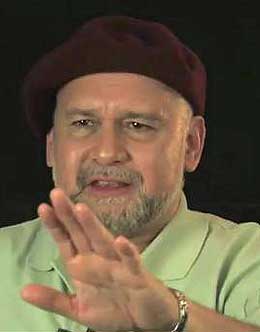
Another person who should not be shunned these days, but is by Pakatan partisans, is blogger Raja Petra Kamarudin (RPK, right ).
RPK also had the good sense to quote former prime minister Dr Mahathir Mohamad who conceded that the social contract did not exist in written form but was a verbal contract. All of this makes "strengthening" it a fool's endeavour.
Let us assume that the social contract is not a figment of Umno imagination but rather a "verbal" ( sic ) contract negotiated and agreed to (by the ethnic power groups of the time) which has been altered over the decades by Umno. Where do we go from here?
New social contract
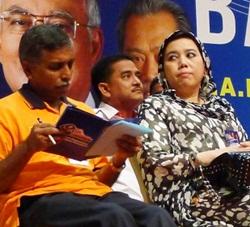 In the same event, Just World Movement president Chandra Muzaffar who shared the stage with perennial virgin Umi Hafilda Ali and butt dancer extraordinaire Mohd Ali Baharom (sheesh, if you judge a man by the company he keeps...)
asked
, "What does the other side have?" Well, I may have an answer to that.
In the same event, Just World Movement president Chandra Muzaffar who shared the stage with perennial virgin Umi Hafilda Ali and butt dancer extraordinaire Mohd Ali Baharom (sheesh, if you judge a man by the company he keeps...)
asked
, "What does the other side have?" Well, I may have an answer to that.
This understanding openly acknowledges the tensions that arise out of a multireligious country having as its backbone a fundamentalist Islamic party as a possible governing party.
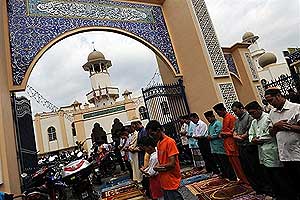 The numerous skirmishes over the role of Islam in the alternative alliance is evidence that unlike the social contract of Umno, where Islam was used as a tool to divide the country, Islam in this social contract is a tool which would determine if the concepts of rights is applicable to all or if Muslims would be forever segregated from the rest of their countrymen.
In other words, the nature of the discourse when it comes to Islam is different. No longer are the non-Muslims who subscribe to this social contract afraid to voice their concerns when it comes to Islam intruding into their lives.
It is an understanding of a sizeable section of the voting public in its support of a disparate group of political parties divided along racial and religious lines pursuing the ideal of good governance and accountability as a route to peace and stability. and not the old social contract which emphasised unequal racial power-sharing as a means to sustain tolerance and economic co-dependency.
Voluntary participation
This social contract was a long time in the making and perhaps found expression in the political tsunami of 2008. However unlike the Rukunegara which is only paid lip service, this social contract, our social contract, is aspiration turned into action when we take to the streets in support of Bersih, or Hindraf or vernacular school education or the recent Himpunan Hijau march.
It is an expression of voluntary participation for goals that would benefit society and not necessarily political parties. It is a new phenomenon in Malaysian society where people shrug of their empathy and march for what they believe in.
It is not a social contract that has coverage in the press or is explicitly expressed by opposition leaders. It is not a social contract which we are told binds us but rather a contract that is instinctively embraced by a certain section of the electorate of their own free will.
It is a social contract that means different things to different people but at its core is a belief that mutual cooperation in the face of diversity is a way out of the racial and class quagmire that Umno and its social contract has bestowed us.
It is there in the forums where race, religion or rule of law is debated and which is predictably used by the current regime as propaganda characterising those who attend as unpatriotic.
However, like most contracts of this kind, it is flawed. At times, it is myopic. At times, it relegates principle to the backburner in favour of political expediency. At times, it is racist even though it claims inclusiveness. At times, it is hypocritical in the way how it views the conduct of Umno and Pakatan.
 The good news is that it is a work in progress unlike the Umno social contract, which is a sword of Damocles that hangs over our heads. Its virtue is that it will continue evolving as long as those who subscribe to it mature politically. Time is on this social contract's side.
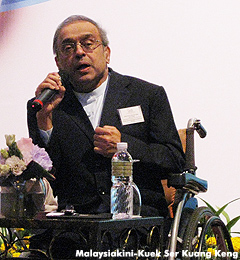
Chandra ( left ), this is the social contract of the "creatures" you wish the majority would reject. I think this is the greatest gift the political tsunami has given to future generations of Malaysians.
Or maybe I am wrong. Maybe Umno-BN is a virulent strain of chlamydia and Pakatan is a strong dose of Azithromycin.
S THAYAPARAN is Commander (rtd) of the Royal Malaysian Navy.


