




Chinese M'sians and S'pore Malays
When I last visited Singapore, it was a female Malay officer who was examining my passport at Changi Airport. Having anticipated no hassle, I was proven wrong when she smirked and said, “Planning to stay for two nights? Don’t go somewhere and do something funny you know.”
When I last visited Singapore, it was a female Malay officer who was examining my passport at Changi Airport. Having anticipated no hassle, I was proven wrong when she smirked and said, “Planning to stay for two nights? Don’t go somewhere and do something funny you know.”
“ Apa benda pelik saya nak buat kat sini? Kalau tak suka saya terus balik Johor aje .”
Rather irritated, I replied in Malay. Surprised and embarrassed, she stamped on my passport in no time and let me in.
She, perhaps, happened to be one of those Singapore Malays who were, in the self-righteous view of Mahathir Mohamad, marginalised in the Chinese-dominated state.
Picking on Malaysians was most probably a way to compensate for her inferiority complex. I was somehow pretty certain that no Singaporean immigration officer would dare to be nasty to a Mat Salleh, especially one from the United States, Australia or Britain.
But I in fact do not dispute some of Mahathir’s observations on the Singapore Malay community. As a regular visitor to Singapore since I was a child, I can safely say the fast disappearance of Malay culture on the island is a serious concern.
The most flagrant humbuggery can also be seen in the lip service paid by the People’s Action Party (PAP) to Malay as the national language.
Yes, in case one finds this incredulous, it is actually enshrined in the Singapore constitution. What is more, any foreigner who would like to naturalise as a Singaporean citizen is required to prove that ‘he has an adequate knowledge of the national language’, which makes me wonder if any of the Chinese nationals rushing to become a citizen there has passed the test.
However, I am also mindful of Mahathir’s hidden agenda, that he has been ‘speaking up for’ Singapore Malays not for the latter’s interest, but with a clear intention of disseminating the culture of fear and paranoia among the Malays in Malaysia in order to sustain Umno’s rule.
Still, seeking to educate non-Malay Malaysians, and the Chinese in particular, about the plight of the Malay community in Singapore is a daunting task. Because Singapore is ostensibly a multi-cultural society with equal opportunity, many Chinese Malaysians who detest Umno’s supremacist policies have chosen to vote with their feet and moved down south where their expertise and talent can be better appreciated.
It is hence natural that their experience of Singapore is vastly different from what a Singapore Malay may have encountered all his/her life.
The most popular argument by many of my friends who have made Singapore their home is that, while the PAP government is no more benign than Umno when it comes to restricting political freedoms, it has successfully built up the economy and ensured one’s material comfort.
It would seem that a benevolent dictator is more desirable than an inefficient democrat.
But why can’t we, as rightful citizens, demand both political freedoms and economic prosperity? We would be no different from pigs in the pen if all that we ask for is simply a bowl of rice but not the freedom to think and act for ourselves.
Servility is still alive and kicking
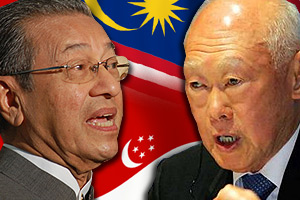
It is quite obvious that servility remains alive and kicking in those who think likewise. They may not like Mahathir as a tyrant, but would readily embrace Lee Kuan Yew as a little emperor, or vice versa.
“Racism is a non-issue here,” said one of them.
 The thing is, racism is a non-issue because the Chinese in Singapore in general do not have to feel it. Ask a Singaporean of Indian or Malay descent, the answer could be the opposite if he or she cared to be frank.
Just like the Malays in Malaysia can hardly understand the grievances of their Indian and Chinese compatriots. As part of the majority, one’s senses tend to be numb to those of others.
So, for certain Singapore Malays and Chinese Malaysians, the grass is always greener across the causeway depending on which side they are from. Chinese Malaysians may look up to Singapore as a model while being indifferent to the misgivings of the Malays on the island, just as a Singapore Malay, desperate to vent his/her frustrations or even despondence, may portray Malaysia as an utopia without taking a serious look at the racist and fascist nature of Umno.
But the reality is that both countries do have their fair share of dirty linens in terms of racism, and there is indeed no need to romanticise one just to run down the other.
Chances are, these pent-up feelings are driven by ethnic sentiments rather than a deep reflection on the lack of respect for and sensitivity towards others, which explains why a Chinese Malaysian may resort to sweeping statements against the Malays simply because he/she has had enough of Umno, or a Singapore Malay may lash out at anything Chinese after witnessing the sorry state of Malay culture.
The disgruntled Chinese may quit Malaysia and cross over to Singapore, or an unhappy Malay may board a bus from Lavender Street in Singapore for Kuala Lumpur. Either way, it is not gonna solve the real issues confronting the respective countries.
The litmus test lies, still, in whether or not we can rise above our narrow sentiments by tackling the autocratic nature of the state so as to open up space for debate in search of a solution, instead of launching a vacuous attack that may just end up alienating those who could be won over.
JOSH HONG studied politics at London Metropolitan University and the School of Oriental and African Studies, University of London. A keen watcher of domestic and international politics, he longs for a day when Malaysians will learn and master the art of self-mockery, and enjoy life to the full in spite of politicians.


