




Police budget formula helps BN to maintain power
MP SPEAKS As Parliament concludes the debate on Budget 2013 this afternoon with the debate on the allocation for the Home Ministry, it is very sad to note that budgetary figures of 2010, 2011, 2012 and 2013 show that the Barisan Nasional government is more interested in using the police to maintain power than to fight crime.
MP SPEAKS As Parliament concludes the debate on Budget 2013 this afternoon with the debate on the allocation for the Home Ministry, it is very sad to note that budgetary figures of 2010, 2011, 2012 and 2013 show that the Barisan Nasional government is more interested in using the police to maintain power than to fight crime.
Prime Minister Najib Abdul Razak became prime minister in April 2009 and Budget 2010 was his first budget. Since then Najib has had full power to change the course of history and hence should take full responsibility for the crime situation in the country.
In the context of the heightened crime situation nationally, it is high time for the nation to examine the priorities of the police through its budgetary arrangements.
It is important to note that the police force executes the policies of ruling politicians. There is no point to blame the police for misplaced priorities. Ultimately, the policy directions of the police reflect the choices made by the ruling government.
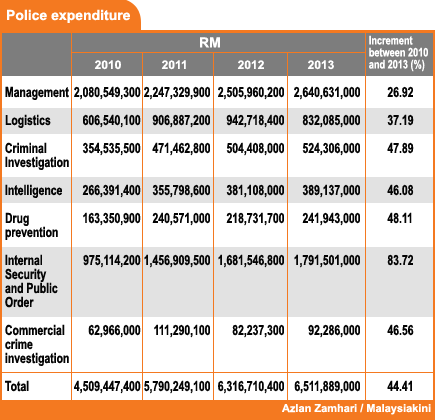 The police force was given an allocation of RM4.5 billion in 2010, RM5.8 billion in 2011, RM6.3 billion in 2012 and RM6.5 billion for 2013 respectively. There is an increase of RM 1.8 billion or 44 percent between 2010 and 2013.
(Budget 2013 documents show that actual spending in 2012 will reach RM6.78 billion, beyond the original budgeted RM6.3 billion.)
Consistently in the past four years, the criminal investigation department receives only 8 percent of the total allocation.
Management and logistics jointly consume 59 percent of allocation in 2010, 55 percent in 2011 and 2012 and 54 percent in 2013.
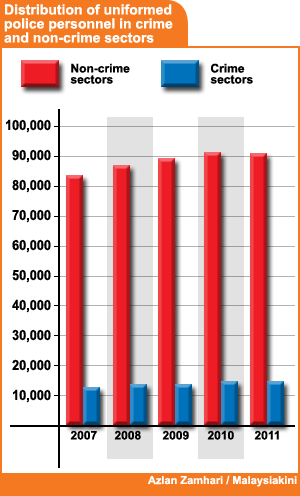 The Internal Security and Public Order category’s share of allocation was 22 percent in 2010, 25 percent in 2011, 27 percent in 2012 and 28 percent in 2013.
Indeed, the Internal Security and Public Order category increased its allocation from RM975 million in 2010 to RM1.46 billion in 2011, RM1.68 billion in 2012 and RM1.79 billion in 2013.
Between 2010 and 2013, allocation given to Internal Security and Public Order increased by 84 percent while the total financial allocation for the police increased by 44 percent during the period.
While Internal Security and Public Order includes the traffic police and border patrol, the bulk of allocation goes to police units that deal with the security of the government than the security of the people, such as the paramilitary unit General Operations Force, as well as Federal Reserve Unit and other categories of riot police.
Spy agency not needed in a democracy
Likewise, Intelligence (in particular Special Branch) receives 6 percent of the allocation. A spy agency like the Special Branch is not needed in a democracy.
Elaborating on the roles of ‘Intelligence’, Budget 2013 says that it is “to safeguard the security of the nation by gathering intelligence through secret and open means on communist, subversive and extremist elements and (shielding the nation) from intelligence and spying of local and foreign threats”. Two decades after the Hatyai Accord, it is comical to target the communists, even more so in view of Umno’s recent exchange partnership with the Chinese Communist Party.
The budgetary figures on the police during Najib’s premiership speak for themselves. The government is more interested to maintain power through the police than to fight crime.
LIEW CHIN TONG is DAP MP for Bukit Bendera.


