




PAS remains under pressure from conservatives
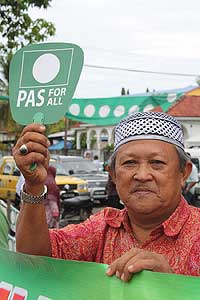
COMMENT The just-ended PAS annual general conference (muktamar) has landed Pakatan Rakyat in troubled waters again.
What started off on the right footing with Abdul Hadi Awang's presidential address reflecting PAS as a matured partner in solidarity and harmony with Pakatan in hot pursuit of Putrajaya, has ended in near disaster.
 On the first day of the main conference last Friday, Hadi gave much cheer to the entire Pakatan alliance and its supporters with a speech that hammered on common agenda and centred on issues conducive to winning the electoral battle ahead.
Even delegates debating Hadi's speech largely skirted the controversial issues of hudud and Islamic state that could potentially disrupt unity within the Pakatan alliance.
However, this politically pragmatic approach has caused unease among the conservatives, who were disturbed by the lack of mention of implementing hudud and other Islamic agenda, and construed this as deviation from PAS' original struggle, which is to realise an Islamic state...
COMMENT The just-ended PAS annual general conference (muktamar) has landed Pakatan Rakyat in troubled waters again.
What started off on the right footing with Abdul Hadi Awang's presidential address reflecting PAS as a matured partner in solidarity and harmony with Pakatan in hot pursuit of Putrajaya, has ended in near disaster.
 On the first day of the main conference last Friday, Hadi gave much cheer to the entire Pakatan alliance and its supporters with a speech that hammered on common agenda and centred on issues conducive to winning the electoral battle ahead.
Even delegates debating Hadi's speech largely skirted the controversial issues of hudud and Islamic state that could potentially disrupt unity within the Pakatan alliance.
However, this politically pragmatic approach has caused unease among the conservatives, who were disturbed by the lack of mention of implementing hudud and other Islamic agenda, and construed this as deviation from PAS' original struggle, which is to realise an Islamic state.
Spearheaded by the ulama and the Youth wing, the conservatives mounted a fightback that culminated in delegates vowing to work towards a resounding electoral success that would allow PAS to assume the leading role in the Pakatan alliance, with Hadi as prime minister. Such clamour eventually won the apparent approval of the assembly, with Hadi tacitly going along with the idea.
Electoral backlash
Little did the delegates at that hour of jubilation realise that such an ending to the muktamar has sent a shock wave through the Chinese community, with which I am in close contact. The first thoughts that come to their minds are notions of a PAS-dominated government with Hadi as prime minister in a post-BN era.
What follow are uneasy thoughts associated with a country veering towards Islamisation, things like restrictions on alcohol and pork consumption and entertainment, and general conformity to Islamic practices such as gender segregation, dress codes in public places, etc.
Above all, there is the implementation of the much feared but little understood hudud and the Islamic legal system, with all its vague implications. In short, such a new Pakatan rule is envisaged to adversely alter the present way of life of the Chinese minority.
Accuracy aside, these are common perceptions and initial reflexes of many in the Chinese community.
Needless to say, the electoral backlash to Pakatan in general, and to PAS in particular, is predictable.
Many Chinese Pakatan supporters must have been jolted into reflection and self-doubts:
- Am I right to vote Pakatan to power?
- What if PAS really becomes the dominant political force, with its leader as prime minister?
- What if the country is transforming into an Islamic state?
These thoughts and doubts, if allowed to nurture and no doubt inflamed by relentless BN propaganda, will culminate in the ultimate question:
 To take the risk with Pakatan, which may lead to Islamisation of our way of life or to keep the status quo, which no doubt is unpalatable with all its evils of racialism, corruption and abuse of power, but undeniably familiar or even comfortable (to some), having been ruled by such a political power for ages?
My bet is that a sizable portion of this electorate will prefer to remain in the comfort zone ruled by "the devil we know".
But of course, those well-informed about the current politics will remain steadfast in their determination to support Pakatan, knowing that the chances of Islamisation in the foreseeable future are slim.
This is because the Pakatan alliance works on consensus, and DAP and PKR will continue to want Opposition Leader Anwar Ibrahim to take the premiership in a triumvirate, where PAS is unlikely to predominate.
And yet, there is the third camp of current Chinese Pakatan supporters - those who would take the cautious approach of continuing to support Pakatan, but will vote in such a way that PAS will not become dominant. This would mean that these voters, while continuing to vote for PKR and DAP, will refrain from voting for a PAS candidate to avoid the Islamic party becoming dominant.
The hard truth
Thus, PAS will become the first casualty in such an electoral backlash triggered by the muktamar. Many PAS candidates, who may otherwise be able to squeeze through due to overwhelming Chinese support, might now be felled by BN.
Under this scenario, PKR and DAP may not suffer as much as PAS, but their hopes of reaching Putrajaya will be similarly dashed, as any electoral setback of this size to any of the partners will prove to be fatal to the alliance's chances of winning a simple majority in such a tight race.
My estimation is that, discounting the adverse impact of the muktamar, three-quarters of the Chinese electorate are currently supporting Pakatan. On this level of Chinese support, Pakatan will win in the next election, unless electoral frauds far exceed those of the last election in 2008.
My sincere advice to all those who yearn to see real changes taking place in this country is to recognise the reality that this is a multiracial country, with Malays forming only slightly above 50 percent of the population. It is hence totally unrealistic to force Islamisation on such a country without multiracial consent.
 There is only one future for this country, and that is the government's and the people's full acceptance of multiculturalism and happy co-existence of religions under a governance that practices universal values of justice and equality.
To those exuberant muktamar delegates who champion PAS as the new ruler and with its leader as the prime minister, I urge them to give serious thought to the hard truth that they can only have one of the following two options:
Either to rule the country in equal and equitable partnership with PKR and DAP on the currently agreed common agenda or to continue to force the pace of Islamisation without the expressed consent of the other races, in which case all the three partners of Pakatan will continue to remain in the opposition for God knows how long.
The clock for the next election is ticking, and it is now up to the wisdom of the leaders of Pakatan to undo the damage of the 58th PAS muktamar in the shortest possible time.
KIM QUEK is a retired accountant and author of the banned book ‘The March to Putrajaya'.


