




Khalid vs feudalism - plot to remove MB?
COMMENT Is there an internal plot to replace Khalid Ibrahim as menteri besar?
There is no doubt that he is under attack. After all, piercingly outspoken though she may be, nobody believes that Faekah Husin wields enough power to be anything more than a buffer for Khalid - certainly not true target material.
COMMENT Is there an internal plot to replace Khalid Ibrahim as menteri besar?
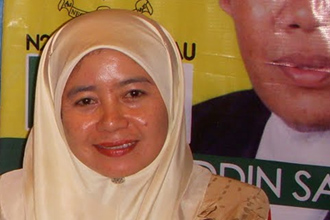 There is no doubt that he is under attack. After all, piercingly outspoken though she may be, nobody believes that Faekah Husin (
right
) wields enough power to be anything more than a buffer for Khalid - certainly not true target material.
There is no doubt that he is under attack. After all, piercingly outspoken though she may be, nobody believes that Faekah Husin (
right
) wields enough power to be anything more than a buffer for Khalid - certainly not true target material.
Internal politics makes the best of us cynical. No one wants to be fighting petty wars amongst ourselves just when we stand the best chance ever of removing unchallenged, unchecked Umno/BN hegemony.
Yet, we are not always permitted the luxury of choosing our battles, or when and where principles must be defended. Some battles we find on our doorstep whether we like it or not.
Who really chooses the menteri besar?
In the early aftermath of that Sinar Harian front page which suggested that Khalid Ibrahim might be replaced as menteri besar, at least three fairly prominent PKR leaders were quick to say that this matter could ultimately only be decided by the rakyat.
Unfortunately, within our Westminster-based political system, that is far from entirely true. In this system, the people can only elect a party into majority, after which the members of said party will then elect its leader as head of state.
As the party with the most seats in Parliament, the leader of Umno becomes the leader of the country, and the leader of Umno is selected only by Umno members - no one else.
This is a fact often overlooked by those allergic to political participation - when people of principle do not join political parties, then who is left within parties to elect leaders of principle?
One crucial caveat of course is that to be prime minister, one has to be an elected Member of Parliament. Once again, it is the party that holds absolute power to decide who can run as a candidate for public office under the party flag.
The scenario is the same at the state level in Selangor. To become menteri besar, an individual has to win a seat in the state legislative assembly and then be elected by a majority of that assembly to the post.
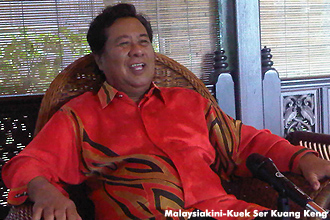 With the recent show of support by PAS and DAP, Khalid (
left
) probably would not have trouble on that front - especially given the recent discomfort understandably expressed by both parties regarding the aforementioned open display of ambition and lack of consensus-seeking within Pakatan.
With the recent show of support by PAS and DAP, Khalid (
left
) probably would not have trouble on that front - especially given the recent discomfort understandably expressed by both parties regarding the aforementioned open display of ambition and lack of consensus-seeking within Pakatan.
One of the only reasons the hullabaloo over Pakatan’s next candidate for Selangor’s menteri besar is of concern however, is that there exists one very simple option for those in PKR who might want to be rid of Khalid: simply refuse to field him as a PKR candidate for a state seat (under the pretense, say, of ‘saving’ him for a ministerial post at the federal level).
Should the party exercise its absolute discretion to do so in this manner, then any hope of Khalid returning for a second term as menteri besar will be decisively eliminated.
Politics of Feudalism vs Politics of Principles
Is this scenario likely to come to pass?
People sometimes talk about an “Umno culture” within PKR - a fact that used to irritate me, back in the day. What “culture” do they mean?
Feudalism is probably the best word to describe this unfortunately common feature of relatively immature democracies.
In essence, feudalism describes a relationship between a lord and his underlings - the chain of underlings fight for the lord, and the lord ensures his chain of underlings are well fed.
Central to this relationship is the concept of unflinching, unquestioning personal loyalty to the lord; conversely, only lords who know how to reward loyalty well survive long in a feudal game.
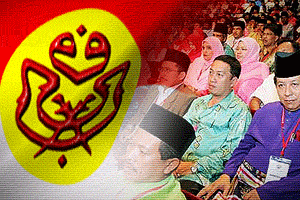 We see this pattern clearly within Umno, with each major leader having a specific support base of his own - without which he would never have risen to any high office of his own.
In medieval days, the underling performs military service for the lord in exchange for land to live off. Today, the currency is basically votes for money and power.
Just as a king then would distribute lands and their incomes to certain lords, so does the prime minister today distribute ministries and positions - providing lords whose loyalty he needs with the gravy trains and means to feed the base of their pyramid of underlings.
Wanting a bigger piece of the pie
It has been said that politics is the question of who gets what where when and how. Feudalism is largely about how a lord and his underlings can get a bigger piece of the pie to the exclusion of anyone who does not pledge loyalty to the same lord - a game of thrones, as it were, where if you are not with us, then you are against us.
In a system and culture such as this, we come to find that blind loyalty trumps principle almost every time - the latter used and abused only to serve the former as and when it is expedient.
This explains why so very little about Malaysian politics is about ideology or policies. Instead, it is dominated by the politics of personalities.
After all, Muhyiddin Yassin is not against Najib Abdul Razak because Muhyiddin is an ultra-Malay; Muhyiddin is an ultra-Malay because he is against Najib (let’s not get started on the even more galling ideological and intellectual emptiness of the bumbling home minister).
Adherents to this culture do not seek power to further a cause, they seek causes to further their pursuit of power.
(Luckily, it would seem that a good proportion of Malaysiakini readers, at the very least, seem cognisant of the dangers of feudalism and have expressed a desire to see such culture kept out of PKR, alongside an appreciation for the strict professionalism of Khalid and team.)
Tomorrow - Part II: Ambition and career politicians
NATHANIEL TAN works as a consultant to the Selangor state government. He tweets @NatAsasi.


