




Whistleblowing - a syariah imperative
COMMENT In today’s enlightened age of democracy, it is rather unfortunate that when the term ‘Islamic political thought’ is raised, one is often confronted with two polarised and contradicting points of view.
COMMENT In today’s enlightened age of democracy, it is rather unfortunate that when the term ‘Islamic political thought’ is raised, one is often confronted with two polarised and contradicting points of view.
The Muslim apologists will unreservedly disconnect any form of relationship between Islam and politics, which they consider as part of the secular public sphere. Islam is perceived as a mere set of theological arguments and rituals akin to other beliefs and must be distanced from worldly politics.
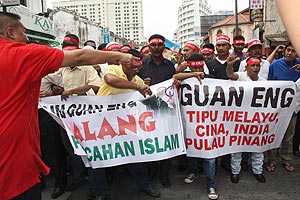 On the other extreme, there exists a Muslim body politic obsessed with the traditional and conservative interpretation of the holy texts, and relentlessly confining the notion of Islamic politics within the limited boundary of
hudud
,
wilayatul faqih
(rules of the clerics) or the re-establishment of the global Islamic caliphate (
khalifah
).
On the other extreme, there exists a Muslim body politic obsessed with the traditional and conservative interpretation of the holy texts, and relentlessly confining the notion of Islamic politics within the limited boundary of
hudud
,
wilayatul faqih
(rules of the clerics) or the re-establishment of the global Islamic caliphate (
khalifah
).
Many have failed to understand, Muslims included, the ethical and moral dimensions of the term ‘Islamic politics’ from the holistic and all encompassing concept of maqasid al-syariah or the highest objectives of syariah .
As the true and authentic compass of the entire corpus of Islamic legal prescriptions, maqasid al-syariah defines the cardinal purposes of the Muslim’s individual, societal, national and global life experiences.
These higher objectives of syariah dictate the Muslims’ participation in civil society or political governance in their mutual quest for mercy and justice for all mankind.
Al-Ghazali (d 505 AH) pioneered the development of the concept of maqasid al-syariah. It was a major breakthrough, remapping our religious imperatives and it threw a whole lot of new challenges for legal scholars.
 There was unfortunately a lull, a void that was later to be addressed by the brilliance of the Andalusian scholar in the 8th century of Hijrah. This scholar, Imam Abu Ishaq al Shatibi al Andalusi (d 790 AH), crystallised the ideas of Ghazali and discussed this in a very lucid and “scientific” manner in his magnum opus Muwafaqaat fi Usuul al Syariat.
Deeply rooted in the Islamic ontological-based epistemology of tawhid (oneness of God), maqasid al-syariah lays down the foundation of Islamic polity encompassing all the meanings and objectives of the spirit of syariah in attaining falah (success) in the worldly life.
The success of this human project is reflected in the well-being of human society, which is nurtured and protected by the comprehensive preservation of the five essentials in human life: faith, life ( nafs ), intellect (‘ aql ), progeny (nasl) and wealth ( mal ’) (see: Quran, 2:189; 3:130; 3:200; 5:35; 5:100; 24:31; 28:67; 24:51). Thus, it implies that the principles of Islamic politics must lead to ‘human well-being’.
Political activities and processes from the Islamic point of view must therefore consist of maqasidic elements to fulfill the maqasidic endpoints. It embraces a virtue-based consequentialistic paradigm, as its supreme purpose and overriding objective is the pursuit of adl wa ihsan , justice and goodness towards the attainment of maslahah , (public interest and benefits) for and among individuals, communities and nations, both in this world and the hereafter.
Embodied in the maqasid al-syariah are a few cardinal principles in relation to the Islamic political framework. These include the concept of ‘ adl wa ihsan (justice with fairness and mercy); amanah (trust and responsibility); syura (mutual consultation) and islah (continuous transformation towards the society’s well-being).
These maqasadic concepts and principles empower the Muslim individuals to be responsible and functioning players in the political process. To put it another way, all Muslims are inherently vanguards of the Islamic polity.
This individual empowerment has been promoted in Islam through the Quran, the traditions of Prophet Muhammad and the administrations of the four rightly-guided caliphs.
Syariah empowers individuals politically
Muslims as individuals and citizens in the community are empowered to have their say, to determine their own destiny and not to be dictated to or bridled by the elites under the yoke of the ‘state’ or the ‘authority’.
These ideals also reflect the concept of empowered civil society centred on the concept of responsible citizenry and can be clearly articulated within the healthy environment of democracy, as frequently asserted by the prominent Sudanese thinker Hassan al-Turabi in many of his writings.
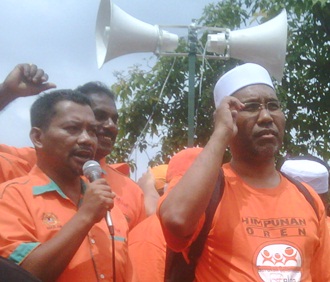 Essentially, every single individual in the Islamic community is empowered to preserve justice and peace for the public interest according to these principles, which are the main objectives of syariah.
The Quran emphasises the need for this mechanism in various verses (see: Quran: 3: 110; 9:71; 22:41; 4:114; 5:2; 7:165; 5:78-79). Similarly, many authentic prophetic traditions have underpinned the major role of individuals in enhancing universal justice within a community.
The four rightly-guided caliphs have received numerous unsolicited advice, complaints, opposition and also rejections of their policies from their citizenry. This socio-political ambience reflects the political maturity of the empowered citizens and their rulers during this enlightened period.
In the same way, islah as a landmark theme in the lives of individuals will transform them into self-actualised people striving to achieve ihsan (excellence) in their pursuit of falah (salvation) in their daily life.
These righteous concepts thus take centre-stage in the society and consequently determine the consistency of justice, benevolence, religiosity, good governance and the development of the ummah (Muslim nation).
 As an imperative, this concept allows for vertical accountability of peer assessment to be implemented within the larger governance process to ensure the trust is delivered effectively.
At the same time, both top-down, and bottom-up evaluations as part of islah at all levels of governance and community life will enable accountability to be exercised comprehensively.
Through the spirit of amr ma’ruf nahy munkar (enjoin the righteous and forbid the evil), the intrinsic meaning of islah is articulated to guide Muslims in their continuous striving to attain falah in both worlds.
Amr ma’ruf nahy munkar as an important imperative of syariah also contributes towards the evolution of functioning and responsible individuals who live with the awareness of their responsibility to enjoin and promote virtue and, at the same time, to eradicate indecency and evil in their community.
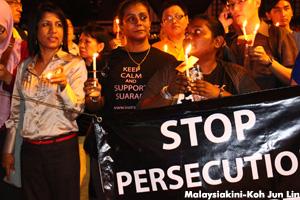 Evil is not only perceived as the sinful acts of individuals, but includes all acts of corruption, bribery, dictatorship, violation of rights, discrimination, misuse of power and non-performance by leaders and administrators, which will lead to the destruction of the community.
It is only through collectively practising the obligation of amr ma’ruf nahy munkar that society will progress, achieving unprecedented heights in development, and therefore, good governance.
Any effort to eradicate evil in community life reflects the true meaning of faith and religiosity as it expands the exercise of justice, and epitomises the wider implication of jihad according to the Quranic verse (9: 111-112). The effective implementation of amr ma’ruf nahy munkar also stipulates the importance and the active participation of individuals as citizens in governance activities.
 This injunction is illustrated in the Quranic verse: “Let there arise out of you a group of people inviting to all that is good (in Islam), enjoining
al-maaruf
(righteousness) and forbidding
al-munkar
(evil and forbidden) and it is they who are successful.” (Al Imran (3): 104)
This injunction is illustrated in the Quranic verse: “Let there arise out of you a group of people inviting to all that is good (in Islam), enjoining
al-maaruf
(righteousness) and forbidding
al-munkar
(evil and forbidden) and it is they who are successful.” (Al Imran (3): 104)
In Verse 116 of the chapter al-Hud, it is stated: “If only there had been among the generations before you persons having wisdom, prohibiting others from fasad (crimes and sins) in the earth, except a few of those whom We save from among them! Those who did wrong pursued the enjoyment of good things of (this worldly life) and were mujrimun (criminals).”
In a tradition narrated by Muslim, Prophet Muhammad was reported as saying: “Those who witness evil must correct it firstly with the hand, failing which, with the mouth (verbally), failing which, with the heart and that is the lowest of Iman.” (narrated by Muslim)
It was also narrated that the prophet said, “The master of all martyrs is Hamzah bin Abd-al-Muttalib (the prophet’s uncle) and any man who was killed because he stood up to an unjust imam (leader) and enjoined for what is right and forbade what is wrong.” (narrated by al-Hakim)
On another occasion, Prophet Muhammad said, “The best word is the word uttered by a person before a tyrant to stop him from his evil doings.” (narrated by Abu Dawud)
Tomorrow: Part II Whistleblowing an imperative in Islam
MASZLEE MALIK is with Universiti Islam Antarabangsa, while MUSA MOHD NORDIN is with the Muslim Professionals Forum (MPF).


