




PKR: S'gor had rejected oil refinery proposal
The Selangor government had previously rejected the proposal by two Taiwanese companies to build a refinery and petrochemical plant in Pulau Indah due to a host of environmental and health concerns, said PKR vice-president Chua Jui Meng.
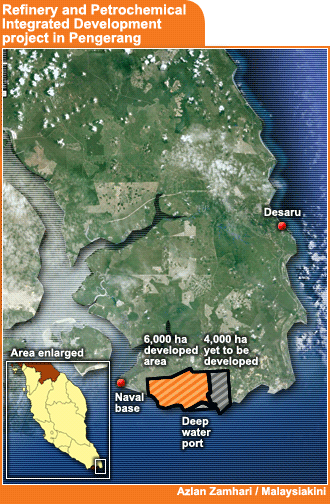
He told a press conference at the party's headquarters today that Everwish Sdn Bhd had proposed the project to the state government on behalf of China Petroleum Corp (CPC) and Kuo Kuang Corporation, who are now project partners in the Petronas Refinery and Petrochemical Integrated Development (Rapid) project in Pengerang, Johor.
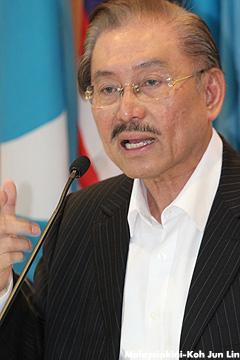 Chua (
right
) said the state was promised RM10 billion investments, 2,600 new jobs, and 20,000 indirect employment opportunities.
Chua (
right
) said the state was promised RM10 billion investments, 2,600 new jobs, and 20,000 indirect employment opportunities.
Everwish also claimed that the project could potentially earn RM13 billion in foreign exchange reserves.
"That was a good proposal, but after a detailed study, all Selangor government agencies rejected this project from Taiwan. They said although it would be good for the economy, it would be to the detriment to the people of Selangor.
"In other words, they (the state government) took the same stance as the Taiwanese president (to reject the project)," he said.
Chua, who is also a former health minister, then questioned the Johor and federal government for approving a similar project, just three months after the Selangor government rejected the Taiwanese proposal in February last year, this time with Petronas as partner, involving a larger tract of land , and reincarnated as Rapid.
"We don't fault them (CPC and Kuo Kuang, for making the proposal), but we blame (the) federal and (Johor) state governments for accepting what had already been rejected by Taiwan and Selangor," he added.
'Original EIA report rejected'
Among the reasons for the rejection, he said, were that it posed an environmental hazard to nearby coastal buffer zones and mangrove swamps, has an excessive water consumption of 70,000 cubic metres a day, and the plant itself would be a 52-year-old refinery, dismantled and shipped from Kaohsiung.
In addition, he said the plant would pose a cancer hazard, particularly nasal, colorectal cancer, and leukaemia, as well as causing respiratory diseases such as asthma as well as endocrine diseases.
 For the environment, Chua said emissions such as sulphur dioxide and carbon monoxide would contribute to the green house effect and acid rains.
However, Pengerang MP Azalina Othman had previously said the comparison between the plant rejected Taiwan as unfair , as the plants are "similar, but the circumstances are different," and the claim that it would reduce life expectancy is not based on direct evidence.
Additionally, he claimed he had been told that the Environmental Impact Assessment (EIA) report for the Pengerang project had been rejected by the Department of Environment (DOE) just before the fasting month began in July this year.
However, the decision was quickly reversed, as both the EIA and the detailed EIA (DEIA) reports were later approved.
He demanded that Prime Minister Najib Abdul Razak answers whether there was pressure on the DOE to approve the project, as demands he makes the well as to make the EIA, the rejected EIA and DEIA reports public.
This, Chua said, is so that environmentalists could compare the documents against those from the Taiwan project, of which the anti-Rapid NGOs already have a copy.
Anti Kuo-Kuang activists from Taiwan had supplied the EIA report for the scrapped Taiwanese project, which among others, claimed that it would reduce the life expectancy of the island-nation's inhabitants by an average of 23 days, and warned of a similar disaster in Pengerang.
Related stories


