




Questions over water and nuclear power
COMMENT The Association of Water and Energy Research Malaysia (Awer) has studied the Budget 2013 announcement as well as the detailed budget for some of the related ministries that were published by the Finance Ministry. We urge the government to consider the following recommendations to enhance the government’s financial expenditure and perhaps saving billions of ringgit from being wasted unnecessarily.
Water services industry
The federal government is allocating RM 300 million for replacement of water pipelines and sewage to improve water supply and sewage systems. In addition to that, the Energy, Green Technology and Water Ministry’s detailed budget outlines almost all the states are receiving either funds or loans for water services infrastructures development amounting RM 2.8 billion in total for year 2012 to 2013.
Unfortunately, this is not in line with Water Services Industry Act 2006 (WSIA) model because there are a few states that have yet to be restructured. We urge the federal government to ensure Labuan, Kedah, Terengganu, Pahang, Kelantan and Selangor complete the restructuring under WSIA before the funds or loans are channeled.
 These funds must also be administered by Suruhanjaya Perkhidmatan Air Negara (Span) as Span is the regulator for water and sewerage industry. Span will regulate these industries from the economic, service quality and technical perspective. This will ensure proper usage of allocations.
Besides this, Indah Water Konsortium’s (IWK) concession agreement must be abolished and IWK must restructure under the WSIA model as soon as possible. This will prove the federal government’s commitment in implementing WSIA model. Restructuring of IWK should have been completed in year 2010 according to the 9th Malaysia Plan. Now, it has delayed for almost two years. What is delaying the Finance Ministry from doing so?
Furthermore, IWK is also seeking a tariff increase now and will be receiving allocations for sewerage infrastructure recovery projects from Budget 2013. None of the above should be granted to IWK until it is restructured and fully regulated by Span.
The federal government must also close down Jabatan Bekalan Air (JBA) and Jabatan Perkhidmatan Pembentungan (JPP). Both agencies are redundant in operation with Span and Pengurusan Aset Air Berhad (PAAB). They are actually duplicating and messing up duties that should be carried out by Span and PAAB.
On one occasion, JPP had given a recommendation for a project involving IWK and a private company to be implemented where it has no regulatory power. The regulatory power for sewerage services falls under Span, according to the WSIA. Any recommendation on projects related to sewerage industry should be done by SPAN and not JPP.
Awer has made an official communication to Span to investigate the matter. Closing down these redundant agencies will reduce the government’s operational expenditure, optimise usage of taxpayers’ money and eliminate unnecessary operational problems.
Rural water and electricity supply
Generally, almost RM 10 billion has been allocated for these programmes since 2010. We urge the auditor-general to conduct a detailed audit specifically for rural water supply and electrification programmes from 2000 to 2012. The scope of the audit should include deliverables, cost, transparency, material durability, operational life and water quality as well.
Last year, we had also urged the federal government to embark on educating the rural communities in basic maintenance work to maintain the implemented projects in their respective communities. This will also create semi-skilled workers among the people and improve their quality of life simultaneously.
In Budget 2013, the federal government is allocating RM100 million to install rainwater harvesting systems in Sabah and Sarawak. Rainwater harvesting is a mechanism used to store rainwater for non-potable use (non-drinking and non-edible).
According to the National Standard for Drinking Water Quality by Ministry of Health, the pH standard of drinking water should be between 6.5 and 9.0. However, according to the Meteorological Department, the northern states of peninsular Malaysia and East Malaysia receives rainfall with pH between 4.8 and 5.2, while the other parts of the peninsula received rainfall with pH between 4.4 and 4.8.
This acidity will give direct impact to piping, fittings and tanks of the rainwater harvesting system. The usage of stored rainwater for potable use without proper treatment is also jeopardising the people’s quality of life in Sabah and Sarawak.
This is because the harvested rainwater is not disinfected and possibility of contamination is also high. Birds’ droppings and other debris on the roof can easily enter the rainwater harvesting system. There might be valves built in to prevent the early flow of rainwater entering the rainwater harvesting system. However, this does not guarantee the quality of the water stored. Maintenance of the filters and tanks are also a must.
Therefore, implementation of the WSIA model for Sabah and Sarawak is inevitable. Under the WSIA model, treated water supply programmes do not only represent huge water treatment plants. Small community-based treatment plants and rural water supply programmes are also part of it.
We urge the federal government to form a task force to start and speed up implementation of the WSIA model in Sabah and Sarawak. This can benefit both of the states to increase the treated water supply coverage compared to giving billions of allocations to carry out ad-hoc implementations that are not sustainable and jeopardising people's quality of life.
Nuclear power for energy
Based on the Energy Ministry’s detailed budget, they are planning to start a public awareness programme on nuclear power for energy. While the ministry has been silent on issues raised related to nuclear power plants, this planned programme only leads people to assume that Malaysia will build a nuclear power plant soon.
However, the federal government and the Energy Ministry must address the following seven core issues before embarking on nuclear power project:
- Short-term, mid-term and long-term energy mix policy must be clearly defined and published for public knowledge. Uranium, plutonium and thorium are non-renewable energy resources and also will deplete one day. Therefore, nuclear may not be the actual solution. It may assist Malaysia in short term energy mix management only. For example, the failure of the Bakun Hydroelectric Plant to supply electricity to peninsular Malaysia (as it was designed to do) is forcing people to bear an additional tariff for energy from new gas-fired power plants.
- Location of nuclear power plant must be disclosed from the beginning of planning. This includes all of the possible locations. This will allow proper public discussions on issues related to nuclear power plant. The public’s acceptance of usage of nuclear for energy must be done with full transparency and not “make-up” consultancies.
-
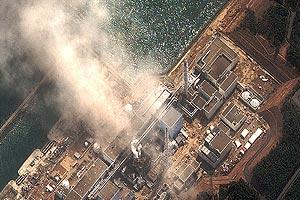 Radioactive leakages, emergency response and reporting procedures must be made clear to the public. Nuclear ‘experts’ always claim that nuclear power is safe. If it is safe, why do leaks happen? For example, about 150 leakage incidents happened in France in a year. There should be only one answer, it leaks or not. Therefore, reports on nuclear technology and leakage incidents must be made transparent and clear to the public. The recent Fukushima incident has brought down confidence in nuclear technology tremendously and revealed the dark side of ‘transparency’ in nuclear incident reporting. What policy does Malaysia have if such an incident takes place?
- Decommissioning cost of nuclear power plant is always a concern for many nuclear energy generating countries. With stricter laws and regulations pertaining to disposal of nuclear waste and related materials, we would see a sharp increase in decommissioning costs of a nuclear power plant. With the government saying that usage of nuclear for energy is economical, we can only assume that the government has dismissed the decommissioning cost component from the overall planning. Now, who is going to bear this cost? If the future generations are going to bear the cost, is it fair for us to pass the buck to them?
-
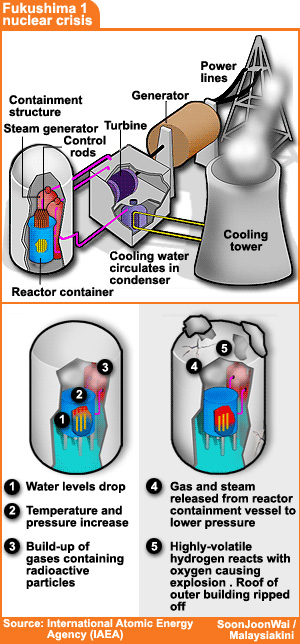 Capable human capital to manage a nuclear energy facility is vital. Unfortunately, we never see any ‘nuclear experts’ from Malaysia extending their expertise to solve or control a nuclear leakage crisis such as had happened in Fukushima last year. Many reports have also indicated that the leakages or nuclear incidents are very much linked to human errors. Failure to have proper technical expertise means we are asking for trouble and creating a nuclear disaster in our own backyard. What would be Malaysia’s plan to develop such expertise? Nuclear science graduates alone would not be enough to manage the nuclear power plant.
- Nuclear waste (spent fuel) disposal is the mother of all issues related to nuclear. Nuclear waste from the power plants must be safely deposited into a waste storage facility. Therefore, the cost and safety of the waste storage facility are the main environmental concerns. What is the projected cost and its impact to tariff? What about leakages from storage facilities due to natural forces? Does the Energy Ministry include such details in their planning?
- Cheap electricity from nuclear energy, is it a reality? A group of South Korean ‘nuclear experts’ did not answer this direct question when issue of raw material supply was raised to them. How could a country achieve low electricity tariff via nuclear energy where so many issues need to be taken care of? Furthermore, with increasing pressure on environmental protection from nuclear wastes, the cost of generating electricity from nuclear is set to rise. We have also witnessed the drastic price increase of natural gas when many countries switched to gas-fired power plants. How can the Energy Ministry guarantee cheap electricity when many countries are also switching to nuclear simultaneously?
Awer urges the federal government to form an independent task force to supervise the process of introducing nuclear energy generation in Malaysia and solve the seven core issues raised before building the nuclear power plant.
The members of the task force must be independent and the task force must also periodically (once in every six months) report the progresses to the public. An awareness programme alone is not sufficient when the bulk of the core issues is swept under carpet.
Awer hopes that our recommendations are given due consideration and implemented for the benefit of the nation and the people. The amendments and suggestions are to strengthen the implementation of plans in Budget 2013 and to lead Malaysia to be a developed nation by the year 2020.
S PIARAPAKARAN is the president of the Association of Water and Energy Research Malaysia (Awer).


