




BNM reinstated as defendant in Rosli Dahlan's suit
The Court of Appeal today has unanimously reinstated Bank Negara Malaysia (BNM) as one of the parties in lawyer Rosli Dahlan’s RM50 million lawsuit for unlawful search of his assets during former Commercial Crime Investigation Department chief Ramli Yusuff’s Copgate saga.
The Court of Appeal today has unanimously reinstated Bank Negara Malaysia (BNM) as one of the parties in lawyer Rosli Dahlan’s RM50 million lawsuit for unlawful search of his assets during former Commercial Crime Investigation Department chief Ramli Yusuff’s Copgate saga.
Last November, Kuala Lumpur High Court judge John Louis O’Hara had struck out Bank Negara financial intelligence manager as one of the defendants in the lawsuit.
However, today the appellate court has reinstated Bank Negara as one of the parties.
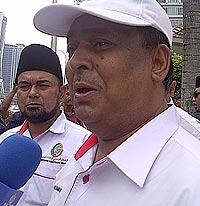 The other defendants include the Malaysian Anti-Corruption Commission (MACC), its chief commissioner Abu Kassim Mohamed, the MACC deputy head of prosecution Anthony Kevin Morais, who is a representative of the Attorney-General’s Chambers, as well as
Utusan Malaysia
and one of its editors Mohd Zaini Hassan.
The other defendants include the Malaysian Anti-Corruption Commission (MACC), its chief commissioner Abu Kassim Mohamed, the MACC deputy head of prosecution Anthony Kevin Morais, who is a representative of the Attorney-General’s Chambers, as well as
Utusan Malaysia
and one of its editors Mohd Zaini Hassan.
The appellate court, in reinstating Abdul Rahman ( right )as a defendant, said he had colluded with the others to unlawfully search Rosli’s assets in its investigations on Ramli.
The three-member panel was led by by Justice Ramli Ali. The others are Justices Zaharah Ibrahim and Anatham Kasinather.
In addition, the Court of Appeal has ordered Bank Negara to pay RM10,000 in costs.
Rosli's partners in his law firm of Lee Hishammuddin Allen & Gledhill, Kumar Kanasingam and Chetan Jethwani appeared for the lawyer.
They managed to convince the three-member panel that Justice O' Hara misdirected himself on the law and facts of the case on conspiracy.
Rosli had three years' ago filed a suit against various individuals in the MACC, Bank Negara and government.
He is seeking RM20 million for general damages and RM30 million for exemplary and aggravated damages.
Helping Ramli and Johari Baharom
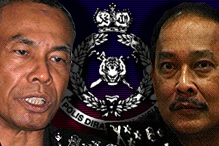 In his claim, Rosli described the acrimonious relationship between Ramli and former inspector general of police (IGP) Musa Hassan and how the IGP had used the MACC, formerly the Anti Corruption Agency (ACA), and the Attorney-General’s Chambers to implicate him and Ramli in what is now described as
Copgate
affair.
In his claim, Rosli described the acrimonious relationship between Ramli and former inspector general of police (IGP) Musa Hassan and how the IGP had used the MACC, formerly the Anti Corruption Agency (ACA), and the Attorney-General’s Chambers to implicate him and Ramli in what is now described as
Copgate
affair.
Rosli claimed he had acted for Ramli and the then Deputy Home Minister Johari Baharom against the habeas corpus application of alleged crime lord Goh Cheng Poh or better known as Tengku Goh in 2007.
His predicament came when Johari instructed Ramli to conduct an investigation into a money-lending syndicate in Tangkak, Johor led by Tengku Goh who was then detained and banished under the Restricted Residence Act 1933, where the order was signed and executed by the Deputy Minister.
However, Musa sees Goh's arrest as disloyalty on the part of Ramli resulting in the IGP further initiating ACA investigations on him. This resulted in a strained relationship between Musa with Ramli and Johari.
Rosli further stated in his claim that the Attorney-General’s Chambers did not want to act for Ramli and Johari in Tengku Goh's habeas corpus application, resulting in them and several police officers involved in the investigation to seek Rosli's help.
However, in return Rosli claimed he earned the wrath of the Attorney-General’s Chambers and Musa leading to investigations by the MACC where Bank Negara was used to initiate investigations under the Banking and Financial Institution Act 1984. This led to his arrest and subsequent charge on the eve of Hari Raya.
On Oct 12, 2007, Rosli was charged with failing to declare his assets in two months as required under a notice dated July 17, which was later extended to Aug 16, an offence punishable under Section 32 (2) of the Anti-Corruption Act 1997.
He was later acquitted by the Sessions Court without his defence being called.
Earlier this month, he further won a reprieve after the prosecution withdrew its appeal at the Kuala Lumpur High Court over his acquittal.
Meanwhile Ramli, who faced five charges following the persecution, was also acquitted. So were his men, who were charged with fabricating statements leading to Tengku Goh's arrest. They were then reinstated and promoted.


