




Cops vows to fix perception gap
The public are unable to accept that there is a reduction in crime despite available evidence and validation from the international community, but the police believe that this is a natural process.
The public are unable to accept that there is a reduction in crime despite available evidence and validation from the international community, but the police believe that this is a natural process.
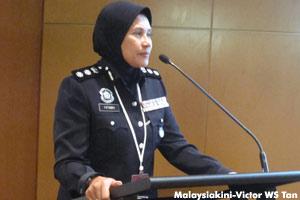 Speaking at a breakout session today for members of the press at the Government Tranformation Programme 2.0 (GTP2.0) day, police assistant director of management (public affairs) Fatimah Abdul Hamid (
left
) described the acceptance of crime statistics as a three phase process.
Speaking at a breakout session today for members of the press at the Government Tranformation Programme 2.0 (GTP2.0) day, police assistant director of management (public affairs) Fatimah Abdul Hamid (
left
) described the acceptance of crime statistics as a three phase process.
“In phase one, people do not believe that change is possible. In phase two, they don't believe that the results are true. In phase three, they ask 'why did you not do this earlier?’.
“We are in phase two,” she said.
Fatimah cited recent surveys by several international think tanks which corroborate police data which showed a reduction in crime since the first GTP roadmap was unveiled.
Among others, the 2011 World Justice Project listed Malaysia as the safest among 19 middle income countries in the world. Globally, the group placed Malaysia 12th, ahead of the US and Britain.
Fatimah also cited the 2011 Global Peace Index survey which ranked Malaysia as the safest country in South-East Asia and fourth safest in the Asia Pacific.
A 2011 World Economic Forum survey listed Malaysia as the 63rd safest country in the world, climbing up 30 spots since 2010.
Bridging the gap
Fatimah conceded that there was a gap between delivery and perception of crime and the solution for this was greater community engagement in the process of addressing crime.
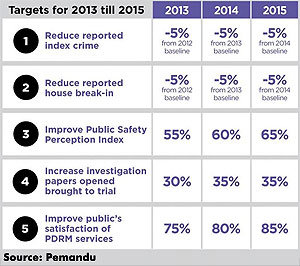 "We need to step up local initiatives to reduce the gap between delivery and perception of law enforcement.
“We need to get people engaged and involved in reducing crime, and this is the most important thing that we can do,” she said.
Critics have argued that the crime rate in Malaysia is not fully represented by crime statistics, amid a series of high profile cases, including a burglary at former Malacca chief minister Rahim Thamby Chik's house in Bukit Bandaraya, Bangsar, as well as a robbery at the home of Faizah Shuib, widow of former cabinet minister Megat Junid Megat Ayub.
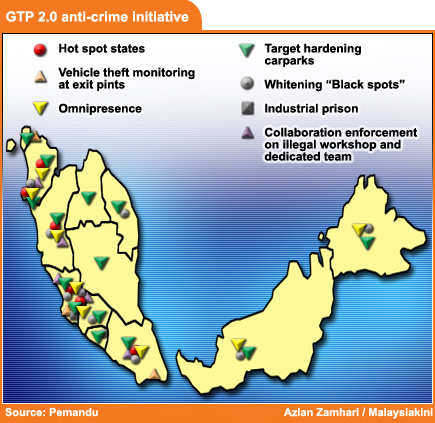
The GTP 2.0 introduces five key initiatives in addressing crime, which is one of the national key results areas (NKRAs).
They are prevention of house break-ins, vehicle theft, omnipresence, creation of an online tracking system and addressing crime hot spots.
Related stories
'JI and reds claims meant to distract from crime issues'
Why police are impotent in dealing with growing crime
Kit Siang: Najib must affirm peaceful transition if BN loses


