




Appellate court upholds Apcet II decision
The Court of Appeal today upheld the Kuala Lumpur High Court's decision for the government to pay RM30,000 to each of the 29 civil activists and journalists who were unlawfully detained by the police during the Asia Pacific Conference on East Timor (Apcet) II in 1996.
The Court of Appeal today upheld the Kuala Lumpur High Court's decision for the government to pay RM30,000 to each of the 29 civil activists and journalists who were unlawfully detained by the police during the Asia Pacific Conference on East Timor (Apcet) II in 1996.
It delivered its decsion after the court dismissed the applicants' appeal on the quantum of compensation awarded.
The same court also rejected the government's cross-appeal of liability in the arrests made during the Apcet II event.
A three-member bench led by justice Abu Samah Nordin arrived at the unanimous decision following a day-long arguments from both sides.
“After hearing the appeal, we unanimously dismiss both appeals and uphold the KL High Court decision,” he said.
The other two sitting with him were justices Zaharah Ibrahim and Mohtaruddin Baki.
 The appellants, who were represented by Ranjit Singh and Abdul Rashid Ismail, submitted that the court should have awarded aggravated and exemplary damages as they were detained in excess of one day.
Meanwhile, senior federal counsel Amarjeet Singh told the court that the High Court judge had erred in pinning liability on the government over the arrest as ample warning had been given for them to disperse.
Justice Abu Samah however interjected, asking why did the Dang Wangi OCPD order the arrests made on the fourth floor of the hotel whereas the Umno Youth mob had already dispersed downstairs.
To this, Amarjeet said the OCPD thought it was still an illegal gathering as there was one Chinese man standing (now Batu MP Tian Chua) and speaking to the crowd.
In reply, Ranjit Singh said that Sivarasa Rasiah (now Subang MP), who is one of the 29, had signalled the Dang Wangi OCPD for more time - that at least two more minutes be given - as they had to gather their personal belongings before leaving.
“However, in testimonies by the junior police officers they said that they only heard one warning to disperse and not three as is the usual practise,” he said.
Besides Sivarasa and Tian Chua, among the other high-profile plaintiffs are: former PRM secretary-general Sanusi Othman; former PKR deputy president and senator Syed Husin Ali; Malaysiakini chief executive officer Premesh Chandran; Malaysiakini editor-in-chief Steven Gan; Malaysian Trade Union Congress former president Syed Shahir Syed Mohamad; Parti Sosialis Malaysia president Dr Nasir Hashim and former New Era College principal Kua Kia Soong.
On Dec 22, 2009, the Kuala Lumpur High Court had ordered the government to pay the amount for wrongful detention following Umno Youth's disruption of the Apcet II civil society gathering in the capital.
Sum sufficient to ease pain
The sum amounted to a total of RM870,000 in general damages. The plaintiffs were also awarded 8 percent interest per annum from the date the suit was filed on Nov 11, 1998.
In delivering the decision, former Court of Appeals judge Wan Adnan Muhamad, who was then sitting at the High Court, said: "The facts here are clear and straightforward and the judgment is based on facts submitted by both parties.
 "I think the amount is enough for the suffering endured during their detention of almost 24 hours behind bars."
The international conference was organised to discuss human rights abuses in East Timor and its struggle for independence from Indonesia.
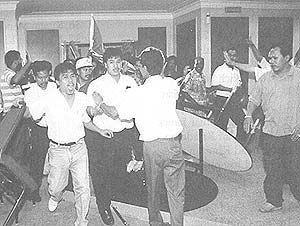
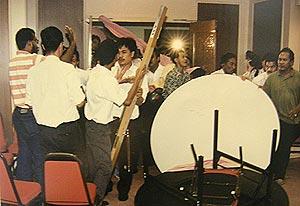
It was held at the Asia Hotel in Kuala Lumpur and saw nasty scenes when a mob led by Umno Youth stormed the venue, harassing the 100 participants.
On that day, as the conference was about to begin, 400 members of the Umno Youth-led Barisan Bertindak Rakyat Malaysia (BBRM), or Malaysia's People's Action Front, burst into the hall and disrupted the meeting.
While the police largely ignored the Umno Youth mob, the Apcet II participants and journalists were detained for up to seven days.


