




'Some would feel down if retirement age goes up'
The government’s move to raise the retirement age has not gone down well in some quarters, with the main worry being that this will increase unemployment among youth, whether they are graduates or not.
The government’s move to raise the retirement age of civil servants has not gone down well in some quarters, with the main worry being that this will increase unemployment among youth, whether they are graduates or not.
Aspirasi, a pro-government student coalition, said this is among findings of a survey it conducted during its roadshow across the peninsula between Feb 6 and 12.
T
 his was part of the group’s Aman Kampus (Peaceful Campus)
campaign
to find out the people’s problems and the extent to which they “understand and appreciate” government policies and development projects.
his was part of the group’s Aman Kampus (Peaceful Campus)
campaign
to find out the people’s problems and the extent to which they “understand and appreciate” government policies and development projects.
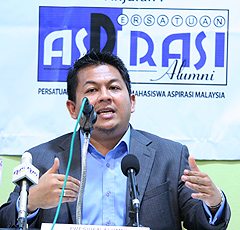
Aspirasi president Mohd Shahar Abdullah (right) told a press conference today that 6,492 responses from 18 survey locations were obtained using a survey form developed by Biro Tata Negara.
The report, which did not give any details of the responses, also found that the “majority of society... reject street demonstrations, which are seen as immoral and only favours the cause of an individual”.
Other findings and recommendations of the survey include:
- Most people are not familiar with the Lynas issue and many received information only from the opposition. Therefore a “creative and proactive” strategy is needed to “prove the safety and benefits of the Lynas project to the country, especially the locals”.
- Migration of youths into cities has left rural areas lacking in social activities and people to inherit local cultures. Cities face a similar problem because youths are busy with work.
- Most respondents reported problems with government bureaucracy and hope it could be sped up and simplified.
- Public housing projects succeeded in helping the poor, but there are complaints about government efficiency in distributing aid, while property prices remain high in cities.
- There are still rural areas suffering frequent blackouts and there are some amenities promised by the government that are yet to be fulfilled. Damaged roads and clogged drains are the most popular complaints in every location surveyed.
- Despite the government’s efforts, many find the rising cost of living difficult to swallow, and the lack of Kedai Rakyat 1Malaysia (KR1M) has led to complaints of unfair distribution of amenities.
- About 85 percent of respondents are in favour of the 1Malaysia concept.
- Many respondents asked whether it was true that “extremist students” were causing chaos at campuses, based on media reports of “several incidents caused by a minority of students acting beyond boundaries”.
“We can conclude from this survey that the people have certain needs that are unfulfilled.
“However, the people’s expectations of leaders and politicians are not high. They just want basic necessities and security,” said Shahar.
He added that the findings were submitted on Feb 19 to Deputy Prime Minister Muhyiddin Yassin via his aide, and Prime Minister Najib Abdul Razak, whom Shahar claimed was pleased with the group’s efforts and received the report personally.
He also announced the second phase of the roadshow, which will involve collaboration with 19 NGOs.
Unlike the first phase of the survey which focused on the community, he said the second phase would be targeting students over the weekends between Mar 16 and Apr 29.
Over the seven-week period, 21 institutions of higher learning would host Aman Kampus programmes, while those in institutions around these campuses are also expected to attend.
The hosts include both private and public institutions of higher learning, such as Universiti Tunku Abdul Rahman, Universiti Perguruan Sultan Idris, Universiti Malaya, several technical training institutes plus a National Service camp in Setiu, Terengganu.
The roadshow is slated to include another round of survey, sports, dialogues with national leaders, religious programmes, poetry recitals and debates on issues affecting youths and society such as the University and University Colleges Act, 1Malaysia, and Lesbian, Gay Bisexual and Transexual (LGBT) “threat”.
“The LGBT issue is a new threat to our country, we must fight this just as we fought communists because we are an Islamic country.
“This perverse culture is wrong in religion and we can’t have elements of this culture become ingrained in our society,” Shahar added.


