




'Keep an eye on dishonest polling officers'
The removal of indelible ink from the finger of one who has voted in an election can only happen with the cooperation of fraudulent polling officers.
The removal of indelible ink from the finger of one who has voted in an election can only happen with the cooperation of fraudulent polling officers.
In an email interview with Malaysiakini , the Bangkok-based Asian Network for Free Elections (Anfrel) said this was because a fraudulent officer could facilitate actions to ease the removal of indelible ink.
 "The ink removal could be happen... by applying bleach or oil before the ink is applied. The skin will not absorb the ink properly as there is another chemical in between.
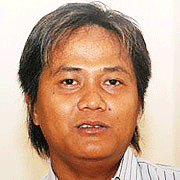
"But, of course, such a practice only can be done with the help of the polling officer," Anfrel officer Ichal Supriadi ( left ) said.
He said it was the responsibility of polling officers to clean the voter's finger before marking it, with cloth for this purpose provided by the election authority.
"But often, polling officers lack in understanding (procedures), and do not clean the finger before applying the ink, and immediately wipe the ink on the finger with a tissue, sponge or small cloth provided by the election authority, together with the polling materials," Ichal said.
The ink when applied needs about 30 seconds to dry up and can last up to four days before it can be completely removed.
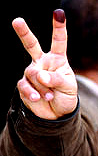 According to Ichal, who has acted as an election observer in a number of elections in countries across Asia that use the indelible ink, dishonest officers have also tried to facilitate cheating in elections by not properly marking those who have voted.
"(Cheating) that happened in both Indonesia and Afghanistan was with the polling officers intentionally not dipping the finger of the voter in the ink, as they were biased and wanted to allow particular people multiple voting," he said.
In other cases, the officers only dipped the nail area of the voter's finger in the ink, making it easier to remove it with chemicals or bleach.
In Afghanistan, where Anfrel has been observing the presidential elections since 2004, Ichal said the lack of voter education has led to many trying to remove the ink.
"(There was no information to say) the ink is ‘halal' and will not harm prayers (by Muslims), so people tried their best to remove it once it was applied, using bleach or other chemicals," he said.
'Plenty tried to remove ink'
In 2004, Times Online reported that many voters in Afghanistan were spotted trying to remove the ink , with varying degrees of success.
It also reported that presidential candidates in that country also complained that the ink was being removed in attempts to commit electoral fraud.
Ichal said that "plenty had tried" to do so, but Afghanistan continued to use the ink in subsequent presidential elections due to "a lack of confidence in the voters' list and lack of neutrality of the polling officers".
He said Anfrel continued to support the use of indelible ink as its observations across Asia proved that the ink could reduce multiple voting, if all procedures were met.
Anfrel was established in 1997 to support democratisation at national and regional levels in Asia, and has acted as election observer in countries such as Afghanistan, Bangladesh, India, Indonesia and the Philippines.
The 2004 Afghan presidential election was cited in a recent report in The Star , which said a Europe-based company has found indelible ink used there could be easily removed with off-the-shelf stain removers.
The unnamed firm, which claimed to have "extensive experience" in fingerprint identification, was reported to have given a demonstration to the daily and said it would submit its "findings" to the Malaysian authorities.
The use of indelible ink on voters is one of the eight demands of the Coalition for Clean and Fair Elections (Bersih 2.0) in its call for electoral reforms.
The EC said recently that it would decide if indelible ink, a biometric system or both would be used in the 13th general election.
Related stories :
To be 'cool', PM must implement Bersih's demands
Citizenship-for-votes: Home minister flays M'kini
Asian polls watchdog defends use of indelible ink


