




Human trafficking: Minister dares US to keep watching
Home Minister Hishammuddin Hussein has dared the United States to take a closer look and say that the government is not doing enough to prevent human trafficking in Malaysia.
Home Minister Hishammuddin Hussein has dared the United States to take a closer look and say that the government is not doing enough to prevent human trafficking in Malaysia.
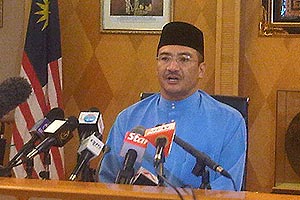 Speaking to reporters in Putrajaya today, he said the efforts rolled out by several ministries to combat human trafficking this year show they are serious in trying to make it off the US State Department's annual trafficking report.
If the United States cannot recognise this, then "someone is not doing their job," he said.
"If they are genuine in their assessment then we shouldn't be on the watchlist (next year).
"But that is not my concern, my concern is the innocent Bangladeshis being exploited and the commercial sector which needs workers," he said.
Nevertheless, he said that Malaysia is rightly under US scrutiny because much of its long list of initiatives has yet to be rolled out.
In the Trafficking in Persons Report released Monday, Malaysia retained its 2010 position on the watch list, while Singapore and Philippines were removed.
Bangladeshi workers programme in the works
At the press conference, Hishammuddin also announced a joint agreement with the Bangladeshi government to identify the roughly 500,000 illegal and legal Bangladeshi workers as part of the broad amnesty programme rolling out next month.
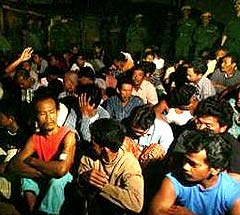 Under this programme, Bangladeshi workers will be biometrically registered so that commercial sectors requiring workers can hire them instead of bringing in more workers.
The details of the programme will be announced later by Home Ministry officials who have been appointed to handle different parts of the initiative, he said.
As part of the government's "war against (human trafficking) syndicates", Hishammuddin said the move will involve cooperation with the Ministry of Human Resources, police and intelligence agencies in both Malaysia and Bangladesh.
Also at the joint-announcement was Bangladesh High Commissioner to Malaysia Atiqur Rehaman, who said that strong bilateral relations will mean that Bangladeshi workers will receive "special treatment".
"The basic idea is for the workers to have proper documentation while working in a foreign country to save them from exploitation (and so that) they can work peacefully," he said.


