




Sabah's NCR guidelines 'illegal', warns activist
A leading land rights activist, a senior counsel, has warned that the Sabah Land and Surveys Department’s (LSD) seven-point guideline used to deal with NCR cases is an illegality. The illegality is evident if read in conjunction with the concept of native customary rights in keeping with Adat and common law positions on the issue, he added.
A leading land rights activist, a senior counsel, has warned that the Sabah Land and Surveys Department’s (LSD) seven-point guideline used to deal with NCR cases is an illegality. The illegality is evident if read in conjunction with the concept of native customary rights in keeping with Adat and common law positions on the issue, he added.
“The seven-point guideline restricts NCR claims to a limited version,” said Kong Hong Ming, who handles NCR cases on a pro bono basis.
Kong was elaborating on his remarks earlier this week in the local media that there were “too many land grabs in Sabah”. He heads the Land Development and Management Committee in the Sabah PKR presidential council.
 He referred to the seven points as customary tenure, land planted with fruit trees, isolated fruit trees, grazing land, land cultivated or built on in the last three years, burial grounds or shrines, and the usual rights of way of men or animals from rivers, roads or houses to any or all of the above.
The seven-point guideline, spelt out in Section 15 of the Sabah Land Ordinance, is said to be “a narrow definition of customary rights”.
“Section 15 is not what NCR is all about,” points out Kong. “This has been well-established in several landmark cases in court in Sabah and Sarawak and even going up to the Federal Court.”
The cases however, stressed Kong, have not prevented the continue seizures of NCR land in both Sabah and Sarawak.
He cited one major case as Rambilin binte Ambit vs Ruddy Awah and the Assistant Collector of Land Revenue, Pitas and the Director for Land and Surveys Sabah (2007) in one civil suit and two judicial reviews.
Two other landmark cases cited by Kong are Madeli (2007) and Nor Anak Nyawai (2001) both from Sarawak.
‘Natives are part of the land’
“The law is clear on NCR cases,” said Kong. “The concept is that the natives are part of the land as are the trees, mountains, hills, animals, fish and rivers.”
Hence, they cannot be removed from surviving from foraging on the land, plucking the fruits of the trees, fishing in the rivers and shooting the wild boar and other animals, as their “right to life”. NCR, reiterated Kong, is “the right to life” as spelt out in the federal and state constitutions.
The “right to life” is also the position recognised by Article 9 of the Charter 1881 given to the British North Borneo Chartered Company by the British Parliament.
Kong wants a special mechanism to be set up for the recovery of lost land or, failing which, suitable compensation be provided either in monetary form or, as he highly recommends, alternative state land. “Money will disappear quickly,” noted Kong. “Land would be compensation in perpetuity that would benefit future generations.”
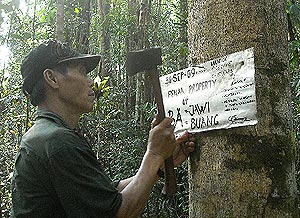 Moving forward, Kong does not see going to court as an option when most NCR owners have neither the sustaining power nor the means to seek legal redress.
“At present, those who grab NCR land are simply taking a calculated gamble that the matter will not end up in court,” said Kong. “This includes the state government, state agencies and GLCs as well, besides the private companies who prey on poor people.”
The government, continues Kong, has a fiduciary duty under the federal - Articles 153 and 161A(5) - and state constitutions to “protect the natives, NCR land, Adat and their way of life”. This is not happening at the moment because the government itself remains ignorant on its role, he added.
Kong disclosed that he will be studying the protection and safeguards given to Malay reservation land in peninsular Malaysia and the Aboriginal Peoples Act 1954 (Act 134).
“These two approaches might be useful, along with the federal and state constitutions, statutory law, common law positions, NCR and Adat to enact a new specific law to protect and safeguard the rights and interests of the Orang Asal (original people) of Sabah,” said Kong. “This should be done on bi-partisan basis.”
The Sabah PKR spokesman on land matters said that he was against politicising the NCR issue “as it would prevent a final resolution of the problem”.
‘First step is to educate the LSD’
“The first step is to educate the Lands and Survey Department (LSD) itself on NCR,” said Kong in suggesting a way out. “If the LSD could be convinced on the NCR issue, there would be no land grabs and no need to end up in court.”
The inability to engage legal help is the major reason why natives in Sabah have lost and continue to lose their native customary rights (NCR) land, stressed Kong. The legal route, in short, is a dead-ender for the majority of natives.
He also cites the natives being ignorant of their rights and the “ignorance of the state government itself” as two other major factors behind the erosion of NCR rights.
“Many people in the rural areas of Sabah are simply too poor to engage the services of lawyers to help save their land,” said Kong Hong Ming. “The natives who lose their land end up hoping that the state government will not take what little land they still have left.”


