




No 'trick or threat' in obtaining Anwar's samples
The prosecution has denied that the authorities employed trickery in gathering DNA evidence for the Anwar Ibrahim sodomy trial.
The prosecution has denied that the authorities employed trickery in gathering DNA evidence for the Anwar Ibrahim sodomy trial.
Solicitor-General II Mohd Yuso
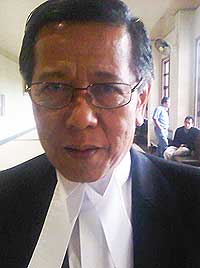 f Zainal Abiden urged the Kuala Lumpur High Court to accept three items from which DNA was retrieved - a mineral water bottle, Good Morning towel and a toothbrush - as evidence of relevance to the charge.
Anwar was not tricked into using the towel or toothbrush supplied him by the police while under detention, Yusof insisted today.
Anwar had brought the water bottle with him when detained for his statement to be recorded, and left it behind in the cell where he had been held overnight.
"He was not induced or threatened. There was no oppression. Even if the evidence gained is obtained though illegal means, it is admissable based on relevancy," he submitted in a trial within a trial.
Citing case law from countries as diverse as the UK, the US, Jamaica and Africa, Yusof sought to show that evidence - even if gained in a controversial or illegal manner - can be admitted if relevant.
He began his submission by urging the court not only to look at the issues raised during the trial-within-a-trial, but also throughout the proceedings.
Anwar, he said, did not categorically deny the execution of the warrant of arrest, although his lawyers have claimed that the arrest was illegal.
"He (only) said that he did not know what document he had signed," Yusof said, noting that arresting officer Ahmad Taufik Abdullah had informed Anwar that the arrest was based on a seizable offence under Section 377B (consensual unnatural sex - i.e. sodomy - of the Penal Code).
"Taufik also provided the warrant of arrest and the charge at IPK (police headquarters) KL, which was produced by investigating officer Jude Blacious Pereira.
“Anwar did not deny the existence of a warrant. Taufik made a copy of it and photocopied it - this is already good evidence. The fact remains that Taufik made a copy of the warrant.
"Anwar signed the warrant (and this) is basis for the grounds. The arresting officer’s statement merely corroborated it.”
The prosecution had faced a set-back earlier today when the Justice Mohamad Zabidin Mohd Diah refused to accept the original copy of the arrest warrant on the ground that the mini-trial had been closed.
The copy of the arrest warrant is “not fabricated evidence because Taufik was not an interested witness or the investigating officer”.
"Anwar also said the officer was polite and nice. Taufik did say that the arrest was made under a charge of (Section) 377B."
Yusof cited a case where a person was arrested but was informed of the grounds hours later.
"In Anwar's case, Taufik mentioned the charge under Section 377B. Sufficient ground was given and the police again read the charge less than an hour later at IPK KL.
 "Anwar had complained about not getting (the complainant’s) police report. The police report is not important, as there was no delay in informing him (Anwar)."
Yusof submitted there was no mala fide (bad intention) on the part of the police in making the arrest as Federal CID chief Bakri Zinin, had issued an order on July 15, 2008 for fear that Anwar would not honour his pledge to give his statement at 2pm on July 16.
"There was the allegation of sodomy, a seizable offence. Taufik was under a duty to make the arrest. Where is the unlawfulness of the arrest?” he asked.
He said the Hospital Kuala Lumpur is impartial and that Anwar should not regard the physical examination as degrading, since certain procedures have to be observed in investigating such complaints.
Limit to court’s discretion
Yusof said the test of admissability of the three items is relevancy.
Citing case law, he said the court has discretion to exclude evidence obtained illegally but the court “has no discretion to refuse evidence even if gained unlawfully, if it is relevant".
He highlighted a case where an accused had a blood sample taken involuntarily for a DNA test and which was admitted as evidence.
Citing British case law, he said a sample of body fluid was taken illegally without consent in a rape case but was admitted as evidence.
He cited another rape case this time from Iowa in the US, where the accused was feted with cake and given a mineral water bottle. The bottle was replaced with another water bottle, and used as evidence.
The respective courts in all these cases had admitted the evidence although it was obtained illegally.
He cited an American murder-and-rape case in which the accused was caught five years later, and had refused to give a blood sample.
"However, the police wanted to his DNA and they used his discarded cigarette butts to retrieve his saliva. Similarly in (this sodomy) case, the evidence was obtained from a mineral water bottle which was discarded."
Yusof said the prosecution has to show that the DNA retrieved from the mineral water bottle corresponds to DNA from sperm retrieved from complainant Mohd Saiful Bukhari Azlan’s rectum.
"It does not amount to a confession (by the accused) but it shows relevancy,” he said.
He concluded his two and a half hour submission by saying that, on balance of probability, the defence had failed to prove that it was improper to obtain the items.
"The items were taken without tricks being employed, there was no inducement, no threats, no promises...It would not be unfair for the court to admit the items as evidence (as it has) general discretion to admit such evidence,” he concluded.
“The defence application to remove the three items should be dismissed and the prosecution should be allowed to call (crime scene investigator) Amidon Anan and (chemist) Nor Aidora Saedon to admit the items as evidence.”
The hearing resumes tomorrow at 10am. It has attracted foreign attention, with officials of various embassies attending the trial almost daily to monitor the proceedings.


