




DPM in for cool reception over land titles
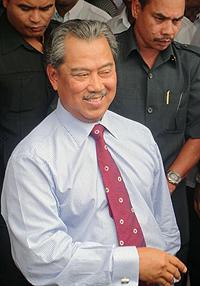
A leading land rights activist and lawyer has expressed shock and dismay that Deputy Prime Minister Muhyiddin Yassin is to hand out communal titles in Tongod tomorrow, during a scheduled visit to Sabah.
A leading land rights activist and lawyer has expressed shock and dismay that Deputy Prime Minister Muhyiddin Yassin is to hand out communal titles in Tongod tomorrow, during a scheduled visit to Sabah.
 The 16 villages concerned in Mukim Lalampas in Tongod, Sandakan, have not applied for such titles, according to Kong Hong Ming.
In fact, he added, the people had rejected the offer outright because it is contrary to Chapter 76 of the Sabah Land Ordinance, which confines such grants to native customary rights (NCR) land.
“The deputy prime minister is perhaps not aware of the situation” said Kong who is responsible for the land and development portfolio in the Sabah PKR presidential council.
The people, he charged, are being forced to give up their NCR land in exchange for inferior land in hilly terrain.
Meanwhile, their NCR land has been earmarked for an agropolitan and integrated agricultural development project, without the beneficiaries being disclosed.
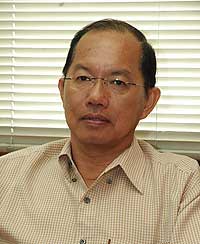 Kong
(right)
disclosed that representatives of the people would try to meet Muhyiddin during his visit and hand over a memorandum on the background to the offer of communal titles to them.
Kong
(right)
disclosed that representatives of the people would try to meet Muhyiddin during his visit and hand over a memorandum on the background to the offer of communal titles to them.
The villagers are of the view that this is a land grab exercise by the authorities and one being masked by the offer of communal titles to non-NCR land elsewhere.
They will plead that the state and federal governments have a fiduciary duty under the federal and state constitutions to protect their well being and advancement.
The villages are Lilinsah, Kulat, Kukulau, Tansiring, Dangison, Langa-Langa, Makataun, Watos, Nadau, Lalampas, Diangau, Talamud, Totomolon, Babakat, Ansung and Titimang.
“If the memorandum does not bring results, the native land owners may have no choice but take the matter to court,” said Kong.
“The courts cannot be a party to assisting anyone, whether the state government, its agencies or private companies, to indulge in an illegality.”
The villagers had held meetings with the state authorities in March and April last year. At the first meeting they learnt that their 1,194 applications for titles to NCR land would not be considered because the land had become part of an agropolitan project covering 38, 000 acres.
As a way out, the state government came up with the offer of communal titles to some inferior land nearby.
The villagers pointed out that there is no provision under the law for this; that they are not interested in the land offered; and that NCR cannot be extinguished under the law.
Opposing approaches
Kong, who has fought for the issuance of communal titles to NCR land, has since discovered that the state government has other ideas.
His idea was that communal titles would facilitate development of NCR land along modern lines while preventing native owners from selling their property for quick money.
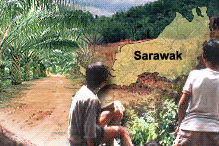 The government approach has focused on state agencies and private companies getting their hands on NCR land for the purpose of joint-venture projects.
This means that communal titles are handed out for NCR land only if the owners agree to hand over the plots to state agencies or private companies.
Kong said he sees this as duress on the part of the authorities, apart from being highly irregular under the law.
At other times, it has meant NCR landowners giving up their land completely to developers in return for communal titles to other land “as in the case of Tongod”. Again, the law does not provide for issuance of communal titles for non-NCR land.
“Either way, it means that the natives lose their NCR land. In the first scenario, they become landless and in the second, they are left holding inferior land,” said Kong.
The idea of native land-owners getting dividends from joint-ventures “is a fallacy” that must be laid to rest.
“What dividends are you taking about? The companies concerned might just plead that they are not making profit. There’s no one to protect the interests of the native landowners in the joint-venture development.”
To add insult to injury, the native landowners end up virtually as plantation slaves on their own land, Kong said, citing several case studies.
“Land provides a social safety network for the natives. Without land, what are they going to do? Are they going to transmigrate to the towns and add to the social problems being created there by the illegal immigrants?”
A major worry for Kong is that NCR landowners may not have much time left to assert their rights under the law, as the state government, state agencies and private companies cast covetous eyes on properties that occupy prime land.


