




Should subsidies still be rolled back?
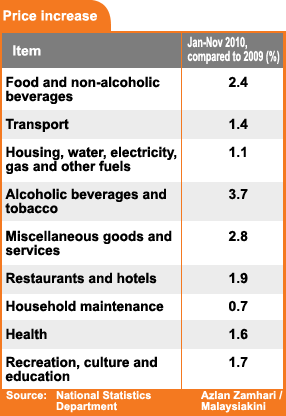
SPECIAL REPORT Working families may already feel the pinch from rising food prices, but experts believe that the worse is yet to come.
According to Ratings Agency Malaysia chief economist Yeah Kim Leng, global monetary policies are expected to pump more money into the system, thus raising demand and pushing prices across the board.
SPECIAL REPORT Working families may already feel the pinch from rising food prices, but experts believe that the worse is yet to come.
According to Ratings
 Agency Malaysia chief economist Yeah Kim Leng, global monetary policies are expected to pump more money into the system, thus raising demand and pushing prices across the board.
“There is a threat of stronger inflation for (emerging) economies (including Malaysia) in the second half of this year,” he said when contacted.
“This is especially with greater liquidity in the United States, following the quantitative easing (where the US Federal Reserve Bank will buy back government bonds).”
This could lead to higher commodity prices, he warned, which is bad news for Malaysia which imports half of its food needs - including items used in food production like feedstock - which could feed into the inflation spiral.
The situation, cautioned Yeah, could worsen if the government insists on continuing to roll back subsidies, with the third round of cuts expected by the middle of the year.
While it is important for the government to carry on with its plans to prove its seriousness on the matter, the economist said he feels the “timing is not right”.
 “A rise in commodity prices would be good for smallholders who will have extra income and be able to absorb any rising cost of living as a result, but this is not the case for the urban poor who live on a fixed income.
“It would be better if the government holds back its plan of subsidy rationalisation, given the circumstances.
“Subsidies, especially for food and essentials, can still be continued. But of course the government will need to make sure that they find a way to raise funds to sustain itself.”
Even those who enjoy improved incomes due to commodity prices cannot be expected to withstand price hikes beyond a “moderate” 10 percent, said Yeah.
“Any price hike beyond 10 percent is considered unjustifiable, although this will vary from item to item,” he said.
Commercial farming as a solution
Price monitoring by the Consumer Research and Resources Centre of the Federation of Malaysian Consumer Association (Fomca) have shown hikes of over 100 percent on several food items, while grocers estimate a hike of 10-20 percent for at least half of their products.
Both Consumer Association Penang president SM Idris and Yeah agree that a long-term solution to Malaysia’s food price conundrum is greater investment in agriculture, particularly on a large commercial basis.
But this i
 s a debate which Malaysia has yet to resolve, having moved away from an agriculture-driven economy, in the hope of achieving higher income through industrialisation.
“On a community level, we should look at setting up community farms in neighbourhoods,” Yeah said.
Idris said the 40 percent of working families earning less than RM1,500 a month are barely managing. They are taking on debts and not paying bills every month.
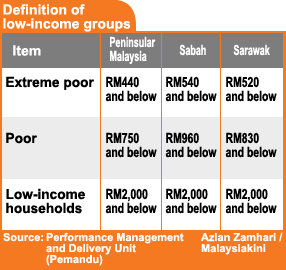
In Peninsular Malaysia, families earning RM750 and below are considered poor, while a low-income household is one that earns less than RM2,000 per month.
Food stamps and ration cards
A quick and efficient way to assist families hovering on the poverty line, said Idris, would be by issuing them food stamps and other similar means of income support.
Thinking along these lines, the Performance Management and Delivery Unit (Pemandu) had during its subsidy cut proposal last May mooted compensation for low-income households.
Pemandu proposed that, in the first year, each member of a low-income household would receive RM20 for the whole year, while each family would receive support through discount stores and cards the following year.
Whi
 le it is unclear if this proposal has been taken up by the government, Fomca president Paul Selvaraj believes that RM20 a year appears scant for a family which is to face the level of price hikes anticipated.
“More than food stamps, we should look at comprehensive support packages for low-income households to include (the cost of) things like transport and education which is also on the rise,” he said.
Implementing the RM20 per person plan for the about 100,000 families registered as low-income under the government’s eKasih programme would cost the government an estimated RM10 million the first year, based on an average household of five people.
If this continues over five years, the amount would be RM50 million - but still a fraction of the whopping RM103 billion the government is said to be able to recoup from cuts proposed by Pemandu over the same period.
Idris said the main hurdle in income-support programmes is in determining who is qualified, and in making sure that the rebates are not abused.
This is where the eKasih comes in, and to its credit, the programme has provided RM300 per month in income support for the 100,000 qualified, of whom about 44,643 are hardcore poor.
According to Pemandu, as at the end of last year, all the hardcore poor registered under eKasih were uplifted out of that category while 16,471 were helped out of poverty.
But eKasih is unable to assist the many families earning RM1,500-2,000, who are still considered to be in the low-income bracket but do not qualify for income assistance.
“In any sort of welfare programme, there will be a cut-off line. So, for those just above the line, life will unfortunately be very hard,” Paul noted.
Yesterday: Food inflation: Why grocery bills are higher


