




Why M'sian First is a joke
Tangan kanan memberi, tangan kiri tidak mengetahui is a Malay saying with Islamic flavour that carries this idea - Sedekah adalah lebih afdal jika dihulurkan secara diam-diam .
With DAP and its supporters though, it’s Tangan kiri memberi, tangan kanan pandai-pandailah panggil pemberita .
Tangan kanan memberi, tangan kiri tidak mengetahui is a Malay saying with Islamic flavour that carries this idea - Sedekah adalah lebih afdal jika dihulurkan secara diam-diam .
With DAP and its supporters though, it’s Tangan kiri memberi, tangan kanan pandai-pandailah panggil pemberita .
As we can see of late, DAP insists on publicising their every effort of “getting close” to the Malay electorate. This going after the Malay votes has resulted in the behaviour of the party Chinese leaders becoming melebih-lebih (overdoing it).
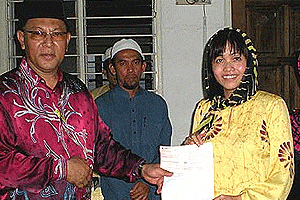 The superficial, inter-racial smooching comes across as contrived, much like Najib Abdul Razak wearing a red shirt with Mandarin collar during Chinese New Year, or Teo Nie Ching donning
selendang
upon the advice of DAP top guns.
The superficial, inter-racial smooching comes across as contrived, much like Najib Abdul Razak wearing a red shirt with Mandarin collar during Chinese New Year, or Teo Nie Ching donning
selendang
upon the advice of DAP top guns.
There’s another saying Di mana bumi dipijak, di situ langit dijunjung . I’ve given it my own twist - Di mana bumi dipijak, di situ warong dikunjung . Patronising mamak stalls is the mark of Malaysian First-ing; I eat Malaysian food, therefore I’m Malaysian First, the slogan’s proponents would have you believe.
National food and national drink are the bells and whistles in the Malaysian First advertising copy. However, for a legalistic take on Malaysian First, we need to look at the federal constitution (which does not mention roti canai, teh tarik, selendang or the Caliph’s turban). The elements mentioned in our constitution are Islam and national language.
When we think about the defining characteristics of other nationalities (‘Malaysian’ does refer to nationality after all), we go along the line that a Swede is someone who speaks Swedish. A Finn, someone who speaks Finnish, Dane, Danish and so forth.
Therefore to promote Malaysian First, DAP ought really to be promoting BM because it is our national, and therefore Malaysian language, and the only one accorded the status in the constitution - that portentous document which defines what this country is.
Link between BM and Islam
Anwar Ibrahim was a Universiti Malaya undergraduate doing Malay Studies at the same time that Syed Naquib al-Attas was Dean of the university's Arts Faculty, the eminent professor having started his academic career in the Department of Malay Studies.
When he was Education Minister, Anwar was quoted as saying: “The development of the Malay race and culture in the country must be related to the development of the current Islamic civilisation. The Malay cultural and linguistic civilisation which had been Islamised should be in line with the building of Islamic civilization itself”. ( The Sunday Times , Sept 15, 1985)
For the purposes of this article, I will note that part of Anwar’s statement, viz “the Malay cultural and linguistic civilisation [is] Islamised”.
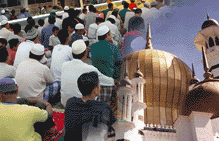 Syed Naquib’s impressive body of scholarly work on Islam and its impact on the Malay world will lend clarity to Anwar’s espoused philosophy. Which is to say, in more straightforward terms, the Malay worldview is informed by Islam and the Quran, and this is reflected in the Malay language which borrows extensively from Arabic.
Key terms and their meanings are shared by all Islamic languages. Or to put it another way, the special connection between Malays and the Malay language with the Arabs and Arabic language is founded upon what both have in common, namely Islam and the Quran.
Take for example the following key terms, Arabic words in Romanised spelling, with their Malay equivalent in brackets: tawhid (tauhid), iqraa (ikrar), da’wah (dakwah), hijrah, doa, aql (akal), ilm (ilmu), adl (adil), zulm (zalim), wajib, halal, haram, akhlaq (akhlak), fitnah, ikhlas, hikmah, ijma (ijmak) .
I’ve not learned Arabic before and never been directly exposed to the language in my life, yet I can pick out Arabic words just on the basis of my knowledge of BM: fiqh (fikah), nafaqah (nafkah), sadaqah (sedekah), ma’sum (maksum), wahy (wahyu), ma’na (makna), niyyah (niat), siyasah (siasah), haqq (hak), iddah (edah), zahir, batin, waqf (wakaf), fajr (fajar), madhhab (mazhab) .
When I read Khaled Hosseini’s The Kite Runner - an international bestseller whose story is set in Afghanistan - I recognised some native words he used:
yateem (yatim), shahbas (syabas), qurma (kurma), biryani (briyani), tandoor, watan, qoam (kaum), nazr (nazar), pari, burqa (burka), hijab, ghazal, rubab (rebab), azan, zakat, noor (nur), nika (nikah), qorban (korban), mujahedin, Hadj (fardu haji), Haddith (hadis), surrah (surah), ayat, shar’ia, rasul, Qiyamat (kiamat), Sawl (Syawal), Eid Mubarak , and the expressions Allah-u-Akhbar, Inshallah, Mashaallah, Alhamdullellah, Bismillah, Salaam Alaykum/ Alaykum Salaam .
In Khaled’s novel, these are Afghani words but we recognise them because they’re shared by the ‘Islamic languages’.
Logical conclusion of M’sian1st-ing
Among the most significant words borrowed from Arabic that tug at the Malay heartstrings are, I think: iman, warak, rahmat, taubat, adat, amanah, maruah and adab . Interestingly, biadab means tiada adab (the prefix bi in Arabic is a negation).
Many non-Muslims cannot grasp the extent to which the Malay soul is faithfully wedded to the Muslim ethos, and how rock solid the marriage is. This is an outcome hundreds of years in the making.
 And the DAP supremo dares to slight this matrimonial bliss with his harangue at Muhyiddin Yassin, which panned out in the vein of: I, Kit Siang, object to you Muhyiddin being Malay First (which by constitutional definition equates Muslim); instead you must be Malaysian First - like me who no longer consider myself Chinese (casting off 5,000 years of civilisation in one fell swoop).
Mind you, the Malaysian First prototype has a product history of merely 47 years.
Our nationwide population census was conducted from July 6 to Aug 22. Census commissioner Wan Ramlah Wan Abd Raof complained that “about 70 percent of non-response participants were from the Chinese community”. She added that some of them claimed they only spoke Mandarin and thus the reason for their failure to cooperate with the census enumerators.
Doesn’t their inability to speak Malay disqualify them from Malaysian Firstness? Imagine, say, a Korean First-er who can’t converse in Korean.
But these Malaysian First-ers are too takbur and disdain BM as having little economic value.
Language influences habits of mind
There has been continued debate about how language shapes our experience of the world.
“When your language routinely obliges you to specify certain types of information, it forces you to be attentive to certain details in the world and to certain aspects of experience that speakers of other languages may not be required to think about all the time.
“And since such habits of speech are cultivated from the earliest age, it is only natural that they can settle into habits of mind that go beyond language itself, affecting your experiences, perceptions, associations, feelings, memories and orientation in the world,” writes Guy Deutsche, a University of Manchester research fellow at the School of Languages, Linguistics and Cultures.
The Pakatan people marketing Malaysian First are insisting that we (minorities) must engage or make friends with Malays for the sake of ‘national unity’ or more crucially, for the opposition coalition reaching Putrajaya.
But there’s the language barrier. There are those Malaysians the census commissioner complained about, i.e. Chinese who can’t speak BM. There was that woman the policeman told off to Balik Cina for the same reason.
In contrast, there are the non-Malaysians from various parts of the Muslim world who can recognise hundreds of Malay words [see endnotes] because of the common vocabulary shared by the Islamic languages.
 While it’s true that there are many loan words too from English (e.g.
kelab, hotel, farmasi, mesin, elektrik, diesel, automatik, magnet
), their mostly scientific or technical terminology are not those describing feeling, thought or belief and the core of one’s being.
While it’s true that there are many loan words too from English (e.g.
kelab, hotel, farmasi, mesin, elektrik, diesel, automatik, magnet
), their mostly scientific or technical terminology are not those describing feeling, thought or belief and the core of one’s being.
Powerful words pregnant with meaning are mostly unquantifiable, such as ‘honour’, ‘trust’, ‘integrity’, ‘conscience’. If you're not steeped in Malay semantics, you will never understand the backlash against the mengaibkan Anwar episode. The Arabic key terms that our national language has taken to heart can pack an emotional wallop for Malays.
Linguistically at least, an Arab tourist can better comprehend the worldview of a Malay, than can the Malay’s countrymen who have a poor command of the national language. That's why so many Malays instinctively feel the people who are their soulmates are the Palestinians, not the Penans.
I’ve never heard DAP in its Firstness campaign ever promoting the national language at all. If “getting to know the Malays” - as the DAP parrots claim their leaders are actively and aggressively doing - is the desired objective, isn’t language the key? Ask yourself, what is the basic building block for understanding each other? Communication, no?
Yet DAP, in their Malaysian First-ing, has failed to display, on this very fundamental issue, any sound ideological moorings. Only very crass politicking.
ENDNOTES: Arabism in Malay language
Below is a cursory compilation of words with Arabic origin. I cluster them loosely by association.
Words to do with faith (ilahi, firman, takwa, mukmin, syariat, hidayah, syiar, kitab, hadrat, alim, syuhada) ; jurisprudence (hadis, sunnah, nas, fatwa, qisas, qazaf, takzir, hudud, faraid, zakat, jizyah) ; positions and institutions (masjid, bilal, muazin, kadi, mufti, ustaz, ulama, mubaligh, mualaf, rabbani, baitulmal, qari/qariah) ; beliefs (akidah, qadak, qadar, takdir, tawakal) .
Prayers and observance (ibadah, solat, shahadah, jemaah, istikharah, istighfar, dikir, zikir, tajwid, tahlil, takbir, syukur, tawaduk, wuduk, sejadah, saf, rakaat) ; society ( sahsiah, ummah, khalifah, darjat, tadbir, wilayah) ; social workings (mukadimah, musyawarah, shura, ijtimak, muktamar, islah, muzakarah, hudnah) .
Family ties (muhrim, umi, wali) ; fellowship (akrab, ikhwan, ukhuwah, muhibah) ; personal relationships and ceremonies (akad nikah, mutaah, fasakh, talak, nusyuz, zina, jimak, baligh, khatan) .
 Words to do with obligations
(haj, umrah, fardu ain, amal, jariah, kifarat, ehsan, ikram, afdal, soleh, aurat)
; determination
(iltizam, ikhtiar, nawaitu, ikrar, muhasabah, mujahadah, taat, insaf)
; business and transactions
(muamalat, riba, takaful, wadiah, iktisad, wasatiah)
.
Words to do with obligations
(haj, umrah, fardu ain, amal, jariah, kifarat, ehsan, ikram, afdal, soleh, aurat)
; determination
(iltizam, ikhtiar, nawaitu, ikrar, muhasabah, mujahadah, taat, insaf)
; business and transactions
(muamalat, riba, takaful, wadiah, iktisad, wasatiah)
.
Learning and understanding (tarikat, khutbah, tafakur, ijtihad, iktibar, tafsir, takrif, tawarikh, hisab, ilmiah, ijazah, takyin) ; writing and language (nahu, eja, harakat, riwayat, hikayat, warkah, mukadimah) ;
Aspirations (jihad, mujahid, syahid, zuriat, wasiat) ; prohibitions and negative words (arak, maksiat, khalwat, kafir, harbi, murtad, laknat, syirik, makruh, bidaah, dajal, batil, khurafat, hawa, musibah, daif, fasik, jahil, munafik, liwat) ; death and afterlife (ajal, nazak, takziah, talkin, rahmatullah, arwah, akhirat, azali, abadi) ; the universe and everything else (insan, malaikat, alam ghaib, masyar, barzakh, hakikat, hakiki, fana, syumul) .
HELEN ANG used to be a journalist. In future, she would like to be a practising cartoonist. But for the present, she is in the NGO circles and settling down to more serious writing and reading of social issues.


