




Penan rapes demand a prompt national response
COMMENT It was hard not to miss the consistent media reports since the end of 2009 to date on the sexual abuse of Penan women and girls. What was more distressing was the government inertia in responding promptly to the reported abuses, despite a government task force supporting the allegations of rape and sexual abuse.
COMMENT It was hard not to miss the consistent media reports since the end of 2009 to date on the sexual abuse of Penan women and girls. What was more distressing was the government inertia in responding promptly to the reported abuses, despite a government task force supporting the allegations of rape and sexual abuse.
 It is unclear if the report is an official secret as that report is still not on any government website. These are the hiccups associated with the BN government’s fear of dissemination of information that has the public giving the thumbs-up to Selangor’s FOI enactment.
The delay in releasing the task force report is disquieting. The reason for the delay could be that Malaysia’s UPR (universal periodic review) was due in February 2009 before the Human Rights Council (HRC). Malaysia’s country report did mention the task force to “investigate the report of alleged sexual harassment and abuse of Penan women in Sarawak by logging company workers”.
Government losing control
As the report was under the radar, it went unnoticed in the NGO report to the UPR and in the NGO lobby at the HRC, missing the international attention which the issue now receives.
The Public Support Group fact-finding report (PSG report) of 2010 recorded other incidences in addition to the initial eight in the government report, and highlighted the dispossession and disempowerment of the community as a result of development in the region.
 The backlash to the PSG report can only be understood of a government losing control of the situation.
Action on the government report was postponed, as the ministry will now investigate the new incidences. This inaction supports suspicion that there are no concrete steps developed to address the immediate needs of the victims, nor were there measures to address root causes.
Instead of welcoming the report as an important contribution to the cause, the report was taken by BN politicians as an affront to the popular support which the government says it enjoys. Alfred Jabu, Sarawak’s DPM claims that it’s only the disgruntled few who had “their own agendas”.
It is hard to follow the logic of ministers James Masing and Fadillah Yusoff. Their opinions are reminiscent of colonisers, to wit that the natives are different from us and that difference allows us to treat them differently.
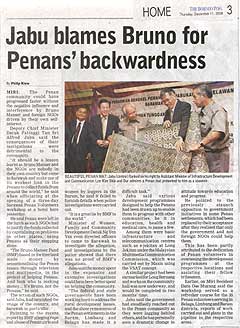 They also appear to moot the idea that because of difference of sexual mores between ‘us’ and ‘them’ - for example, that sexual activity has cultural acceptance at 14 years of age - therefore the sexual abuse of Penan women and children is legitimate. It’s like saying that the victims asked to be raped and abused. In any other working democracy, these two ministers would have to show cause as to why they should not resign from their posts.
This sideshow does not help us understand - if and how - Penan women and girls are caught between their own struggle for gender justice within their own communities, and their dependence upon and support for their community’s indigenous identity in its resistance to ‘capitalistic profit-oriented’ development.
Complex issues
This means acquiring knowledge of the problems Penan women and girls face on the basis of their biological sex as females, and on the basis of sex-role stereotyping in their community. We need to know if that internal struggle of women is affected by the women’s membership to the community from which they claim their cultural identity. Then there is the community’s struggle against development which denies the women and their community’s right to cultural diversity and identity as an indigenous cultural group.
 Women are not oppressed on the basis of gender (sex and sex-role stereotyping) alone. In investigating the oppression of Penan women and girls, manifested by sexual assault, other factors such as economic, ideological, ethnic/cultural grouping, political and other divisions and differences among women are equally relevant.
These are some basic points of reference. They are treated in different categories and as many categories in order that we may better understand the complexity of issues involved. In turn this understanding would help us to identify the appropriate strategies and target them accordingly.
Given the complexity of the problem, it is only reasonable to expect that the task force recommendations should go beyond “awareness raising” of Penan women and girls “so that they would be able to recognise and address issues of sexual harassment and abuse” as stated in the Malaysian UPR report to the HRC in February 2009.
While there are important specificities to the Penan crisis, there are measures common to a framework to eliminate violence against women (VAW) and discrimination against all women. The Penan crisis has dramatically brought to light the absence or failures of national mechanisms to address VAW.
List of ‘must haves’
For example, we still do not have national statistical systems geared to measure the magnitude and the different forms of VAW. We are still using police statistics for this purpose. This is highly unsatisfactory as this would only involve actual reports taken by police and on particular kinds of sexual abuse recognised under the law. Talk to any social worker on VAW and they will tell you that the police would be a last resort especially when it involves sexual abuse.
 We do not know if the one-stop centre “at major hospitals” established in 1998 “for a coordinated management of rape and other forms of VAW and children ” - from the 2004 Committee on the Elimination of Discrimination against Women (CEDAW) report - coordinated by the Ministry of Health is fully functioning, properly funded with monitoring and evaluation systems in place. The Royal Malaysian Police partners this programme. There is only one sentence attributed to the one-stop centre in Malaysia’s CEDAW report. The 2009 UPR report is silent.
A functioning one-stop centre, accessible to the Penan community, would have greatly improved some institutional responses to the problem if not the root causes for the time-being.
There is a list of must-haves in any intelligent policy on VAW. This is not rocket science. There is an explosion of tools, modules, frameworks, policies, indicators, anything under the sun over the internet. The UN, international agencies, funders, NGOs, corporations have their best practices and these are accessible.
 The list of must-haves should not detract us from a prompt national response to the Penan crisis. The PSG report states that this is a decade-old problem. A royal commission is doable.
I sincerely hope that voters realise that the setting up of a royal commission for any number of unresolved issues is an indication of failed institutions. And voters should take politicians to task.
What are the commitments of political parties to the elimination of discrimination and violence against women for the next GE? What have been the concrete measures undertaken by the opposition in state governments? Let’s see some concrete commitments from those who wish to lobby for the people’s vote.
SALBIAH AHMAD is a lawyer by training and works on human rights with a specialisation on Islam and gender.


