




Chin Peng loses appeal on technicality
The Court of Appeal today dismissed Ong Boon Hua alias Chin Peng's appeal against last year's Kuala Lumpur High Court decision in striking out his suit against the Malaysian government for breach of contract, in making slanderous statements against him.
The Court of Appeal today dismissed Ong Boon Hua alias Chin Peng's appeal against last year's Kuala Lumpur High Court decision in striking out his suit against the Malaysian government for breach of contract in making slanderous statements against him.
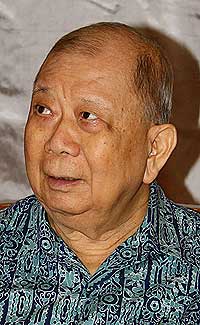 Chin Peng (
right
) maintained that the hostility termination agreement signed between the Malaysian government and Communist Party of Malaya (CPM) in 1989 had provided for both parties not to issue slanderous statements against each other.
Chin Peng (
right
) maintained that the hostility termination agreement signed between the Malaysian government and Communist Party of Malaya (CPM) in 1989 had provided for both parties not to issue slanderous statements against each other.
The said provision, in item 1.2 of the historic agreement - signed on Dec 2, 1989, in Hatyai, Thailand, to end hostilities - reads, "All press statements issued by either party thereafter, shall be in the spirit of the agreement and shall not contain any slanderous terms such as ‘mass surrender' and ‘capitulation'".
The Appellate Court ruled that the earlier High Court decision was correct in limiting the agreement to the two terms mentioned, because the words "such as" limited the scope to those two words.
The plaintiff had argued that following the agreement, then Deputy Information Minister Zainuddin Maidin had breached the agreement by making slanderous statements that had appeared in two English daily articles in 2005 as well as documentaries about the Communist insurgency.
Unanimous decision
In making their decision, the panel of three judges led by Justice Sulong Matjeraie with Jeffrey Tan Kok Hwa and Md Apandi Ali were unanimous.
"We have closely scrutinised item 1.2 of the Administrative Agreement, but we are unable to accept item 1.2 provided for non-publication of all manner of slander," said Sulong.
"Rather, we find item 1.2 is only limited to the non-publication of the words to the effect of ‘mass surrender' or ‘capitulation'. The words ‘slanderous term' was clearly intended to the words that followed ‘mass surrender' or/and ‘capitulation'," he said.
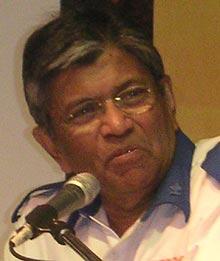 Sulong concluded that the statements made by Zainuddin (
left
) were therefore clearly not covered by item 1.2.
Sulong concluded that the statements made by Zainuddin (
left
) were therefore clearly not covered by item 1.2.
"We could not find any procedural breach by the defendants. On this ground, we dismiss the appeal," he said.
The court however did not order for payment of costs.
The High Court had on Sept 30 last year struck out Chin Peng's suit against the government after the judge Justice Balia Yusof ruled that the suit was "unsustainable" because hostility between the now defunct CPM and the government was a historical fact and undeniable.
Balia also said that CPM had no cause of action, as it is not a registered body under the Societies Act.
Chin Peng filed the suit, on behalf of himself and CPM members, following media reports on March 21 and May 6, 2005, which quoted Zainuddin announcing that RTM would air documentaries on the atrocities committed by communist insurgents after the Second World War.
'Contents binding'
Senior lawyer Tommy Thomas who led Chin Peng's counsel, with Chan Kok Keong and Leong Cheok Keng, submitted that Malaysia must recognise the agreement, and that its contents was binding.
 Thomas (
right
) said the CPM was outlawed by the British, and therefore it should not fall within the realm of the Societies Act used by the court to strike out the claim.
Thomas (
right
) said the CPM was outlawed by the British, and therefore it should not fall within the realm of the Societies Act used by the court to strike out the claim.
"The legal standing of Malaysia is brought to disrepute, as it seems the government is reneging on the peace agreement which was signed in a third country, Thailand."
"Malaysia was in 1989 hailed for signing this historical agreement. Unfortunately the government and the courts seem not to recognise this when it ruled CPM as a unregistered body.
"There are many peace treaties signed by other countries and with various parties, that had been respected, but (Malaysia is) not following that," he said.
Thomas argued that the Appellate Court's questioning of CPM's standing does not hold water, as anyone, and not just a registered society, can take legal action.
"It is clear the respondents had breached the agreement by making such slanderous statements against Ong and the CPM members," he said, adding the court has to look at the treaty in the spirit of the agreement, and not on the technicality of the specific words mentioned as the basis of the ruling.
Outside the court, Chan said the team will consider whether they would appeal to the Federal Court for leave.


