




'Critical changes needed to stem further FDI outflow'
Saying this today, DAP national publicity secretary Tony Pua said the government led by Prime Minister Najib Abdul Razak has backtracked, contradicted or completely foregone the measures correctly identified in his ‘New Economic Model’ (NEM) as necessary to redress the fundamental problems besetting the economy.
Malaysia’s regional competitors will stride ahead as we fade further away from the radars of local and foreign investors unless critical changes are made to the government's policies and practices.
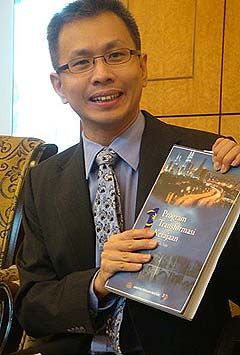 Saying this today, DAP national publicity secretary Tony Pua said the government led by Prime Minister Najib Abdul Razak has backtracked, contradicted or completely foregone the measures correctly identified in his ‘New Economic Model’ (NEM) as necessary to redress the fundamental problems besetting the economy.
Citing the recently-disclosed World Foreign Investment Report (WIR) 2010 by the UN Conference of Trade and Development (UNCTAD), Pua pointed out that Malaysia had in 2009 attracted, for the first time, less investments than the Philippines.
“While we have come to accept Thailand, Vietnam and even Indonesia as having gained competitiveness against Malaysia in recent years, we are suffering the ignominy of attracting lower foreign direct investments (FDI) compared to the Philippines for the first time ever in history,” said Pua in a statement.
“Among Southeast Asian nations , we are now only attracting more FDI than Cambodia, Burma, Brunei, Laos and Timor-Leste,” the Petaling Jaya Utara MP added.
This decline in FDI, Pua noted further, was Malaysia’s worst performance when compared to the other countries in Southeast Asia.
“Thailand, Vietnam and Indonesia's FDI declined by 30.4 percent, 44.1 percent and 44.7 percent, respectively, those figures are by far healthier when compared to Malaysia's 81.1 percent drop.
“This was despite the fact that Thailand was facing a year-long political upheaval while Vietnam was mired in a currency crisis. On the other hand, Singapore, Brunei, Philippines and Burma still managed to register positive growth, although for Singapore, the bulk of its decline in FDI was registered in 2008 which accentuated its improvement in FDI in 2009.”
Malaysia, in fact, was the only country within the region to register a net negative FDI flow.
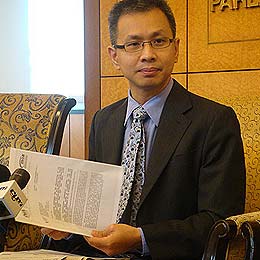 “Out of all the countries in the region in 2009, Malaysia was the only country where our outflow of FDI amounting to US$8.04 billion is substantially greater than the FDI of US$1.38 billion received. All the other countries in the region had a net positive FDI flow in 2009.”
Taking a longer look at Malaysia’s track record over the past two decades, Pua showed that FDI in Malaysia had been on a general decline “while our neighbours are generally trending upwards .”
Turning to the NEM, Pua said it had correctly identified the most critical weaknesses within the economy and put forward measures aimed at their redress..
Since the launch of the NEM, however, Najib has repeatedly backtracked from the NEM and shown little political appetite to implement those measures.
Pua cited Najib’s backtracking on his initial promise to implement needs-based, as opposed to race-based, affirmative action, the spate of open, transparent and competitive award of privatisation projects such as the RM628 million construction of an exhibition and convention centre, the development of the 3,000 acres of prime land in Sungai Buloh and the proposed major redevelopment of the old Sungai Besi airport.
“Even the highly anticipated RM46 billion Mass Rapid Transit (MRT) project for the Klang Valley looks all but awarded to a Gamuda-MMC consortium without any open competitive tenders.’
Najib has been contradicting his earlier assertion that the era where “the government knows best” is over, said Pua.
If the prime minister continues to reject the counsels of Malaysians callling for a drastic rehaul of policies and practices, the economy will only continue to drift away from the radar of both local and foreign investors, said Pua, as our ministers continue to indulge in their daydream of glory and success.
In the meantime, he added, “our neighbours will steadily and consistently improve their economies beyond our reach.”


