




To the elections we go!
COMMENT Is it now quite possible to predict a GE by a chain of events?
An early warning system is often related to civil conflict giving rise to a humanitarian crisis. This is manifested in a set of indicators that will act as a fore-warning of the event and would assist in efforts to avert the situation or to help in preparedness.
Are we witnessing early warning signals to an impending GE? There were suggestions by Malaysiakini readers that the recent name-calling by BN of PR politicians is one sure signal of GE13.
COMMENT Is it now quite possible to predict a GE by a chain of events?
An early warning system is often related to civil conflict giving rise to a humanitarian crisis. This is manifested in a set of indicators that will act as a fore-warning of the event and would assist in efforts to avert the situation or to help in preparedness.
Are we witnessing early warning signals to an impending GE? There were suggestions by Malaysiakini readers that the recent name-calling by BN of PR politicians is one sure signal of GE13.
The Sodomy II trial has too little interest at home and abroad to be a swing factor. Whatever may be the outcome of the legal battle, the case has little to do with the truth as there is continuing public disaffection with the independence of the judiciary after Sodomy I.
 Most foreign governments have already expressed concern with the court case which is seen as a political attack on opposition leader Anwar Ibrahim and an attempt to discredit the opposition as a whole.
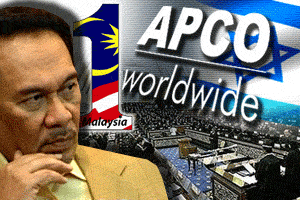
The recent ‘anti-Jew, anti-Zionist’ saga against Anwar is seen as orchestrated. There are allegations of the ruling government’s use of Apco’s professional services for this task. Apco, which is based in Singapore, is registered in the US as an agent of a foreign government.
Opposition and media
Some weeks ago, there was the usual rant on the elusive ‘Islamic state’ between DAP’s Karpal Singh and PAS Tok Guru Nik Aziz Nik Mat reported by Bernama . This is quite a dead subject, especially when there is very little to offer in the expose, in expanding the debate for thinking Malaysians.
What is known to all and sundry is that Karpal will never agree to an Islamic state as he defines it and Tok Guru will never budge on his vision of the Islamic state, with PAS heartland-state, Kelantan as his showpiece. The skirmish is as predictable as a Punch and Judy show.
 It is most regrettable that the constitutional crisis in Perak robbed voters of its government elected at the March 2008 polls. It could have been a new benchmark of state governance under PAS MB Nizar Jamaluddin. In any case, the early days of PR under PAS in Perak have indicated that PAS in Perak may be different from PAS in Kelantan.
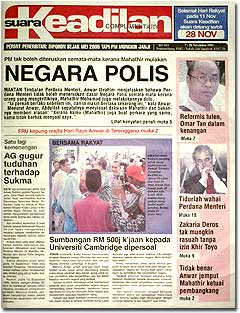
We await the impact of the latest executive interest in banning Suara Keadilan and its warning over Harakah , two opposition newspapers.
Senator Ezam Mohd Nor’s attempt to cast aspersions on The Star ’s and Malaysiakini ’s allegiance to the federal constitution was the most amusing so far. His version of acts of sedition (disaffection against the Malay Rulers) by the reporting on the working conditions of workers at the new palace construction site, must take the prize for the tallest tale in media infamy.
Integrity of elections
Then there are the EC’s visions for law reform. It has a proposal to amend the Elections Offences Act. We have yet to know if it’s just that one provision in the Election Offences Act or a slew of changes to the various electoral laws.
The proposed change is too miniscule to combat illegal and corrupt practices. The EC claims that it cannot do everything under the law and requires assistance from other “friendly” departments. It claims limited jurisdiction.
As a body constituted under the federal constitution and not by any ordinary Act of Parliament, it refuses to undertake the task of reviewing the integrity system of the electoral process. It is happy to apply the provisions of the various Acts of Parliament on managing elections.
The last EC-driven amendments to all election laws were made in 2003 before the 2004 GE11. The amendments sailed through Parliament then because BN controlled a two-thirds majority. Opposition members of Parliament showed their objections by walking out of Parliament at the passage of the amendment bill.
Among others, the 2003 amendments imposed an RM10,000 (from RM2,000 before amendment) security for costs to be paid into court before an election petition can be filed. This change in the law alone is sufficient at the outset of preventing any ordinary voter from defending his/her right to universal suffrage in the election court.
This makes a mockery of the fundamental right of the ordinary citizen to due process. It has impinged on the basic right of representation.
Amendments seen to favour ruling party
The amendments also undermined the right of the voter to a clean electoral roll. The 2003 amendments killed the impact of the 2001 Likas election case.
In that, the election judge ruled that the presence of ‘phantoms’ on the electoral roll makes the roll illegal and consequently, the elections based on that roll, void. In 2003, Parliament has cut back on the judiciary’s power of scrutiny over the EC and the electoral roll. Once the EC has certified the roll, the roll cannot be questioned in future election cases.
 To observers, Parliament in 2003 may have gone too far in its checking and balancing role over the judiciary. This amendment may well be perceived as another spoke in the wheel of judicial independence.
Another related amendment was to install an appeal procedure to the election court. This is a very useful process across the board as now there is that possibility of cases challenging the election thrown out on technicalities at the first instance to get a second chance on appeal.
However, it is to be also noted that action on the calls for an appeal court was only made in 2003, after the Likas decision. Was it finally instituted to countermand the Likas decision?
In Likas, the judge said that he was not bound by other election cases, and struck out on his own. All election cases are of the same standing and a judge is not bound by a previous decision on same/similar facts. In 2001, there was no possibility of an appeal to the Likas decision. It would seem to the ordinary voter, that the timing of the amendment to the right to appeal section, was made in favour of the ruling party.
Integrity of the electoral roll
BN lost its two-thirds majority of the Dewan Rakyat in GE12. If continuing defections would increase the chances of restoring the two-thirds in favour of BN in the Dewan Rakyat, then there is that possibility of pushing more changes to the electoral laws before GE13.
The integrity of the electoral roll is undoubtedly a hallmark of electoral integrity in Malaysia’s electoral process. Voters remain sceptical of the EC’s professionalism even in maintaining the integrity of the roll.
 In the Hulu Selangor by-election in April, it was reported that some 13,400 people in Hulu Selangor were effectively
transferred
in what the EC claims to be a “rectifying” exercise. The election roll used in GE12 in 2008 is not the same one used in the 2010 Hulu Selangor by-election. No notice had been given to voters of this transfer exercise.
In the Hulu Selangor by-election in April, it was reported that some 13,400 people in Hulu Selangor were effectively
transferred
in what the EC claims to be a “rectifying” exercise. The election roll used in GE12 in 2008 is not the same one used in the 2010 Hulu Selangor by-election. No notice had been given to voters of this transfer exercise.
Speculations abound if the roll was ‘cleaned-up’ for GE13 and in fact used for the by-election without complying with the required procedure prior to certifying the roll.
Would this situation be covered by the last amendment in 2003 where a certified roll cannot be questioned in court? Would the EC be mulling a change in the law to cover a “rectification” exercise? That would also depend on the magic two-thirds in the Dewan Rakyat, which numbers may fluctuate before GE13.
It is highly unlikely that there would be defections in favour of PR before GE13 to champion the electoral changes that civil society groups had lobbied for with politicians, including those from the opposition before GE12.
The passage of laws is technically out of the voters’ reach. The RM10,000 security for costs to challenge an election is prohibitive to the ordinary voter.
It is the election process and machinery which remain the vital instruments to the voter for a representation in the next Dewan Rakyat. It is never too early to start moving the ground.
SALBIAH AHMAD is a lawyer by training and works on human rights with a specialisation on Islam and gender.


