




Najib's attack on Anwar may backfire
COMMENT As an American, I probably should be flattered that Malaysia’s two most important political figures, Prime Minister Najib Razak and Opposition Leader Anwar Ibrahim, seem to be engaged in some kind of contest to ‘win friends and influence people’ in Washington DC.
COMMENT As an American, I probably should be flattered that Malaysia’s two most important political figures, Prime Minister Najib Razak and Opposition Leader Anwar Ibrahim, seem to be engaged in some kind of contest to ‘win friends and influence people’ in Washington DC.
Actually, it probably is more accurate to say that Najib has joined the battle. That is because Anwar has had close personal ties to a number of prominent Americans for years. On top of that, after his release from prison in 2004, Anwar spent about 18 months living in Washington, where he taught at Johns Hopkins and Georgetown universities.
Anwar’s time here strengthened his ties to political and intellectual leaders in the United States. Without question, he is the most well-known and respected Malaysian in America.
As for Najib, he is not as well-known in our capital city. At the official level, many present and former US government officials and think-tank scholars have known Najib for years, going back to his first appointment as defence minister in 1991. But I doubt that there are any American officials here who could say that they know Najib at the personal level or consider him a friend, despite having dealt with him for nearly two decades.
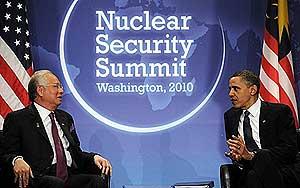 American journalist Ioannis Gatsiounis describes the prime minister this way: “British-educated, Najib cuts a worldly profile... Najib does not seem to share Mahathir’s inferiority complex toward the West, nor does he share the former premier’s impulse to scapegoat the West for Malaysia’s problems.”
While the Malaysian government spin machine is trying to say that US-Malaysia relations have improved significantly under Najib, the warming trend actually began under former prime minister Abdullah Ahmad Badawi, who reached out almost immediately after taking office to improve Malaysia’s relations with America (and Singapore and Australia), reversing two decades of Mahathirism.
In his meetings with Americans, however, Abdullah did not make a strong personal impression. By contrast, Americans are impressed right off the bat when they meet Najib. They find Najib to be an engaging and charming interlocutor, who because of his personal style and fluent English sometimes comes across as more British than Malaysian. Since we know the British so well, that is an advantage for Najib. In contrast to the tart-tongued Mahathir, conversations with Najib are pleasant.
But Americans know little about Najib beyond these superficial impressions. Nor do they know about his government’s actions. Other than Malaysian expatriates and a handful of Americans like myself, there are not that many people in Washington DC who follow developments in Malaysia.
As a result, few people here know about the continuing influence of Mahathir and his cronies, the no-bid contracts, the blind eye towards corruption, the legal unfairness of Anwar’s latest trial, and the restrictions on press freedom - not to mention submarines and a dead Mongolian part-time model.
Instead, people see the British suit, and they hear the British accent.
But in the future, this could change – and when it does, the Malaysian embassy and the Washington-based media consultant Apco will be working overtime to earn their salary.
Israeli flag burned at Umno Youth rally
Reading the Malaysian press and Internet, it would be easy to think that Washington DC is obsessed with Anwar’s comments on ‘Zionist aggression’ and his so-called “apology”.
The Malaysian embassy and its agents have been working hard to make sure that American opinion leaders know about Anwar’s comments on ‘Zionist aggression’. But for reasons that are very understandable, they do not want to call attention to Najib’s own remarks, which were even stronger.
When he met with the Malaysians who were aboard the Turkish aid ship ‘Mavi Marmara’, Najib called Israel’s actions a “blatant act of aggression and terrorism” committed by the “Zionist regime”.
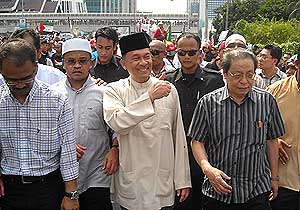 The Malaysian embassy has also been letting Americans know that
Anwar led a protest march
to the US embassy in Kuala Lumpur, where someone burned an Israeli flag. To Americans, that is provocative (maybe because our flag is burned so much, so often, around the world).
The Malaysian embassy has also been letting Americans know that
Anwar led a protest march
to the US embassy in Kuala Lumpur, where someone burned an Israeli flag. To Americans, that is provocative (maybe because our flag is burned so much, so often, around the world).
But again, for reasons that are understandable, the embassy does not want Americans to know that Umno Youth leader Khairy Jamaluddin also led anti-Israeli demonstrations a few days earlier, where an Israeli flag was burned .
When asked about Anwar’s comments on Zionist aggression, Khairy said, “I don't see anything wrong with his statement. I believe that Malaysians agree with his statement.”
Najib himself referred to the Israeli attack as ‘Zionist terrorism’. So, if that is the case, then why is the Malaysian embassy here working so hard to publicise what Anwar said? I believe it is because they see it as an opportunity to undercut Anwar and his influence in Washington. They believe that if they succeed - if people doubt Anwar - then American officials will be less likely to express concern over the fairness of Anwar’s trial and the Malaysian government’s restrictions on the political opposition.
But to be honest, Anwar’s comments did raise questions in Washington among those who know him. Anwar, after all, is held to a higher standard. As The Wall Street Journal said, “Malaysia's political class has a long history of stoking anti-Semitism, so from that perspective Najib's remarks aren't a surprise.” But the Journal added that Anwar’s actions are “less understandable.”
Anwar was once labeled ‘pro-Jewish’
Anwar’s friends here are intelligent people. They have served as US vice-president, secretaries of State and Defence, senators, and congressmen. They know that over the years, Anwar has been accused of being pro-Jewish and pro-American.
Indeed, the latest example comes from Deputy Prime Minister Muhyiddin Yassin, who unwittingly undercut his own government’s efforts to portray Anwar as anti-Semitic when he said on July 1, “We know for a fact his ties with pro-Zionist groups .”
Anwar’s friends and professional contacts in Washington are not going to change their views of him after two decades of friendship and interaction, because of a letter that they receive from the Malaysian embassy or a lobbyist. But what they will do is ask questions like “what is going on?” and “what did he say?”
So during his recent visit here, Anwar had some explaining to do . He did not apologise for his criticism of Israeli’s raid on the relief ship or for leading a protest to the US embassy.
But he now understands that in America, the words ‘Zionist’ and ‘Zionism’ mean something different to Jews than they do in the Arab and Muslim worlds, where ‘Zionist state’ and ‘Zionist’ are used in a negative way as codewords for anti-Semitism. He said that in the future he needs to be more careful in his choice of words.
The question remains, will Malaysia’s prime minister, deputy prime minister, and foreign minister (who also has used the word ‘Zionist’) be more careful in their choice of words? A sword cuts two ways.
By pointing out Anwar’s comments on ‘Zionist aggression’ and his criticism of Israeli policy, they are opening themselves up to the same image problem here in Washington if their words become known. That will be one more headache for Apco to deal with.
Tomorrow: Apco too has some explaining to do
JOHN R MALOTT was the United States ambassador to Malaysia 1995-1998 and is a great fan of Malaysiakini .


