




Seven may be enough, says new Suhakam chief
The new line-up of Suhakam commissioners may be enough to do the job, said new chairman Hasmy Agam.
The new line-up of Suhakam commissioners may be enough to do the job, said new chairman Hasmy Agam.
He said while it is a big drop in numbers from 16 to the current seven, all the commissioners are ready "to fill the shoes of the past 16".
"In a sense, this is good because it gives the commissioners a greater challenge to deal with issues," he said in his first press conference as Suhakam chairman at their office today.
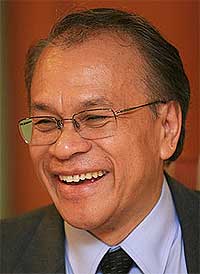 Hasmy (
right
) noted that it is still too early to say if seven is adequate to manage the many issues he and the other commissioners expect to deal with over their three year tenure.
Hasmy (
right
) noted that it is still too early to say if seven is adequate to manage the many issues he and the other commissioners expect to deal with over their three year tenure.
"Let's see if seven is adequate. If need be, we will raise the issue with the government through the selection committee, to see if new members can be added," he said.
Hasmy acknowledged that it is an uphill task for them to live up to the ‘A' status accorded by the International Coordinating Committee of National Institutions for the Promotion and Protection of Human Rights in Geneva (ICC), but repeated that it is too early to say how they will fare this year.
Suhakam nearly lost its ‘A' status last year when the ICC threatened a downgrade because of dissatisfaction with the Human Rights Commission Act of Malaysia 1999.
‘Burden not on Suhakam alone'
The commission will be scrutinised by the ICC again this coming November.
The ICC rating aside, Hasmy said the new lineup plans to follow up on the many recommendations to the government made by the previous commissions over the years.
"We need to engage with the authorities on implementation because we're looked at very closely not only by our community and society, but also internationally," he said.
Hasmy however stressed that the burden of safeguarding human rights does not fall on Suhakam alone, as the government and civil society are equally responsible.
He pointed out that a fairly-elected government is in itself a protector of human rights, though at the same time efforts must be made to educate government servants, especially enforcement staff, on their role in safeguarding human rights.
Certain constraints
"On the other hand, civil society should understand what Suhakam is all about. If you care to read the Human Rights Commission of Malaysia Act (1999), then you would know there are certain constraints we have to live with.
"If you feel Suhakam needs additional muscle, it is up to you to take it up through media, activities, forums, members of Parliament. So it is up to you to engage with your MPs from both sides, to assist Suhakam in the commission's work.
"Don't just throw stones at Suhakam alone, without realising that you also have the responsibility to assist us, we need your cooperation, help and support," he said, adding that Suhakam's reports have yet to be debated in Parliament.
Hasmy added that Suhakam will actively engage the media, NGOs and civil society groups to explain what they have done so far and their intentions and how to further promote and protect human rights.


