




Bumi equity target still 30%
The government attempts a balancing act as it responds to community pressure to protect bumiputera interests, while still trying to address the needs of the low-income earners in the 10th Malaysia Plan.
The government attempts a balancing act as it responds to community pressure to protect bumiputera interests, while still trying to address the needs of the low-income earners in the 10th Malaysia Plan.
 Despite assertions from the National Economic Advisory Council that
racial quotas will be scrapped
,
the 10th Malaysia Plan unveiled today still targets "at least 30 percent of bumiputera corporate equity ownership" by 2015.
Despite assertions from the National Economic Advisory Council that
racial quotas will be scrapped
,
the 10th Malaysia Plan unveiled today still targets "at least 30 percent of bumiputera corporate equity ownership" by 2015.
But the difference is that this time it will be achieved through "more transparent, market-friendly and merit-based" measures.
In its "inclusive development" chapter, the plan states that while significant inroads were made via the New Economic Policy, "there is potential for improvement in the bumiputera's position of wealth".
For example, it notes, despite representing 64.9 percent of the total households in 2009, bumiputera households account for 74.7 percent of total households with income below RM2,000 monthly.
Strengthening bumiputera entrepreneurship
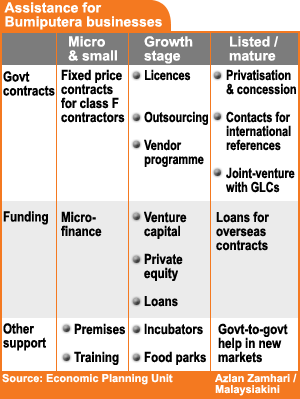
One of the ways out is to strengthen bumiputera entrepreneurship through soft loans and other aid according to the business' development stage.
To diversify their wealth ownership, the Yayasan Amanah Hartanah Bumiputera will set up Real Estate Investment Trusts (REITs) to enable investments in commercial and industrial properties.
"The gains from such ventures will benefit the broader bumiputera community in creating employment and entrepreneurship opportunities," it notes, echoing the aims of the New Economic Policy.
 Currently held bumiputera assets, like prime land in Kampung Baru, will be developed to this end.
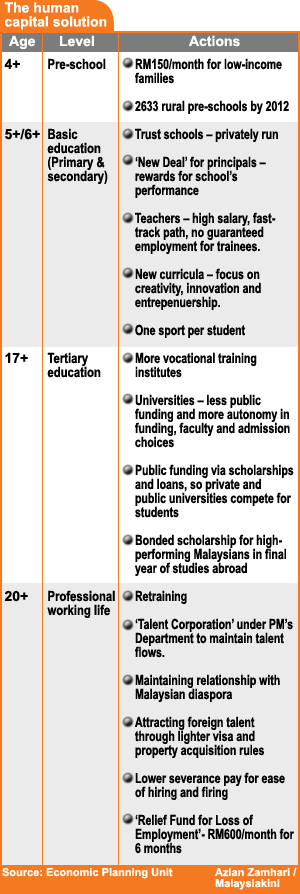
On the human capital side, bumiputera postgraduate scholars in ‘renowned institutions' can obtain scholarships partially-funded by the corporate sector, with ‘flexible bonds' accorded to those who continue to contribute to Malaysia.
Further, companies that secure government contracts will have to commit to more bumiputeras in top positions (or "balanced employment targets"), akin to a proposal made by Malay-based NGOs.
Similarly, the companies must assure more bumiputera participation at the international level, with government-linked investment bodies requiring the same of their business partners and overseas acquisitions.
Catering to lower income groups
While the policies appear targeted to the middle-to-higher class bumiputeras, the lower-income segment of the community will be catered to along with other bottom 40 percent households.
Rural and urban poor, of all races, will be provided with micro finance and training for small businesses.
The rural poor will be encouraged to consolidate their land for industrial plantation purposes, while students will receive special consideration.
Orang Asli reserve land to be developed for agriculture use. After the land matures, they will be given the right to farm two to six acres per household, with an extra 0.5 acres allocated to build a house.
All low-income households will be provided income support to ease the pain of cancelled subsidies, with some help from corporations like Petronas that has pledged RM100 million in provisions.
Chinese New Village residents will given loans to fund land lease applications and home repairs, while better amenities will be provided to predominantly Indian estate villages.
In Sabah and Sarawak special schools which offer primary to Form Three secondary education, and special boarding facilities for other secondary schools will be set up to curb dropouts.
10MP Special Reports
Doubts remain over Najib's reform agenda
PM's 10MP speech - salient points
Faster growth, reducing deficit
Big ticket items lined up for privatisation
Experts: Privatisation drive must be transparent
A leap forward or just talk as usual?
Ibrahim Ali gives thumbs up to 10MP
Clearing the human capital hurdle
Public transport revolution planned for Greater KL
Sg Besi airport to make way for 'Greater KL' plan


