




Hisham: Street crimes down by 40%
Home Minister Hishammuddin Hussein announced today that street crimes and the crimes index nationwide have been cut down by 40 and 15 percent, respectively.
This, he was reported as saying by Bernama , was a direct result of the government’s “revolutionary” and “out of the box” approach to tackling crime following the identification of National Key Results Area (NKRA) ‘initiatives’ to reduce crime under the Government Transformation Programme (GTP).
Home Minister Hishammuddin Hussein announced today that street crimes and the crimes index nationwide have been cut down by 40 and 15 percent, respectively.
 This, he was reported as saying by
Bernama
, was a direct result of the government’s “revolutionary” and “out of the box” approach to tackling crime following the identification of National Key Results Area (NKRA) ‘initiatives’ to reduce crime under the Government Transformation Programme (GTP).
This, he was reported as saying by
Bernama
, was a direct result of the government’s “revolutionary” and “out of the box” approach to tackling crime following the identification of National Key Results Area (NKRA) ‘initiatives’ to reduce crime under the Government Transformation Programme (GTP).
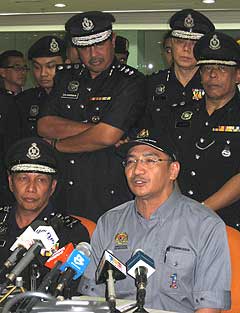
Some 55 initiatives were identified to help achieve the target of slicing the crime index by five percent and street crime by 20 percent in 2010, said Hishammuddin ( right ) in an interview with the government’s Performance Management and Delivery Unit (Pemandu) of the Prime Minister's Department.
“I am happy to report that almost all of the 55 initiatives have been implemented at various stages, which have resulted in some marked improvements in the statistics for crime,” he added.
“For example, in our tracking on a quarterly basis (comparing the quarterly results to the baseline quarter which is Q2 2009), we have noted that nationwide the crime index has seen an encouraging drop of some 15.1 percent while street crime has fallen by 39.6 percent,’ he said.
Out of office, onto the streets move
Hishammuddin explained that after identifying the 50 areas most prone to crime, efforts were made to boost the number of enforcement officers on the streets in those places by drawing on the General Operations Force (GOF),People’s Volunteer Corps (Rela) and the Department of Civil Defence to provide the manpower to train and redeployment as Police Volunteer Reserve for that purpose.
 This was done in addition to the deployment of 7,402 police officers from clerical functions to crime prevention duties, and their replacement by 4,279 civilians.
The pilot initiative was done in January and rolled out in the 50 identified hotspots in February, whereas a national rollout was affected in May, said the minister.
“This redeployment of police officers away from non-core duties to be replaced by civilians would provide a win-win solution for all parties concerned at zero cost,” said Hishammuddin.
“All these efforts are affirmative actions that the government is certainly committed to and intends to deliver on its promises to drastically reduce the crime level, despite the challenges,” he added.
“This effort is... considered revolutionary, not just due to its innovative and’out of the box’ approach towards providing a solution, but also in its ability to showcase speed and inter-agency cooperation at the highest level,” said Hishammuddin in reference to the cooperation between the various law enforcement bodies with the Public Service Department (PSD).
Speaking about Prime Minister Najib Abdul Razak’s visit to the Seapark police station in SS2, Petaling Jaya and his walkabout immediately after that, Hishammuddin said the area was chosen as the police station in one of the 50 identified hotspots.
Creative thinking in combatting crime
“We also wanted to give recognition to the police station which has seen a drastic drop in the crime rate,” he said.
The visit was historic as it was the first time a prime minister had personally visited one of the 40 police stations in the 50 hotspots to see for himself the progress of the GTP’s NKRAs n reducing crime, he added.
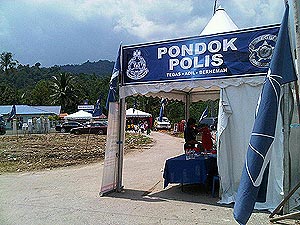
In addition, this visit also offered the premier the opportunity to witness "live" some of the initiatives under the NKRA, such as the redeployment of police officers from non-core duties to policing duties, as well as our mobile police stations, he added.
 In an ironic turn of events,
Malaysiakini
journalist Kuek Ser Kuang Keng (
left
) experienced an ordeal that ran contrary to the decline in street crimes alluded to by Hishammuddin.
In an ironic turn of events,
Malaysiakini
journalist Kuek Ser Kuang Keng (
left
) experienced an ordeal that ran contrary to the decline in street crimes alluded to by Hishammuddin.
Kuek lodged a report with the Seapark police station last night - two days after Najib’s visit - after four people assaulted and attempted to rob him.
Walking through a back lane in SS2, Petaling Jaya, after dinner, Kuek was suddenly accosted by four youths on motorcycles who pushed him against a wall, demanding his valuables.
Kuek managed to scare them off, however, by fighting back and shouting at the top of his voice. He suffered only some cuts and bruises.
At the same Seapark police station where he lodged his report, Kuek met another youth who was not, however, as fortunate.
Six men on three motorcycles assaulted the young man and made off with his handphone and wallet, leaving him with a bleeding, broken nose.
In his interview with Bernama , Hishammuddin also announced plans to position the Kuala Lumpur police contingent headquarters as a “premier policing organisation” in line with the transformation of the city in the New Economic Model.
Selangor, meanwhile, will be a showcase for community-based policing, whereas Penang will be a showcase for high-technology-led policing.


